


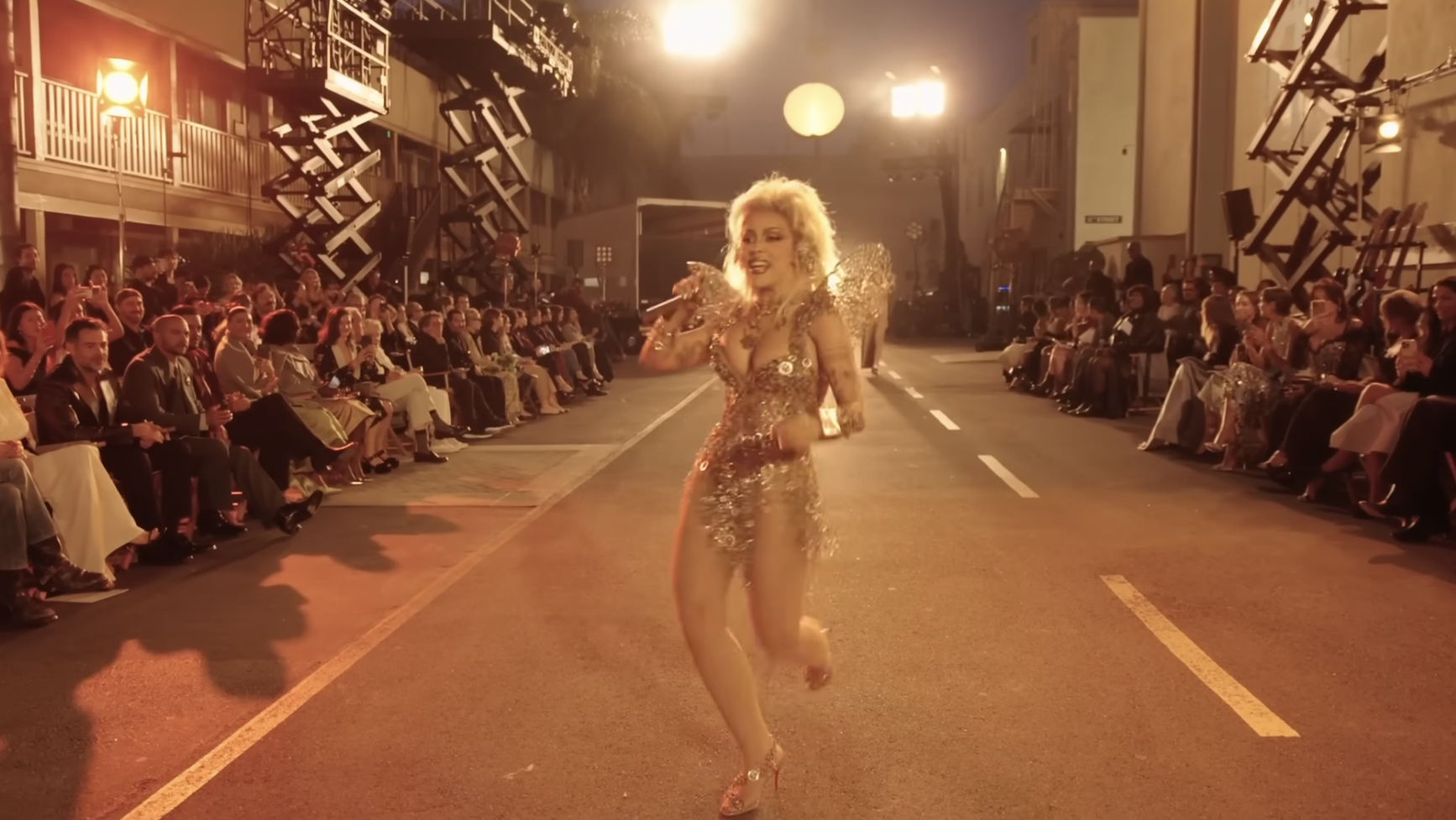
If there’s one thing that Hollywood has always gotten off on—at least since the release of Sunset Boulevard in 1950—it’s holding up a funhouse mirror to itself with a sardonic, even macabre flair (see also: The Player, Swimming with Sharks, Get Shorty, Adaptation and Kiss Kiss Bang Bang—and then, more recently, the TV series that is The Studio). While Doja Cat’s appearance at this year’s Vogue World might not have been intentionally designed to do that, it’s what comes across as she sings such “Gorgeous” lyrics as, “We make a killing being so beautiful/It’s a crime to be gorgeous,” “Then I got surgery ‘cause of scrutiny,” “Pretty hurts, don’t talk to me ‘bout Brazilians,” “Now she got contacts, but no close friends” and “Are your eyes even open?”
All of this said while semi-dancing next to and around the models sauntering past her. And also while wearing a dress by Michael Schmidt, intended to emulate the costume Tina Turner wore as Aunty Entity in Mad Max: Thunderdome (a very specific and somewhat out-of-left-field film reference, but one supposes Vogue just wanted to prove the extent of its “cinema knowledge”). This even though the film that Doja actually references on her latest album is Conan the Destroyer, wielding a clip of dialogue between Princess Jehnna (Olivia d’Abo) and Zula (Grace Jones) at the beginning of “All Mine” that goes: “How do you attract a man? What I mean is, suppose you set your heart on somebody. What would you do to get him?” Without missing a beat, Zula declares, “Grab him, and take him.”
Considering how much the men of Hollywood—whether producers, studio heads, actors, directors, etc.—have wielded that advice when it comes to women without ever needing to be told, maybe Mad Max: Thunderdome was the safer bet here. What’s more, Doja was also sure to sport a hairstyle to match Turner’s. Even if she couldn’t quite match the same level of inherent braggadocio. Regardless, by twenty-first century standards, Doja radiates all the “chutzpah” that Vogue could want as she struts in front of the soundstage to the hauntological backing music that not only pervades “Gorgeous,” but the entire Vie album. Indeed, if there was one word to describe the concept behind this edition of Vogue World, it’s “hauntology.” Starting from the moment that Nicole Kidman does her best impression of Rita Hayworth singing “Put the Blame on Mame” from 1946’s Gilda, it’s evident that the line between Hollywood “homage” and Hollywood “haunting” is entirely blurred. Though, of course, Vogue would like to believe it’s entirely the former, dividing the sections of the fashion show as follows: Hollywood Glamor, The Renegades, Historical Heroines, Summer of Love, Avant-Garde, Afrofuturism and New World.
Out of all of them, it was The Renegades that proved to be the most engaging, mainly with its bang-up start, courtesy of Julia Garner skipping down the “runway” wearing one of the original costumes from Sofia Coppola’s Marie Antoinette to the tune of Joan Jett’s “Bad Reputation” (begging the question of whether or not Coppola is kicking herself for not using that track in the ‘06 movie itself). To be sure, that was the liveliest moment of all, even if it took dressing in eighteenth century attire to achieve it. In short, having to go so far back in time to be able to really “wow” and “dazzle” the audience.
Because Gracie Abrams dressed in her Chanel “hippie” number while singing a cover of Carole King’s “I Feel the Earth Move” before diving into her own “That’s So True” wasn’t exactly invigorating. Though, of course, there was the heartstring-tugging instant when model Betsy Gahan emerged as “Annie Hall” a.k.a. Diane Keaton at the beginning of the Summer of Love segment. And, although it was a loving tribute to one of the great screen icons, there’s no denying that Annie Hall is now forever sullied by Woody Allen. Not that Hollywood really cares about besmirched reputations. Not at its core anyway. For the second Allen could become relevant again through Keaton’s death, Hollywood had no problem reincorporating the film onto its “worth paying tribute to” list. And so, as Keaton’s rendition of “Seems Like Old Times” plays, other “film characters of yore” emerge, including Johnny Strabler, Cher Horowitz and Dionne Davenport, Margot and Chas Tenenbaum (yes, a curveball that it wasn’t Richie) and Bonnie and Clyde. Which makes it all the more glaring that “Alvy Singer” didn’t appear with Annie to round out this overall “couples” motif. But again, Hollywood can only “uncancel” someone so far before risking its own reputation.
So it is that the show decides to return even further into the sartorial past by serving up mostly Shakespeare-inspired looks for the Avant-Garde segment, soundtracked by David Bowie’s “Cat People (Putting Out the Fire).” This then leads into what Vogue must feel is the requisite “Black section” by placing all “Black fashion” into the Afrofuturism portion and relying mostly on Black Panther references to do it.
It isn’t really until Doja Cat emerges to close out the spectacle that things become more “glittering” (and less deliberately contrived) again. Not because of anything related to the sartorial displays, but because of the glaring obviousness surrounding Doja telling the models and onlookers at large, “And she thank God for that Emscuplt/She wanna be chic when it’s inspired by heroin.” And while, of course, heroin isn’t nearly as “in” as it was in the 80s (the decade Doja is most fascinated with right now) and 90s, it doesn’t mean Hollywood’s stance on the importance of being thin by any means necessary has changed (it’s just that now, everyone has access to Ozempic to do it).
Elsewhere, Doja informs the Hollywood ilk, so convinced that they’ve made it to the top and should, therefore, be “happy,” “You feel empowered but not within.” This line also echoing what Lauryn Hill said during 1998’s “Doo Wop (That Thing)”: “How you gon’ win when you ain’t right within?” The answer, for Hollywood, usually comes in the form of excessive denial through various numbing agents (which has a double meaning here) before the inevitable crash and burn (whether that means becoming “washed up” or dying in some self-destructive way depends on the person). Even so, the fact remains that, as Doja also pronounces, “It’s all we want, it’s all we need.” That is, to be beautiful and adored. No matter how much of it is based on a vacuous, two-dimensional presentation.


