


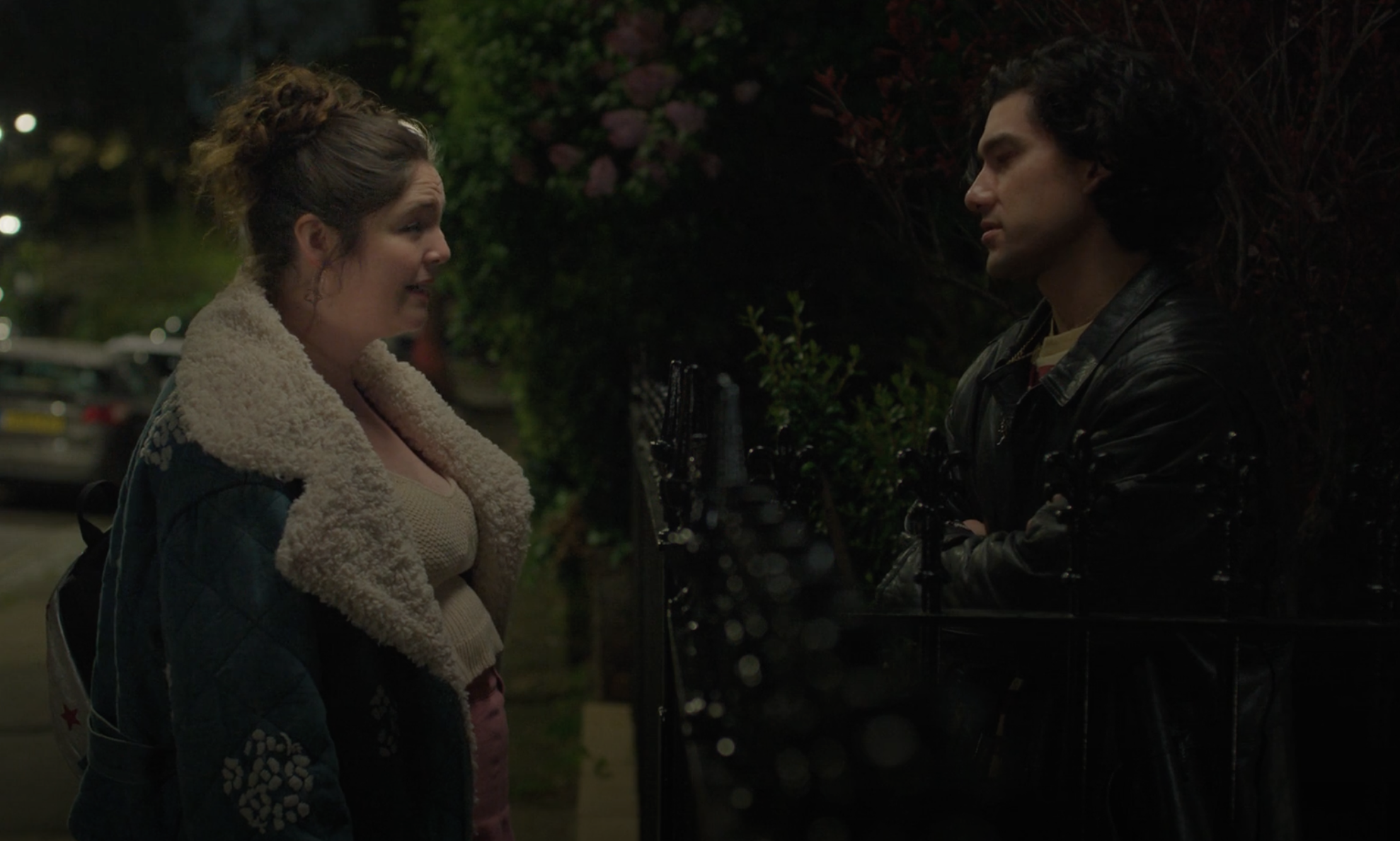
Although Lena Dunham hasn’t disappeared from the spotlight by any means in the years since Girls came out, there’s no denying her cachet has diminished since that era. Even though, to be quite frank, the show is a simulacrum of twenty-something life in North Brooklyn in the 2010s. And, with the arrival of Too Much, her first “major” TV series since Girls (because no one is inclined to count Camping), Dunham has now set her sights on portraying a simulacrum of thirty-something life in various parts of London. Unsurprisingly, that means the parts that Dunham undeniably views as the most “Brooklyn-y”—e.g., Hackney, Shoreditch and Peckham.
And yet, despite the obvious ersatzness of Dunham’s “style,” she is once again being credited—miraculously praised—for her “realness.” Peppered with such review headlines as, “Lena Dunham Netflix Series Is Just Right” (The A.V. Club), “Lena Dunham Returns with a Brash, Big-Hearted and Oddly Conventional Rom-Com” (IndieWire), “A Funny, Sexy, Moving Love Story” (Empire) and “Lena Dunham’s Charming Netflix Rom-Com Too Much Is a Worthy Follow-Up to Girls” (Variety), Dunham continues to be lavished with the type of praise once reserved solely for that so-so kid in elementary school who was showered with gold stars nonetheless. And yes, since Dunham, for whatever cockamamie reason, continues to be held up as some kind of “voice of a generation” for millennials, she’ll understand the gold star reference perfectly.
For her latest series outing, Dunham has at least forfeited the lead role that’s obviously based on herself in favor of giving it to Megan Stalter, who, in turn, has undone the work of being Kayla Schaefer on Hacks to perhaps become more associated with Jessica on Too Much. But Dunham has her reasons for choosing to “slum it” as Jessica’s occasionally appearing sister, Nora, who is, of course, going through her own slew of “issues.” Chief among them being her recent separation from James (Andrew Rannells, formerly Elijah Krantz on Girls), who “ended up in Bushwick doing therapeutic ketamine and experimenting with pansexuality.” Because Dunham can’t resist going back to Bushwick somehow whenever possible, and it won’t be her last mention of the area that, like, invented her. Later, she’ll tell James, in essence, that anyone living in Bushwick over forty ought to be ashamed of themselves. Though Dunham might have suffered such a fate were she not born to two parents whose names are blue on Wikipedia.
In any case, even though Rannells is once again playing Dunham’s ex, it has some variation in that he’s no longer “just” gay, he’s also pan and technically still married to her. What’s more, it so happens that he works with Jess, adding to the “messiness” of the breakup. Although it’s never made totally clear just what kind of production company they’re a part of, one assumes it’s advertising-related, as that’s what Jess is sent to London for—to work on a Christmas ad. Because James apparently has the authority to “put her up for” the role of producer as they merge with a company called Ratigan & Vine. Since, this time around, Dunham isn’t using real companies like GQ (as she did on Girls) to convey her version of a sense of “realism.”
As for suggesting Jess get a change of scenery to improve her mental health, it’s because he notices that she’s particularly “not with it” one day when she runs out on Jessica Alba (just one of many fairly untimely cameos Dunham secures for Too Much, including Rita Ora) after being asked to take the reins on the shoot. Confronted by James in the hallway about her random fleeing, Jess insists that the AD should handle it, to which James rebuffs, “He’s an ass grabber who somehow snuck by #MeToo.” An interesting piece of dialogue considering that, at the height of the #MeToo movement, Dunham came to the defense of accused rapist Murray Miller, a writer and producer on Girls, insisting, “While our first instinct is to listen to every woman’s story, our insider knowledge of Murray’s situation makes us confident that sadly this accusation is one of the three percent of assault cases that are misreported every year.”
This comment incited yet another backlash (as Dunham seems fond of doing), and it surely helped push her out of New York. Even though, like Jess, her plan at the time of going to London in 2021 wasn’t to stay, but rather, to stay for the duration of a work-related project. Besides, there were still so many who wrongfully associated her with being the neo-representation of “New York” (by way of Brooklyn). An upgrade to Carrie Bradshaw or some shit. Which is perhaps why Jess has the gall to tell James, “I can’t leave New York, I am New York, baby.” As about a million other women in New York believe themselves to be.
Except that those women are most commonly twenty-something twigs. Which brings one back to the reason why Dunham claimed she didn’t want to take on the lead role this time, instead playing Jess’ sister. Of that decision, she stated, “Physically, I was just not up for having my body dissected again. It was a hard choice.” One that seemed to be the wrong one in the end, going by the fact that those watching Dunham expose her flesh anew on camera (this time, she keeps her bra on though) are continuing to make comments about the amount of weight she’s gained since the era when they were still calling her fat (cue the Britney lyrics, “I’m Mrs. ‘Extra! Extra! This just in’ [you want a piece of me?]/I’m Mrs. ‘She’s too big, now she’s too thin’”). Granted, Stalter is able to carry off the Dunham shtick (being hyper-neurotic and generally annoying at all times) with far more likeability, so maybe it was the better choice.
And yet, it appears that no choice could have spared Too Much from the “Girls effect,” which consists of 1) the lead character being vexingly committed to staying in a relationship with a really shitty guy, 2) the highly unrealistic portrayal of a “niche” area of a popular city, 3) pretty much all of the characters being odious and giving “I’m a Lena Dunham creation, not a real person” energy and 4) the narrative being quite autobiographical (this extends to even “tiny details,” like Dunham’s cliche announcement to her mother, Lois [Rita Wilson], that she’s listening to Taylor Swift while in depressed mode—Dunham’s IRL friendship with the pop star evidently not being affected by how allied Swift is with Antonoff). Starting with the bad breakup at the center of the plot. Because, clearly, Jess represents the last several years of what’s been happening in Dunham’s life, complete with marrying a British musician named Luis Felber (who co-created the series). So obviously, there’s a lot of Felber in the character of Felix (Will Sharpe, a long way from his role on The White Lotus here).
In fact, Felber is the one providing the “Felix and the Feelers” music (in actuality, it’s Felber’s band, Attawalpa, that viewers are hearing—this includes “Always the Girls,” the song Jess first hears when she sees Felix performing). And yes, perhaps the most autobiographical element of all is Jessica being essentially discarded by Zev (Michael Zegen), her boyfriend of seven years. For it seems that Michael Zegen has become only too adept at playing assholes who abandon the women he’s in a serious relationship with. Even full-blown marriages, as he did in The Marvelous Mrs. Maisel as Joel Maisel. Dunham knew him long before that role, however, for Zegen appeared in three episodes of Girls as Joe, a co-worker of Hannah’s at GQ.
Zegen isn’t the only occasionally appearing character from Girls to reanimate in Too Much; there’s also Richard E. Grant, who goes from being Jessa’s (Jemima Kirke) rehab friend to Jess’ boss, Jonno Ratigan. But back to the Zev-as-Jack Antonoff factor (and yes, like Zev, Antonoff is also Jewish). It’s clear that Zev flitting off with an influencer/model-type named Wendy Jones (Emily Ratajkowski) is based on the Antonoff dating pattern that followed his breakup with Dunham. And if Lorde really was included in that pattern (along with Carlotta Kohl and Margaret Qualley), it means that Antonoff veered in the decidedly “skinny bitch” direction after his stint with Dunham. Which would stir up the kind of insecurities that one actually doesn’t really see in Jess, who appears more insecure about other things unrelated to her looks (like being overly exposed to the word “cunt,” making a decent impression at work and, most of all, the well-being of her dog, Astrid). Yet another aspect of non-realism in this show. Particularly since she’s constantly studying Wendy Jones, which would patently open the floodgates to comparing her body to Wendy’s.
As for the way Dunham ended up meeting her real-life “Felix,” with whom she was set up on a blind date, it was the same story for how she started dating Antonoff in 2012 (at the recommendation of Mike Birbiglia). During a year that just so happened to be, visually speaking, a rearranged 2012 (2021). The same year that Girls debuted on HBO. Her relationship with Antonoff would last as many years as the show, with both ending in 2017 (and the breakup announcement being made in early 2018). It wasn’t long after that rumors began to circulate that Antonoff had left her for Lorde, whose sophomore album, Melodrama (an appropriate title for the accusation), he was producing at the time.
So it is that Dunham funnels that into Jess’ insecurities as she begins her obsession over Wendy Jones, starting from the very first episode, “Nonsense & Sensibility.” Although the viewer is first introduced to her being in London already, it doesn’t take long for Dunham to flashback to “Brooklyn, New York, 1 Month Earlier.” For, as mentioned, Dunham can’t resist the inclination to return to that place whenever possible. The flashback occurs after Jess sees a video of Zev proposing to Wendy on her Instagram account. Naturally, this sends Jess on a spiral as she recalls her last encounter with Zev, going all Betty Broderick on his ass by showing up drunk to his apartment and standing over the bed where he’s asleep next to Wendy. Because when a guy gets together with someone else so soon after a breakup—especially when the relationship was years long—it can send an ex into a frenzy.
Of course, most women have the self-restraint of a nun when it comes to expressing the full extent of their rage. But not Jess. Because rather than five years of being together like Dunham and Antonoff, she was essentially discarded by her boyfriend of seven years. Seven years down the drain. Only for Zev to change the locks on her because he clearly expects that she might engage in this type of psychotic behavior. And, although the viewer is given glimpses of Zev after that first episode, it isn’t until the fifth one, “Pink Valentine,” that the requisite flashback-to-the-relationship-at-its-outset narrative happens. Which is why the viewer is subjected to witnessing an uncomfortable meet-cute at the Alligator Lounge (more of Dunham “flexing” her North Brooklyn knowledge), where Jess goes off on the server for taking away her free pizza (that’s the “gimmick” of the bar: buy a drink, get a ticket for free pizza). Seeing the scene unfold, Zev consoles her afterward, though she’s sure to mention that she’s not usually so uppity (side note: yes she is), it’s just that she thinks Alligator Lounge has the perfect pizza. Like, “Home Alone”-level (this being one of the many references Dunham makes through Jess that’s supposed to be “charmingly esoteric”—this includes Jess singing a rendition of Kesha’s “Praying”).
To further ingratiate himself, he chimes in, “Everybody’s always like, ‘DiFaro’s is the best,’ but no, you know, this…this is like mamma mia. This is authentic pizza right here.” Jess jokingly replies, “I own DiFaro’s.” One only brings up this extremely cringe-y dialogue because it’s Di Fara. Di Fara, goddammit. If you’re so fucking New York, you should probably not allow a bunk pronunciation to slip out of two characters’ mouths. Not that authentic or accurate conversations are Dunham’s forte in any city. Least of all the one between Jess and Jim Wenlich Rice (Andrew Scott, because Dunham is able to get all the A-list talent—Naomi Watts included—on this show for some reason), the director on the commercial that she’s been sent to London to help create. At one point, the two are cozied up at a pub outside the city, where Jim unnaturally says the type of thing that Dunham would reference, which is that Lily Allen should have won the Newcomer Award at the Palm Springs Film Festival (note: there is no such award, and Allen, accordingly, was never nominated for it).
Needless to say, Allen commented on the reference during her Miss Me? podcast with Miquita Oliver, the latter of which proved to be the only voice of reason when she said, “I feel like there’s a little too much of a depiction of London about fifteen years ago. This feels like 2010 London, so it doesn’t feel real from the setup.” Allen concedes, “Well it’s certainly got all the people from 2010 in it. There’s an episode where, like, Clara Padgett is the bride. Josephine de la Baume is in it…” And, of course, Rita Ora. Oliver continues, “It’s just feeling like Jessica is dealing with these issues in London that don’t really exist anymore, and I thought it would be really funny or interesting if they were writing about the issues of today’s London, ‘cause there are issues, but they’re not those.”
But don’t worry, if it’s issues with story and character you’re looking for, as usual, Dunham is sure to deliver. Not least of which is ending the season (though one can hope it’s the end of the so-called mini series, full-stop) with Jess and Felix’s wedding (for Dunham loves to end a first season with a wedding). A decision that feels less like a thoughtful mapping out of the plot from a long-term view, and more like a bid to mirror how quickly Dunham herself married Felber.


