


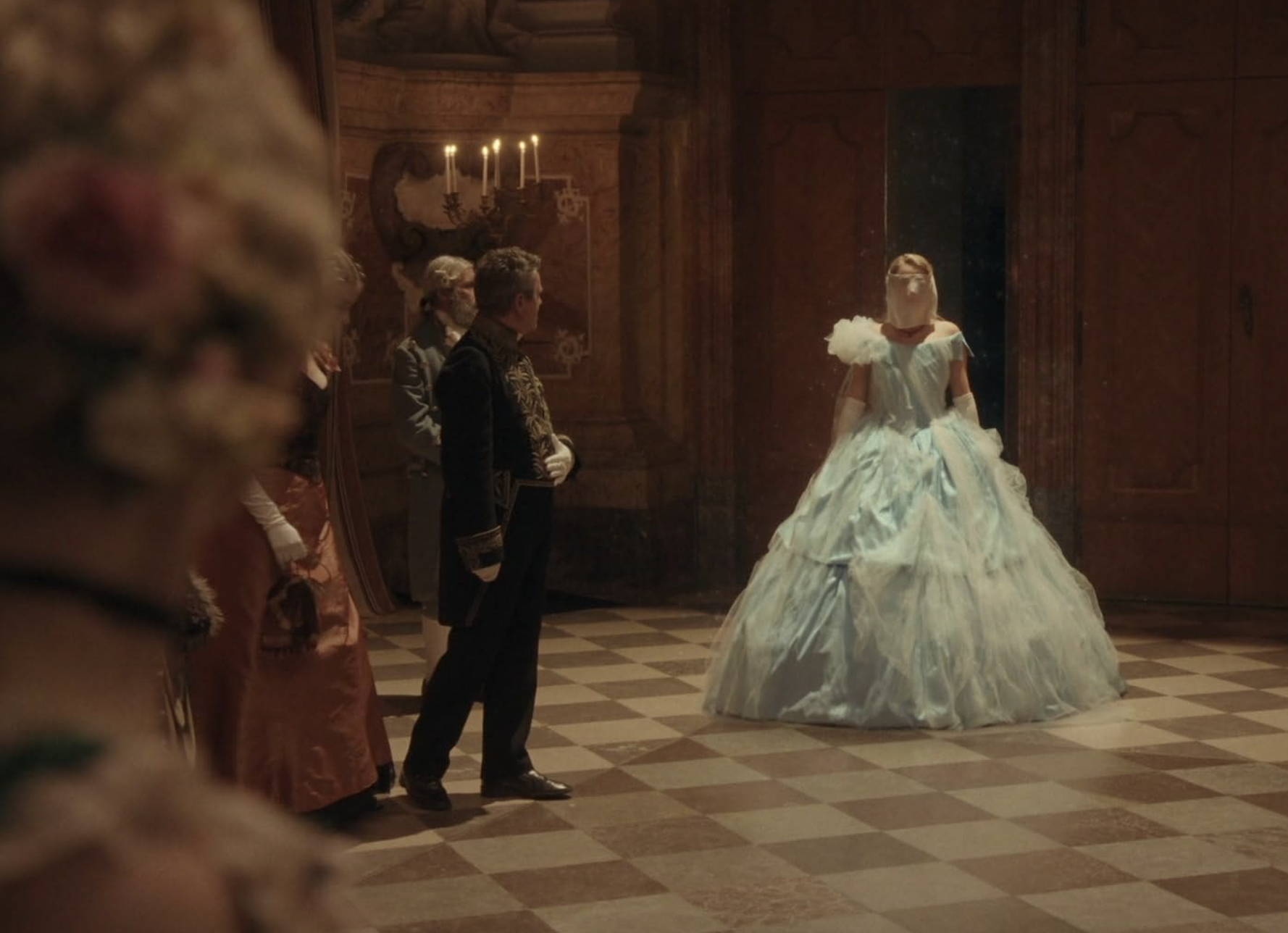
Despite Emilie Blichfeldt’s debut feature, The Ugly Stepsister being an old tale (though not a “tale as old as time”), the writer-director brings a fresh perspective to the narrative better known as Cinderella by presenting it from a more empathetic view of both ugly stepsisters. Though it is the eldest, Elvira (Lea Myren), who serves as the main focus. And, more to the point, the main “target.” That is to say, of trying to live up to the impossible beauty standards that Agnes a.k.a. Cinderella (Thea Sofie Loch Næss) makes no effort to “adhere to.” She’s simply born with “the look” that many other women spend their entire lives trying to achieve in some horrific way or another.
Conventionally attractive with her blonde hair, fair skin and “delicate proportions,” Agnes is at first a source of adulation for Elvira. But that sentiment wears off quite quickly once the supposedly angelic daughter of the widower Otto (Ralph Carlsson) shows her true bitchy colors in the aftermath of his death on the very night he’s just married Elvira’s mother, Rebekka (Ane Dahl Torp). It’s while hunched over crying in bed (her display of grief) as Elvira, in her way, tries to comfort her (even as she tinkers with/uses Agnes’ brush) that Agnes snaps at her about how gauche and uncouth she and her family are. So the truth comes out.
As it also does with regard to the fact that Otto only married Rebekka because he thought she had money. Likewise for Rebekka, who laments to Elvira about how difficult it is to find a man who wants a woman with “saggy tits” and “two hopeless daughters.” As such, it’s now Elvira’s turn to put her “feminine wiles” to good use and save the family from destitution. For, even if she’s not “hot,” she at least still has her youth going for her (granted, at eighteen, she’s approaching “day-old bread” status for the time period). This in and of itself being the “raw material” with which Rebekka has to work with when she calls upon the fittingly named Dr. Esthétique (Adam Lundgren) to help reshape her daughter—literally.
It starts “simply” enough by removing her braces (so much for finishing the teeth-straightening job), then moves up the proverbial ladder of her face when the “good doctor” takes a pick and a hammer to her nose to “rearrange it.” And no, they didn’t seem to think anesthesia was necessary to help numb the pain. Because, after all, as Dr. Esthétique believes (per the sign outside his torture chamber), “Beauty is pain.” Almost as much pain as it is to be ugly in a society that only values what’s on the outside.
After the so-called nose job, Elvira is then tasked with wearing what looks like a muzzle for every part of her face except her mouth, walking around like some kind of barnyard animal freakshow that happens to have ringlets gathered in bunches on either side of her head. But, as it is said, it’s always darkest before the dawn. Or, in this instance, ugliest before the glow-up.
All the while, Cinderella keeps looking effortlessly lovely, carrying on in a romantic and sexual relationship with Isak (Malte Myrenberg Gårdinger), the requisite lowly stable boy, while also making known her intentions to go to the ball and vie for Prince Julian’s a.k.a. “The Prince’s” (Isac Calmroth) hand in marriage as a “noble virgin.” In short, she wants to have her cake and eat it too. Or rather, she wants to have her cake and get her ass eaten by Isak too. And while there is no salad tossing scene (shown) between these two, there’s certainly some penetration happening when Elvira encounters them going at it in the barn (concluded with quite the cum shot flourish).
It’s this, let’s say, vision of love that officially confirms Elvira’s disdain for Cinderella, who assumes she can just traipse through life cutting corners (e.g., saying she’s a virgin for cachet when she’s not) and get away with it. Which, in truth, of course she can. That’s the “magic” of all nepo babies. This being the modern-day term that Blichfeldt uses to describe Cinderella in an interview with The A.V. Club, remarking, “Her heritage gives her the magic… It carries meaning because class is the magic. Nepo babies have a magic that the rest of us don’t.” In effect, a girl like Elvira has to work ten times harder to be even remotely considered…for anything.
Because, yes, Cinderella’s daddy was a legitimate man of status in a way that Rebekka clearly isn’t. Instead, she’s the social climber (a real Kris Jenner type) who’s managed to get her hooks into high society, but seemingly never in a way that doesn’t feel tenuous. Which is why she pours all of her nonexistent money (read: credit) into grooming Elvira to be their next best chance (then, once her youngest daughter, Alma [Flo Fagerli], gets her period, she can start pimping her out, too). Promising Dr. Esthétique his “contingency fee,” as it were, once he gives Elvira the procedures that will lead to her being desired by the prince, therefore plucked from a life of poverty.
Funnily enough, however, in the Brothers Grimm version (titled “Aschenputtel”) that Blichfeldt rooted her script in, it is Cinderella who is the one stricken by poverty. A condition that is more easily reversed when one started out in moneyed circumstances to begin with. And when her father’s money is only, in the end, temporarily being overtaken by her wicked stepmother and stepsisters, as is the case in “Aschenputtel.” However, it is Charles Perrault’s version of Cinderella (released a hundred and seventy-five years before the Grimms’), “Cendrillon ou La Petite Pantoufle de Verre,” that most closely ties into what Blichfeldt was saying about having the class and nepo baby status to continuously get ahead, even when one is “down on their luck.”
But being down on one’s luck as a rich and beautiful person isn’t the same as it is for a poor and ugly one. Something that Perrault makes clear when he sums up the moral of his story as, “…without doubt it is a great advantage to have intelligence, courage, good breeding and common sense. These, and similar talents come only from heaven, and it is good to have them. However, even these may fail to bring you success, without the blessing of a godfather or a godmother.” In modern parlance, that translates to: “without the blessing of a famous and wealthy relative and/or progenitor.”
And even though Cinderella might not have the currency of actual when she’s putting herself in the running to marry Prince Julian, she still has the currency of her beauty. And, despite all of Elvira’s best efforts—and the various physical pains associated with them—they’re no match for the shining, glowing, “legitimate” beauty of Cinderella. Who walks into the ball having barely lifted a finger to look as she does. Indeed, in The Ugly Stepsister, it’s a group of silkworms enchanted by the specter of her biological mother that do all the work to give her the most fetching frock possible. Even though Elvira had previously destroyed it to prevent Cinderella from attending. Alas, you can’t keep someone with the heritage of magic (read: money and status) down. The game is forever rigged in their favor.
For it is as Blichfeldt said: “Nepo babies [who are automatically always of a higher-class echelon] have a magic that the rest of us don’t.” And then the rich and famous who became that way because of their “heritage” wonder why the hoi polloi acts like “trolls” à la the ugly stepsister toward them all the time.


