


Almost forty-eight years ago, in December of 1977, the Talking Heads released “Psycho Killer,” their first charting hit (and yes, coming in at number ninety-two counts as a hit for a band as “fringe” as Talking Heads was at the outset). And now, as though having waited all this time for the right director and actor to bring the song to visual life, the band has seen fit to release a music video for their beloved single. And while some might wonder, Why now? if there’s no milestone anniversary for the song, the reason is instead due to the milestone anniversary of the formation of the band itself, which began fifty years ago in New York. In fact, frontman David Byrne has become so synonymous with the 1970s-era CBGB scene and the founding of stateside new wave that most are liable to forget he’s originally from Canada by way of Scotland.
Perhaps, in part, this is why a fellow UKer like Saoirse Ronan (who, although born in New York, was moved back to Dublin when she was three, therefore, possessing a kind of inverse trajectory to Byrne’s) was tapped to star in the “Psycho Killer” video. This in addition to her (needless to say) acting chops, which are essential to conveying something as nuanced as a gradual mental breakdown for “no reason in particular.” Or, more accurately, it’s a cresting wave of resentment and contempt for the combination of ennui and complacency that sets in as a result of routine. The constant sea of sameness that arises when one gives in to the system and the supposed “success” of having a job, a house and a relationship.
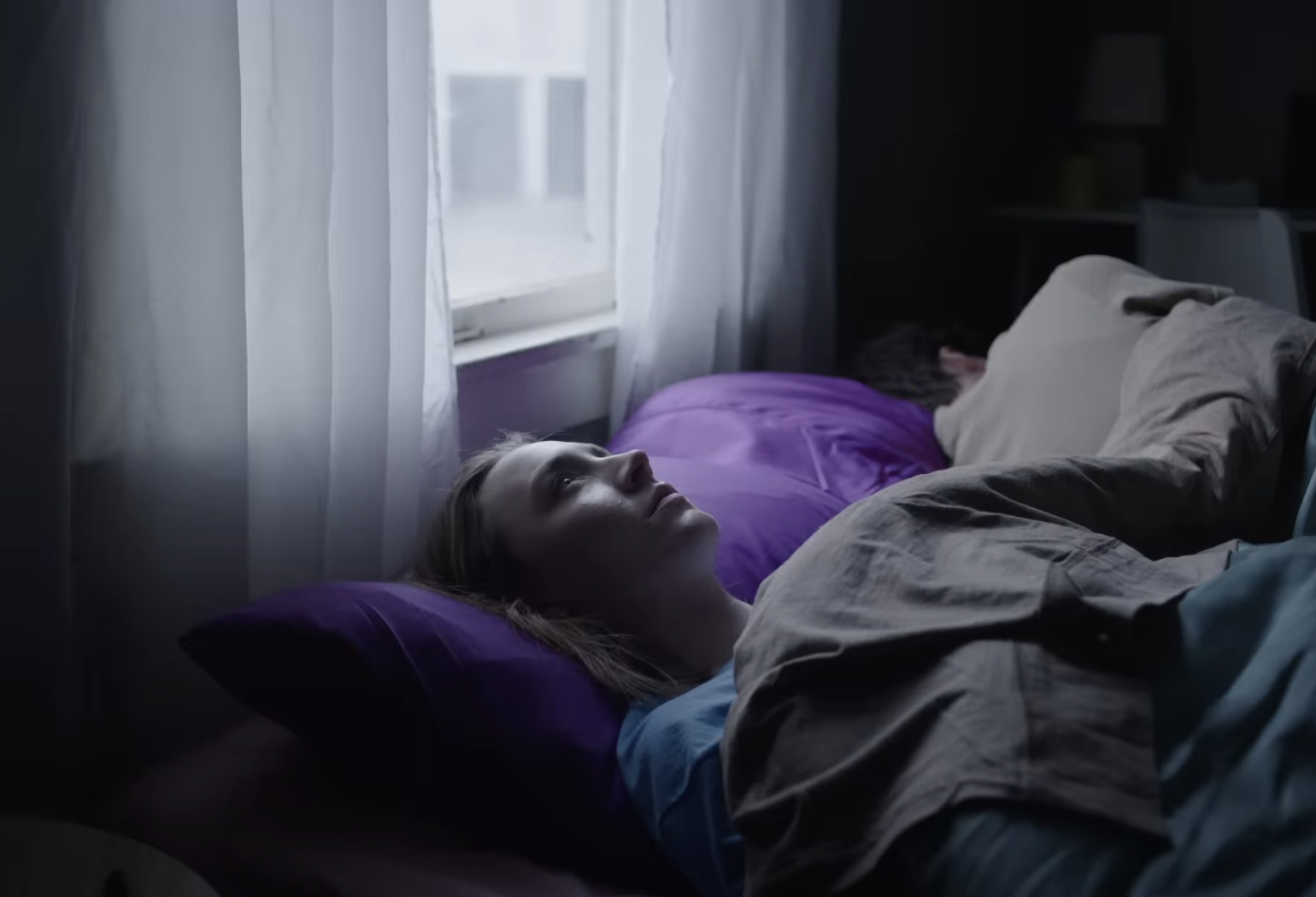
To further assist in documenting this phenomenon is Mike Mills, known for his own keen ability to encapsulate the melodrama of the everyday (see: Thumbsucker, 20th Century Women). The ways in which a person can gradually start to feel like they’re crawling up the walls. As Ronan’s character, who we’ll call The Girl, does with each new rising and setting of the sun. Indeed, the video commences with an image of the sun rising before we see The Girl lying in bed with her eyes already open, as though waiting for something more to happen, beyond just going to work. That her eyes are already open also suggests a combination of anxiety and boredom that reached a new crescendo in the postmodern era when Talking Heads initially rose to prominence. An era that yielded books like White Noise and Less Than Zero. And while humanity has theoretically “come a long way” since the 1980s, the same system is still in place to all but guarantee dissatisfaction and, for those truly delicate spirits, madness.
It’s a system that, sooner or later, renders routine into the ultimate killer. And The Girl’s routine, as the viewer tracks quite quickly, is this: a kitchen chat with her significant other, brushing her teeth, leaving the house, getting in the car, walking into work, standing in her cubicle area, talking with co-workers, having lunch at the same outdoor table, driving home, walking into her house, sitting in bed and, finally, a scene of the moon going up. And then it starts all over again with the sun rising the next morning. There are variations on these scenes (there’s even a “variation” via the insertion of a moment where she’s talking to a therapist), of course, but they’re all the same in the end, save for the outfit that The Girl is wearing. Otherwise, no one on the outside looking in would really notice the difference. Apart from the fact that it’s plain to see The Girl is unraveling at the seams as she starts to act stranger and stranger, laughing for no reason, making arbitrary hand gestures and generally coming across as a raving lunatic. Which is exactly what society makes anyone who doesn’t “fall in line” look like. In fact, it’s built that way precisely to weed these sorts of people out. People who can’t handle the crippling mundanity and complacency.
The Girl’s reaction to this starts to transform into anger, as evidenced by her screaming at other people (including the therapist) who are immune to her rage. To be sure, opting to have no one react to her mood swings is in accordance with the idea that most people don’t really care to look up long enough from keeping their heads down to see if there’s anything “off” about someone else trapped in the same situation (or simulation, if you prefer). When The Girl’s anger gives way to sadness and then an existential questioning of everything, one might be led to believe that she’s going to somehow make her grand escape. But no, the video remains truer to reality in that, like Frank and April Wheeler trying to make plans for their grand escape from “normal” life in Revolutionary Road, it’s the making of plans that keeps one going, rather than the actual execution of them. For, when a person can continue to tell themselves that “one day” they’ll be free, it ends up being the sole motivator for soldiering on in the same prison.
To this point, “Psycho Killer” joins the elite selection of music videos that highlights how working in an office is the epitome of this soul-crushing prison that people have been put into ever since the fine-tuning of modern capitalism. This includes FKA Twigs’ recent “Eusexua” video and Nicky Romero and Avicii’s “I Could Be the One” video, in which the woman a.k.a. office worker, played by Inessa Frantowski, finds herself having a similar revelation/according breakdown as The Girl in “Psycho Killer.” Almost as if to emphasize that similarity, she, too, has a therapist that seems to be doing nothing for her apart from taking her money. Unlike The Girl, however, we get a chance to hear the woman in “I Could Be the One” speak, informing her therapist, “I feel like I’m trapped in somebody else’s master plan. Go to school, get a job, get a mortgage. All I’m really doing is dying.” The therapist’s shrugging response is, “Let me getcha some more pills.” Because if you’re not medicated, you’re not motivated, n’est-ce pas?
And while some might have been hoping for a gorier visual (à la Patrick Bateman in American Psycho) for “Psycho Killer,” the Talking Heads aren’t known for such literalism. Hence, the band’s accompanying statement, “We LOVE what this video is NOT—it’s not literal, creepy, bloody, physically violent or obvious.” Besides, a verse like, “I can’t seem to face up to the facts/I’m tense and nervous, and I can’t relax/I can’t sleep ‘cause my bed’s on fire/Don’t touch me, I’m a real live wire” doesn’t necessarily need to have the Poe-like implications of a killer who’s racked with guilt. Instead, it applies all too perfectly to the torment of being stuck in what amounts to a Groundhog Day-esque time loop. All at the behest of a society that doesn’t know what to do with “real live wires.”


