


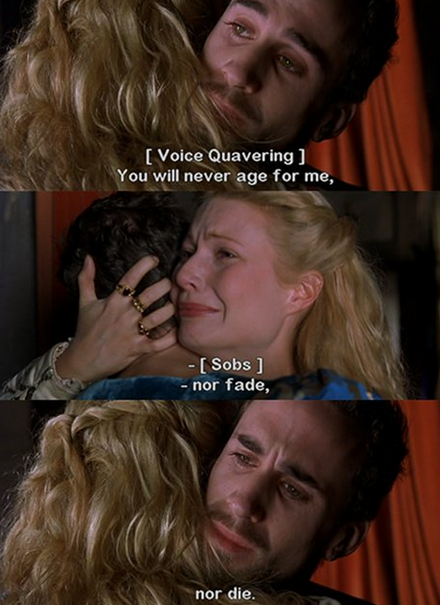

After seeing Shakespeare’s plays performed at the Rose Theater, Viola becomes entranced by and enamored of his work, and therefore, him. However, her one qualm is the delivery of lines by the actors. Insistent that she can do the work more justice, she disguises herself as a man with the help of her Nurse (Imelda Staunton)–who, later, obviously, inspires the character of Juliet’s own Nurse. Armed with a wig and a glued on mustache, Viola auditions for the role of Romeo as Thomas Kent, immediately catching Shakespeare’s attention with his passionate recitation of the lines.

Unaware that it was Shakespeare listening to her until he starts to chase after her, Viola must conceal her identity from him in order to get the part. This masking of her true self, of course, does not last for long. In any case, the intrigue, androgyny and presence of Judi Dench as Queen Elizabeth 1 tend to make Shakespeare in Love, dare one say it, more entertaining than Romeo and Juliet itself.

The rich, poetical script of Tom Stoppard and Marc Norman offers us a glimpse into Shakespeare’s fantastical, fly-by-the seat-of-his-pants world, making Romeo Montague seem like a cold fish by comparison. Moreover, the love between Viola and William seems of a superior quality as they are both bonded by a play that they have equally shared a hand in creating–Viola as muse and William as writer genius. Their alter egos, Romeo and Juliet, surely hold a candle to them, but it is one that burns more dimly than their own impassioned affair.


