


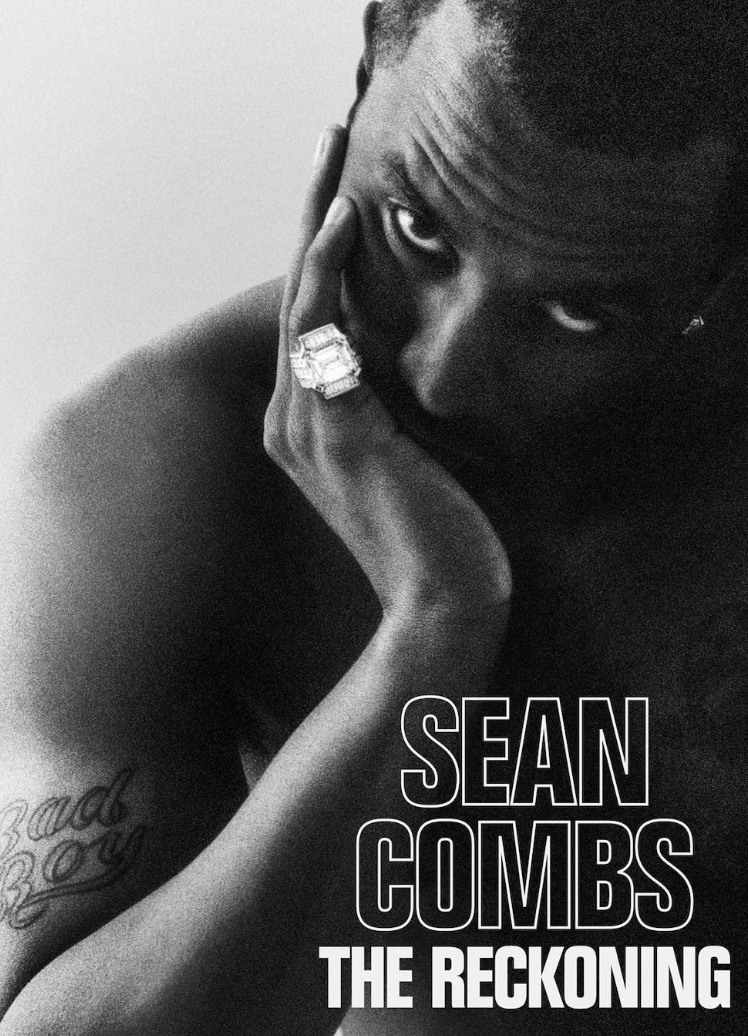
*Note: throughout this article, Sean Combs will be referred to dissonantly by his various names, perhaps a testament to the many masks he wears.
Among the many thoughts that might cross one’s mind while watching Sean Combs: The Reckoning is how similar Combs is to Donald Trump in terms of being a fairly mediocre man who continued to fail upward primarily because he coasted on a combination of other people’s talent and enablement. This is part of why it’s ridiculous to hear Sebastian Stan as Trump in The Apprentice telling one of his dates at Le Club, “There’s a skill to being a billionaire. It’s a…it’s a talent. You have to be born with it. You have to have a certain gene, you know.” In a sense, that’s not totally inaccurate. For the gene required is apparently related to total sociopathy. And, of course, unbridled megalomania. That much is made clear as Alexandria Stapleton’s docuseries, produced by Curtis “50 Cent” Jackson (a major detail to many because of his longtime rivalry with Diddy), unfolds with a merciless look back at how this person rose to such power, and with such little talent (aside from complete callousness). A fact he was able to mask for so long by only surrounding himself with the best to make himself look good. For example, riding on the coattails of The Notorious B.I.G. for most of his career. Indeed, Combs would like to take all the credit for “unearthing” a young Christopher Wallace, who had little ambition when it came to parlaying his rap skills into fame and fortune, when he released a demo tape called Microphone Murderer in 1991. But it was actually New York DJ Mister Cee who deserves all the credit for pushing Biggie in those germinal years, not only playing the demo on the radio, but also reaching out to Matteo Capoluongo, an editor at The Source, who then included The Notorious B.I.G. in the magazine’s Unsigned Hype section.
At that time, Combs was all up in the guts of Uptown Records, so he would have read such material religiously as he turned himself from mere intern into the “right-hand man” of Andre Harrell, the label’s founder. He had also styled himself as a party promoter under the name Puff Daddy. And it was a 1991 charity fundraiser (co-hosted with Heavy D), centered around a celebrity basketball game at City College in Harlem, that first really got his “stage name” in the headlines. This after a stampede a.k.a. bum rush of the gym culminated in nine deaths. While the cause of the stampede was the result of a combination of many factors, at the forefront was Combs’ overhyping of the event and overselling the amount of tickets, attracting far more interested people than there was room to accommodate. This in addition to the fact that this now notoriously cheap man (as most rich men tend to be—“that’s how they stay rich,” it is said) did not purchase the proper insurance, and delegated most of the planning responsibilities to assistants who were just as, if not more, inexperienced than he was in organizing such events. So it was that Diddy’s rise to becoming a household name began, fittingly, in infamy. And the destruction of lives.
With this being a key moment from the first episode, “Pain vs. Love,” Combs’ loveless childhood is also touched upon, along with the absence of his father, Melvin, who turned out to be a “wealthy dope peddler,” as it was described in the article detailing the circumstances of his death (being shot in Central Park West). Something that, as Combs said in BET’s Black and White: A Portrait of Sean Combs circa ‘06 (which Stapleton deftly repurposes throughout Sean Combs: The Reckoning), caused him to breathe “a sigh of relief,” because “I finally knew that what I was feeling was true, you know what I’m sayin’? That I was the son of a hustler or a gangster.” And was raised as such by his mother, Janice, who seemed intent to further secure what Melvin had exemplified: having no moral compass. No concern for or concept of the idea of right versus wrong.
To compound the absence of a father that might teach him right from wrong, all he seemed to have was a mother who emphasized that things—material—were all one needed to “feel good.” As Bad Boy Records cofounder Kirk Burrowes (who was done perhaps dirtiest of all by Combs) puts it, “If you look at some of the early pictures that Janice has of Sean, she was always making him into something. The hats, fur coats. I think she tried to overcompensate for the father being gone by making him into this dandy.” A look that went hand in hand with cementing Combs’ early notions of himself as some kind of new-fangled pimp. Along with being convinced that he had to put on airs and peacock in order to be “loved.” Accepted.
To the point of “pimp dressing,” Tim “Dawg” Patterson, a childhood friend of Combs who would also work in A&R for Uptown Records, recalled that, in Combs’ house, they would watch Blaxploitation movies like Super Fly and The Mack. Movies that clearly influenced his own approach to what it meant to “be Black” and, in turn, continue to exploit the stereotypes of Black culture. Patterson also remarks, “In Sean’s household, you’d start to see all the stuff that you saw in [those] movies.” This didn’t just include the type of parties that would likely later inspire the “freak-offs” Diddy became notorious for, but also the violence. Violence learned from the way that his mother would beat him when she felt it was warranted.
In another segment of the Black and White BET documentary that Combs filmed in 2006, he recalls, “My mother was I guess raising me for the real world. She was always telling me if somebody hit me, make sure I hit them back harder. Make sure they never hit me again. Make sure I fuck them up.” And so, once again the Combs-Trump parallel materializes in the sense that their childhoods—the way they were raised—all but ensured they would be corrupt, amoral men. With the ostensible “superpower” of always bouncing back no matter how blatantly distasteful and/or illegal their behavior.
Case in point, after the CCNY stampede, “the brass that afforded Uptown its distribution wanted Sean out,” as Burrowes said. But it was Andre Harrell who stuck up for his protégé and managed to keep his job at Uptown safe…for the time being. Better still for Combs, Harrell put Jodeci in his care, tasking him with shaping them into a “hitmaking” group. And getting his first taste of being able to take credit for the success of an artist goes back to how Harrell was the one who, according to Patterson, would tell A&R reps for Uptown, “I don’t care who the artist is, you’re more important than them. The artists don’t work without you.” So that right there is an extremely retro approach to “dealing with” musicians, who eventually discovered by the mid-2000s that they could put out their own work on platforms like MySpace and gain recognition without the help of any “Diddy types.” But in the early 90s, the old school system of record labels having all the power was very much in full swing. With Combs setting himself up to be one of the primary gatekeepers.
And, like most people who have managed to secure obscene wealth, Diddy was able to as a result of coming into an industry—rap—that was still in its infancy, still evolving into the bastardized version of itself that it would become by the 2000s. And in no small part because of Diddy himself who, as Burrowes succinctly notes, “is able to sponge from the community and the culture and package it.” Something that he achieved new heights with in terms of taking all the credit for “finding” The Notorious B.I.G., who had been signed by Puff to Uptown Records in 1992. Which was the year before Puff would be fired by Harrell for what some might call “insubordination” and what others have called “his sexual proclivities [with men and women] during his tenure with the label.” Fortunately for Combs, Uptown’s distributor, MCA, was reluctant about taking a chance on such a “hard” album and Harrell, in his role as Combs’ mentor/surrogate father “gave” him Biggie, who would serve as the linchpin of Bad Boy Records. And so, after being “sold” the album that Uptown had already produced, Burrowes and Combs set about finding a way to finance it, shopping it around some of the major labels until Clive Davis at Arista heard something resonant in a track like, of all things, “Gimme the Loot.”
Thus, the beginnings of riding on Biggie’s coattails would proceed. And, in truth, Combs’ “love”/ongoing obsession with Wallace was likely a part of his vicarious living through a real gangster, a street gangster. Or, as Burrowes speculates, “I think that he had this thing with strongmen. And he had a thing with wanting to be one, but not positioned to be one, street-wise, but positioned to be one, industry-wise. And they call that a paper gangster.” As such, it was no wonder he couldn’t pull his own gun to do things like, say, kill Tupac Shakur. Instead openly putting a million-dollar bounty on his and Suge Knight’s heads among the Crips, who saw Knight as part of their rival gang, the Bloods.
This contempt that Combs had for 2Pac and Knight was, once again, jealousy-based, with Combs not wanting any label or “face of gangster rap” to outshine his own. So it was that Combs began to sow the seeds of discord between 2Pac and Biggie, even though the pair started out as friends (a fact so often forgotten), with Pac happily supporting another Black man’s success in the industry. And then, Combs had to take the discord-sowing one step further by effectively instigating the East Coast-West Coast rap war with the “robbery” and shooting of 2Pac when he was going to Quad Studios to record with Little Shawn. As many in Sean Combs: The Reckoning surmise, even before the hit he ordered, Combs was already a strong suspect for orchestrating those shots fired against 2Pac in late 1994, spurred by his jealousy of the friendship that had blossomed between Big and Pac. But after that shooting, it was nothing but bad blood between the pair as a result of Combs’ puppeteering. Invoking a feud that represented the larger, ever-growing one between East Coast and West Coast hip hop. Even if it was an East Coaster like Diddy who had to take notes from the West Coast playbook in order to launch The Notorious B.I.G. to true superstardom.
That’s right, in another example of Diddy’s ability to transcend into a billionaire by sponging up other people’s material and repackaging it for himself, Burrowes recalls how Combs would study the video for 2Pac’s 1993 single, “I Get Around,” like it was some sort of religious text, resulting in the similar vibe for the video that would really blow Biggie up, “Big Poppa.” But it was still clear to him that he couldn’t eclipse 2Pac’s star so long as 2Pac stayed in the picture—though that would ultimately backfire considering that 2Pac has since been elevated to a godlike status.
Further illuminating the depths of evil he was willing to sink to, Sean Combs: The Reckoning posits that, were it not for Combs’ insistence on taking Biggie to L.A. during awards season with the murder of 2Pac still fresh and forcing him to linger there for a party instead of going to the UK for a press junket as planned, Wallace might have been spared from the fallout. But no, Combs wanted to make a big show of having a party on “enemy turf,” parading his “prized pig” as a way to thumb his nose at the West Coast and swing his dick to prove he wasn’t afraid of anyone.
But, of course, no one cared enough about Puff Daddy to kill him. He wasn’t “the symbol” here, Biggie was. And in his death, Combs managed to coast on that too, turning it into the final push toward all-out solo superstardom that he had been seeking all along, as that now-painful-to-watch performance of “I’ll Be Missing You” at the 1997 VMAs spotlights. At the end of episode two, “What Goes Down Must Come Up,” the pattern of Combs’ behavior is made clear. As is the fact that those who were once willing to put up with his shit—including his erstwhile girlfriend, Jennifer Lopez (who has still remained suspiciously silent about this entire matter)—had begun to see Combs for who he was, and began distancing themselves accordingly.
By episode three, “Official Girl” (named in honor of the Cassie song), it’s apparent that Combs is aware his more effortless days of capitalizing on other artists’ talents must take a new shape at the dawn of the twenty-first century. One that saw him taking full advantage, once again, of a newer genre: reality TV. So it was that he used Making the Band as his next hunting ground for musicians who he could attach to and take credit for, as though their success truly was all his own.
“Official Girl” is also the episode that delves more deeply into the toxic romances he cultivated with such women as Misa Hylton, Kim Porter and, of course, Cassie, the woman who arguably got the worst of “the Sean Combs treatment.” And yes, Combs was able to get his hooks in so thoroughly and groom her because Cassie was just nineteen at the time when she came into his orbit. Despite still being with Porter, it didn’t stop Combs from developing his latest “side chick.” As the years went on, the type of things he would make her do included having sex regularly with an escort named Clayton Howard, who appears in the docuseries to further vouch for how poorly Cassie was treated.
In the background of it all, Combs’ early to mid-2000s ascent is highlighted, with his goal to get to billionaire status being achieved with the help of his Sean John fashion line…and Cîroc. Because, obviously, Combs is someone who needs to have his hands in everything and on everyone, yet another mark of his mafioso stylings à la Trump and Harvey Weinstein. Men who also have no real talent other than exploitation and a lot of money to put behind it. Men with an intense and narcissistic desire to see their name and face everywhere. All while deluding themselves into believing that they’re “doing good” for others. Or, in Combs’ case, for their “community.”
However, as Roger Bonds, a former security guard of Diddy’s, noted, “I began to see him use the culture that he came from only when he needed it.” It’s a sentiment similar to Kendrick calling out Drake with, “The settlers was usin’ townfolk to make ‘em richer/Fast forward, 2024, you got the same agenda/You run to Atlanta when you need a check balance/Let me break it down for you, this the real nigga challenge.” Bonds then says that Combs seemed to feel generally uncomfortable around most Black people—this followed by a scene of Combs being driven in his car after feigning being a “man of people” on the Harlem streets. After which he says that he needs some hand sanitizer and to take a boiling hot shower with some peroxide in it.
In the final episode, “Blink Again,” Stapleton covers the result of the trial, for which Combs was charged with racketeering, sex trafficking and a violation of the Mann Act that pertains to transportation of another person for the purposes of prostitution. Of all things, Combs was found guilty only of two counts of the latter. To “give insight” into their verdict two jurors, #106 and #75, are interviewed. Both seem to have ostensible biases, with Juror #75’s Indian male misogyny being especially marked when he offers some bullshit about how Cassie and Combs seemed merely like “a couple in love.”
Elsewhere in the episode, Lil Rod, yet another person who suffered sexual abuse from Combs, brings up how there was little choice but to work for someone like Diddy because he’s one of the industry’s “gatekeepers” (in other words, a real Weinstein type). So it was that he was led down the primrose path of thinking he hit “the big time” when Combs chose him to work on 2023’s The Love Album: Off the Grid, his first solo album since 2006. Alas, like so many, including Craig Mack, the first signee to Bad Boy Records, Lil Rod found that all Combs was really “offering” was fame (though less so in Lil Rod’s case) rather than fortune. Yet another reason that all Combs has done “for the community” is act as another slave master while only seeking to ensure that he gets more powerful so that he can continue to control everyone around him.
Amidst some of the more shocking revelations that were previously unknown, including a situation involving Danity Kane’s Aubrey O’Day, it bears reminding viewers that 50 Cent’s involvement in making the docuseries truly does feel like a matter of something he said during his interview for Good Morning America, asserting that he has a responsibility to say something about what went on, otherwise everyone could just assume hip hop culture is okay with what Combs did. And if it makes him the bona fide victor of their rivalry, well, that’s surely the cherry on top for him. This in addition to so many people validating the notion that 50 Cent already crystallized in 2010, when he called out Diddy during a Hot 97 interview for “not [being] an artist.” Because “an artist would be someone who wrote actually something on a record.”
More specifically, an artist isn’t someone who needs to get their claws into all manner of actual talent in order to seem legitimate, credible. Qualities that Combs conned the public into thinking he had for so many decades, peddling the “subliminal” belief that, ultimately, his “lifestyle” was the thing to aspire to—which meant the music itself was constantly distracted from on purpose. Along with a lot of other more punishable offenses that are highlighted with thorough and scathing detail throughout the series. In effect, this is a reckoning indeed, and one that Combs did not rightfully get when he stood trial.


[…] Genna Rivieccio Source link […]