


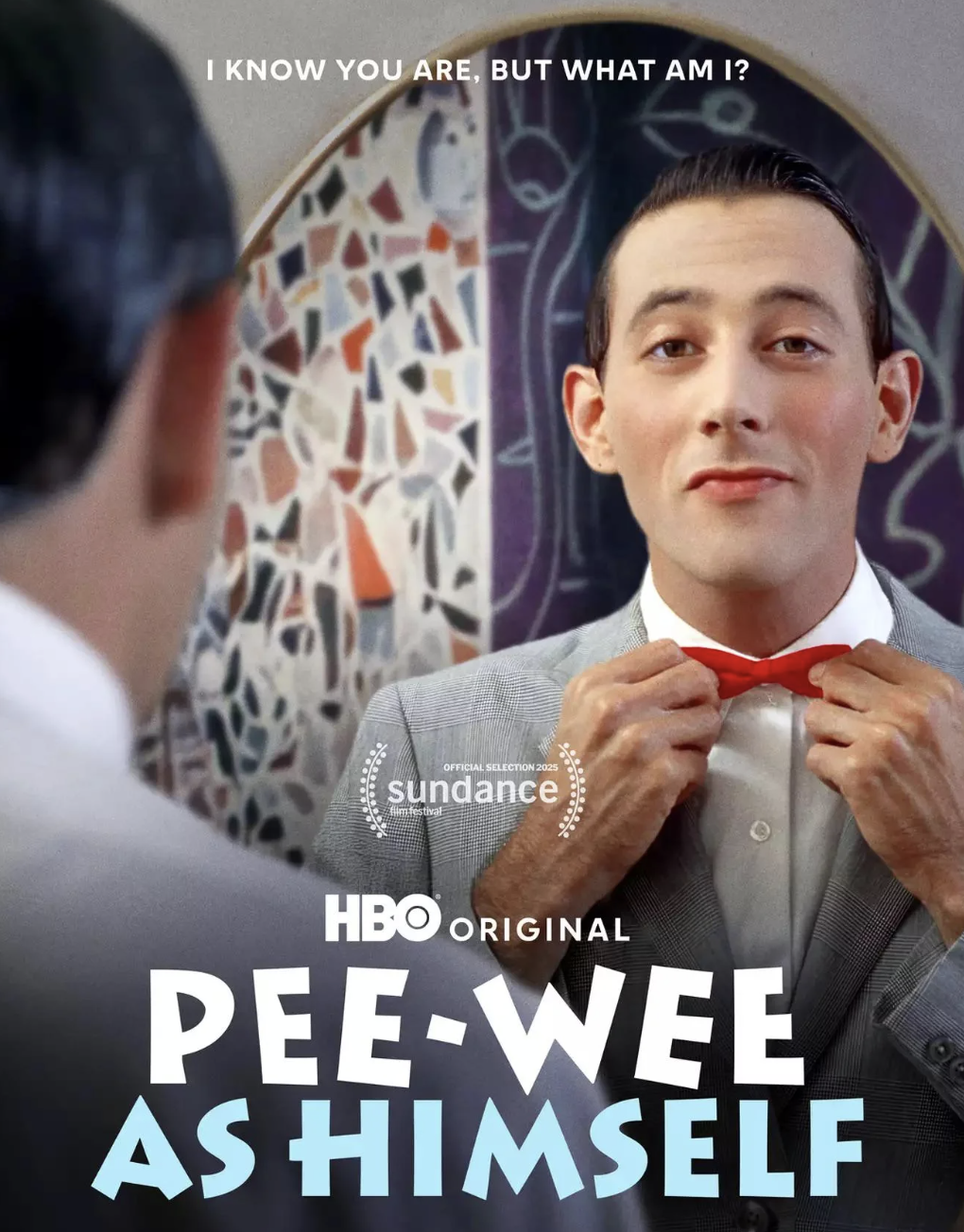
Perhaps the only other “personality”/comedian committed to “the bit” as much as Pee-wee Herman a.k.a. Paul Reubens (and now, a.k.a. Paul Rubenfeld) was Andy Kaufman. And yes, the two did “come up” around the same time, with Kaufman also gaining exposure before full-on fame by appearing on Late Night with David Letterman (Letterman being a springboard for many comedians at that time). Except, of course, both Reubens and Kaufman would insist they weren’t “comedians” of a traditional nature. Indeed, what both men did amounted to performance art. An art that Reubens started to realize he was attracted to during his college years, while attending CalArts.
Kaufman, too, started to explore his “medium” at a junior college in Boston, eventually arriving at the conclusion that he was not a comedian, for “the comedian’s promise is that he will go out there and make you laugh with him. My only promise is that I will try to entertain you as best I can.” The same went for Reubens, whose childhood memories of what was called the Golden Age of Television (though some might now believe that’s HBO’s Sex and the City and The Sopranos years) were instrumental to shaping his later work as Pee-wee.
As Reubens told Matt Wolf, the director of Pee-wee as Himself (appropriately available through HBO Max, considering HBO was one of the first launching pads for Pee-wee in 1981), “I was absolutely transformed in such a strong way by so many things in early television. I wanted to jump in my TV and live in that world.” Citing Howdy Doody, Captain Kangaroo and The Mickey Mouse Club as being among his favorite shows as a child, there’s no doubt that each one crept in as influential “source material” for what eventually became Pee-wee’s Playhouse.
But out of everything from early television, Reubens declared, “My favorite TV show was I Love Lucy. I would, as a four- and five-year-old be sitting in my living room thinking to myself, ‘These can’t be my real parents. My real parents somehow are Lucy and Desi.’ Like, ‘This can’t be my life.’ Like, ‘Wake me up from this dream.’ Like, come on. How am I ever getting out of Oneonta, New York and getting to Hollywood?” Well, as it turned out, getting there by way of Florida was a small stepping stone. Because, much to his and his sister Abby’s delight, his father, Milton, made good on the promise that they were moving to Florida. More specifically, Sarasota (which Reubens would put on the map in 1991 after getting arrested for indecent exposure at an “adult” movie theater).
As Reubens tells it, the closest he had gotten thus far to show business was Sarasota, which was “steeped in circus lore,” being that it was “the former winter headquarters of Ringling Brothers Circus.” Accordingly, circus performers (and their circus animals) abounded, giving Reubens an early sense that this was the life for him: performance. Entertainment. So he started working at the John Ringling Museum, where he found a kindred spirit in a woman named Ann Prim, who would become a filmmaker later on. What’s more, Prim would be the first major example of Reubens having a beard. Taking on a “girlfriend” not because there was a sexual attraction, but an emotional one. Indeed, their shared love of art house cinema and experimental film is part of what bonded them. Including a love for Andy Warhol and Paul Morrissey’s work together on movies like Trash and Women in Revolt.
Thus, Warhol and his “Superstars,” too, would become a key influence on Reubens. For he understood, while watching the likes of Jackie Curtis, Holly Woodlawn and Candy Darling, that, “Those people in those movies, those characters that I was so attracted to were really doing performance art. I mean, we’re living as conceptual people. Creatures in some way.” And, growing up in the era that he did, it’s likely that Reubens himself felt like a “creature”—something decidedly “other.” This due in large part to being aware of his dormant sexuality. It didn’t help that his father was the archetype of a “macho.” The sort of man to pull Reubens aside and ask if he knew that one of the friends he was hanging out with was a “known homosexual.”
However, that didn’t mean his parents didn’t readily accept who he was when he finally did introduce them to his first (and most significant) boyfriend. Even so, that early impression of his father as the “conventional” male made Reubens aware of being, in some way, at odds with him. As for what would become Reubens’ eventual brand of “kookiness,” it’s in keeping with how his father used to tell him, “You weren’t born, you were found under a rock.”
And, in terms of getting into detail about his father, among many of the uncomfortable truths that Reubens brings up in the documentary is that Milton was one of the founding pilots of the Israeli Air Force. Reubens phrases Milton’s influence on the very formation of Israel after the 1948 Arab-Israeli War with the distancing sentence, “Some people in what became Israel were looking for American, crazy stunt pilots to help form the Israeli Air Force. And he just said yes.” Another topic that is met with less acceptance in today’s climate of openly despising people with “means” is the fact that Reubens did have the privileged background to pursue his art when he was floundering. His sister easily mentions that, yeah, Reubens’ parents supported him financially during his struggling artist phase because that’s one of the benefits of coming from “privilege.” The word she herself uses. So while Reubens might have been more embraced today for the sexuality he felt (and knew) he needed to hide, he might have been less so if his audience knew he was, let’s say, supported. Then again, it’s no secret that most successful/famous people had the support of their parents in order to make it.
Part of that support was paying for his CalArts tuition. And, while there, Reubens quickly realized that he was one of the more “avant-garde” students despite initially being worried that everyone might be even more “out there” than he was. But no, as it turned out, Reubens could “out-oddball” most of the oddballs (an expression he uses later when referring to working with fellow CalArts alum Tim Burton on Pee-wee’s Big Adventure). Which probably wasn’t too difficult considering that some of his classmates were David Hasselhoff and Katey Sagal. It was while exploring different personas and guises at CalArts that Reubens fully grasped, “The whole idea of performance art and conceptual art, it spoke to me.”
After graduating, Reubens’ plan was to move to San Francisco and join an underground performance group called the Angels of Light, “an offshoot of a group called The Cockettes.” And maybe Reubens could have still made something out of that trajectory—but it wouldn’t have ended up as Pee-wee’s trajectory. Luckily (or unluckily), as John Lennon said, “Life is what happens when you’re busy making other plans.” And the life that happened to Reubens was going to a party at CalArts before his intention to leave for San Francisco. It was there that he met his great love, Guy. An artist who would end up being Reubens’ most major, long-term gay relationship.
Of the kismet, love-at-first-sight encounter, Reubens remarked, “I met Guy at a very transitional period in my life.” It’s a line that sounds like Tyler Durden telling Marla Singer, “You met me at a very strange time in my life.” But just because it was a strange time, didn’t mean it wasn’t the right time. Thus, rather than going to San Francisco alone, Reubens decided to move to Los Angeles with Guy. More accurately, Echo Park (Reubens was ahead of the curve on that front too). It’s during this segment that Reubens alludes to one of the many things about him that tended to rub people the wrong way, admitting, “I stole a lot of material from Guy.” For example, Guy would say, “Mmm, chocolatey,” in that voice we’ve now come to know as Pee-wee’s. When the stage show of Pee-wee was in more full-swing, Guy came to see it in New York, where Reubens noted, “He absolutely saw me doing a couple of jokes that are his.”
As for ever encountering that kind of love again, Reubens admitted, “Sadly, I feel like I probably never matched that again. And that’s a very, very long time ago.” And yet, in another instance of how the forceful hand of fate appeared to be guiding Reubens to this existence as Pee-wee, it was uncanny that he should choose to close up shop on relationships or dalliances of any kind with men right as the AIDS epidemic was beginning. Tragically, that’s how Guy ended up dying. As a matter of fact, Reubens visited him in New York just a few hours before his death. Yet another sign of how Destiny seemed to always play an integral part in Reubens’ life.
If he was certain of being in the closet before, watching so many gay men around him die of AIDS was plenty of additional confirmation that he ought to just “keep it in his pants” for the foreseeable future and focus only on his career. Fortifying himself with more ambition assisted in, for all intents and purposes, becoming asexual. This being one of the qualities that Pee-wee himself exudes. Reubens recalled living through the horrors of AIDS as a cautionary tale to himself, describing, “Moving through that and knowing so many people die, there’s just something so intense about that. It had real impact on me, like it scared the heck out of me.”
Even so, Reubens finds plenty of opportunity to poke fun at his gayness, as well as how coy he’s been about it for all these decades, quipping at one point, “I like to decorate. Whatever that suggests to you watching, go ahead, make those connections.” When he did come out to his parents by introducing them to Guy, his father wrote him a letter that Reubens summed up as, “If you are homosexual, I want you to know that I hope you’re gonna be the greatest homosexual you can be.” Sounds sort of like the Army mantra, “Be all you can be.” And yet, Reubens didn’t quite take that advice to heart, deciding to go back into the closet for the sake of his career. Recalling his thought process after his breakup with Guy, Reubens said, “When we split up, I just made a conscious decision and went, ‘I’m not doing this again.’ I not only wasn’t gonna be gay, but I wasn’t gonna be in a relationship.”
Choosing to be so single and single-minded undoubtedly contributed to Reubens’ already well-documented belief that it was his way or the highway. Even though he had to march to the beat of someone else’s…gong for a while. That is to say, he had to slog it out on Chuck Barris’ The Gong Show during his early attempts to get his name out. Granted, even then, he wasn’t trying to get his name out, so much as the names of his various “alter egos.” One of them being a Native American lounge singer named Jay Longtoe. A character that got so many laughs, Reubens thought Longtoe would be his “ticket” to the big time before the conception of Pee-wee. As he rightfully says, “Thank God that wasn’t the case.”
During his time with The Groundlings, all the things that had been percolating in his mind, including those early pop culture influences, coalesced to create Pee-wee. As for the name itself, “Pee-wee Herman sounds so weird that it sounds real. It just didn’t sound like a made-up name at all. Like Cary Grant or Rock Hudson.” Fittingly, Reubens chose two reference two other undercover queer icons as a similar example of strange stage names that are so strange they must be real. He also explained that the first name was taken from the wording on his harmonica and the last name from an obnoxious kid he knew with the surname Herman.
To his surprise, audiences really responded to that character in particular. And it led him to fathom that, “In a way, I decided I was no longer pursuing the Paul Reubens career, I was pursuing the Pee-wee Herman career.” Because he was willing to do whatever was necessary to not only become famous, but to fulfill his dichotomous dream: “I wanted to be very artistic and I wanted to be commercial.” The 1980s were just about the only years one could do that (case in point, another person who was at the right place at the right time [and fell in with the right artistic community]: Madonna—who Reubens must surely have met at one point if through no other conduit than Debi Mazar). Yet another indication that Fate, Destiny—whatever—was on his side in conspiring for Pee-wee Herman to exist. Because, yes, he is far too weird, wacky and non sequitur for any other period in time.
Before blowing up at the height of the eighties, however, Reubens details the many acting gigs he took (including a part on a Steve Martin comedy special) to build more awareness around his image in the period before Pee-wee took complete hold. However, he soon fathomed that he had taken things as far as they could possibly go without additional professional assistance. That is to say, an agent. Fortunately, Steve Martin’s manager, Bill McEuen, linked him up with his “associate,” a green, not-quite agent (until he became Pee-wee’s) named Rich Abramson. It was Rich who hatched out a plan (even if he admitted he had no idea what he was talking about at the time) to push Pee-wee over that final cliff toward Fame. This meant taking his stage show on the road, touring various cities throughout the U.S. and calling it the Pee-wee Herman Party—all to prove to some suits that he was a hot ticket for more than just theater. He belonged, too, in movie theaters.
Mostly out of his depth without Los Angeles as his anchor stage, Reubens stated, “I figured out how to be a stand-up comedian without being a stand-up comedian.” This harkens back to Andy Kaufman’s abovementioned quote about not being a comedian (again, he, too, was a performance artist). And yet, Reubens was no stranger to not fitting into a conventional label and still forcing himself to be put into one for the sake of that goal of his: being artistic and commercial.
It was both those sides of himself that made it a challenge for many people to work with him. As Wayne White, a set painter and puppet designer on Pee-wee’s Playhouse, phrased it, “Paul had conflicts with most everybody he worked with. That was just his nature.” And it led to some of the uglier friendship breakups in his life when the professional interfered. This not only included Phil Hartman (who later expressed resentment about not being credited more with some of the development of the original show), but also Abramson, who Reubens cut loose while the first season of the show was filming. Although Abramson is interviewed in Pee-wee as Himself, he confesses that he never really got over that slight, having invested so much time and energy into helping Reubens get to where he was (once again, Reubens is exhibiting some parallels to Madonna, for that’s what her first agent, Camille Barbone, said about her).
Abramson is also the one to comment on Reubens’ lack of business acumen when making a deal about what he was getting for his work on Pee-wee’s Playhouse—yet another indication that artists—true, head-in-the-clouds, I-need-to-be-creating-not-businessing artists—don’t have a head for finances and figures. Even so, Reubens was also fortunate enough to come up during an era when there was still a sense of artistic community in various enclaves throughout Los Angeles (and, sure, goddamn New York). Because if there hadn’t been one, he might never have secured his dream set design for the playhouse, courtesy of Gary Panter, whose work Reubens became familiar with through all the artwork he was seeing on various flyers for punk shows. Taking note of the designs and visuals he liked best every time he saw one, it was always Panter’s work that caught his eye. And so, another key partnership was formed in creating what would be the children’s TV show iteration of Pee-wee’s Playhouse.
And yet, before that, Abramson’s goal was to make Reubens into a movie star. Parlaying the success of his stage show tour into a movie deal that would become the iconic Pee-wee’s Big Adventure. Alas, Reubens stumbled into an issue early on when Warner Bros. presented him with a director he didn’t like. Insisting it was the wrong choice, the suits gave him a week to find his own replacement that could still meet their criteria. Reubens then called Shelley Duvall (just one of his many famous friends by that point) to ask about Tim Burton. She said that was a “fantastic idea” and insisted that he watch Burton’s Frankenweenie. That was all Reubens needed to see to know Burton was the man to shepherd his project into full existence.
When Burton received a large bulk of the praise for the movie, the complexities of Reubens’ nature—that inner push and pull—shined through. For, once again, he found himself resenting his alter ego for holding him back from getting the recognition that Reubens deserved. At the same time, Reubens owed Pee-wee for the mounting fame and fortune they were both sharing. It was yet another example of the extreme paradox that came with being Reubens.
Of hiding behind an alter ego for most of his adult life, Reubens offered that “there’s all kinds of psychology” behind it. “Some of what fits into, like, self-hatred. Or self-preservation.” Both qualities play into the “old world” view of what it meant to be gay. Because, if one thinks that homophobia is bad now, look only to “then” for a better frame of reference. In this regard, it’s obvious why Reubens would play it so close to the vest—more to the point, play it so “Old Hollywood.” This being the term that Debi Mazar wields when at last admitting that she was his beard for most of the 1990s, positioning their dynamic as, “I mean, look, in Old Hollywood, people were set up to date. It was like an arranged marriage” (and, for a minute there, they were trying to position Carol Kane as the “wife” in this arranged marriage with Reubens).
Besides, whether platonic or romantic, were it not for Mazar, there’s no doubt that Reubens would never have come out of the depression he sank into after getting busted for indecent exposure in ‘91. Something that is discussed at length in Pee-wee as Himself, with Reubens commenting, “It’s still a gigantic footnote. And when people said to me at the time, people I work with, said to me stuff like, ‘You know, the public has a really short-term memory,’ I turned around in the moment—and this is true thirty years later—and said, ‘The public has a memory like a steel trap. The memory of the public is like an elephant memory.’” Anna Scott of Notting Hill would tend to agree.
And one of the things that the public also never forgot was the accusation that Reubens ripped off a few people to get to the top (as mentioned, Phil Hartman definitely thought so, and announced as much publicly thanks to Howard Stern’s goading). Something he had no problem copping to, even in using the word “stole” in regard to Guy. Which perhaps just proves the old (self-exempting) adage, “Good artists copy, great artists steal.” Even though what that saying really means is that an artist studies and absorbs the work of others so well that they’re able to make a style entirely their own. Hence, such diverse works as Howdy Doody and Trash infiltrating the stylistic choices of Pee-wee’s Playhouse.
Speaking to his “bad reputation” when he got his Hollywood Star in 1988, Pee-wee ribbed, “Anybody who I stepped on to get to the top…can come down here every day after this and step on me.” It was Pee-wee’s signature brand of arrogant humor. As was the various subtexts he “slipped in” to Pee-wee’s Playhouse. Certain moments, like Miss Yvonne riding a hobby horse as though she’s getting railed, are brought up again onscreen by Wolf, with Reubens assuring that such innuendos were always designed to go over kids’ heads. Thus, in a way, he was sort of like a precursor to the type of shit that Dan Schneider tried to get away with (and, for a long time, did) with his various Nickelodeon series.
Of course, to compare Schneider to Pee-wee is tantamount to sacrilege. As it was for someone to try to put him in the same category as Jeffrey Jones when his name also came up in 2002 as someone who was in possession of child pornography. And so it was that, once again, just when Reubens was fully recovering from the first trauma of being painted as a monster in 1991, his reputation was once again put at risk in a far worse way (and yes, it rather parallels Jackson’s primary years of scandal: 1993 and 2005—except that there was definitely fire where there was smoke in that situation). In truth, although this particular scandal was kept much quieter than the indecent exposure one, it scarred Reubens the most. For it was beyond hurtful to have the word “pedophile” associated with his name. Almost like Hollywood and its various offshoots were trying to burn him at the stake. To punish him for attempting to conceal who he really was: gay. The lie of omission being but a reaction to history—especially Hollywood history—proving, time and time again, that one is never “free” to be their true self.
So instead, Reubens acted out in other ways to declare who he was. Case in point, his beloved Christmas special for Pee-wee’s Playhouse, during which he tells his friends, “Look everyone! A new wing to the playhouse. Made entirely of fruitcakes!” This said as two muscle-parading men keep working to build that wing. It’s in this moment that one of Reubens’ talking head segments is intercut to comment, “Yes. There is gay subtext in Pee-wee’s Playhouse. Yes, there is. I’m saying this seriously so you can put some bum-bum-bum-bum—dark music. Some sting into it.”
It’s around this part of the documentary that the viewer can see some more marked signs of Reubens starting to let his guard down, to take his mask off—even though still putting up the defense of self-deprecating humor. This is all at the hands of Wolf, who clearly endured his fair share of Reubens’ “diva antics” in order to needle him into being at least somewhat authentically himself. Moments that shine through most when Reubens is talking in some way about his sexuality. Sadly, it comes off as though Reubens does view it as a bane. An albatross that got in the way of preserving his previously unblackened record. And yet, it is the thing that not only made him who he was, but made Pee-wee who he was (e.g., a man who dances around in high heels, a man who’s kind of repulsed by his girlfriend in Pee-wee’s Big Adventure [then tries to make up for it with the “longest kiss in cinema history” in Big Top Pee-wee], a man who collects gay icons [Cher, k.d. lang, Grace Jones and pretty much everyone else in the Christmas special]).
Although Reubens had conflicts with Wolf that led to him not doing the final interview, he couldn’t resist recording a parting message the day before he died. One that explained the “why” behind making this documentary (and no, in typical “secretive Paul” fashion, he didn’t feel obliged to forewarn Wolf that he had cancer—or anyone else, for that matter). Which, for him, was “to let people see who I really am. And how painful and difficult it was to be labeled something that I wasn’t. The moment I heard somebody label me as, I’m just gonna say it, a pedophile, I knew it was gonna change everything moving forward and backwards… I wanted people to understand that, occasionally, where there is smoke, there isn’t always fire.” He concludes with declaring, “Everything I did and wrote was based in love and my desire to entertain and bring glee and creativity to young people and to everyone.”
The irony of Reubens being such a beacon for acceptance (of others and oneself) and “freedom to be a weirdo” is that, despite Pee-wee’s Playhouse touting these ideals, Reubens never felt that way. At least not strongly enough to “let it all hang out.” But, to reiterate, Reubens was very much a product of the time he grew up in. A baby boomer that experienced his childhood in the 1950s, it was ingrained within him that being “out” was never really going to be “okay.” As Wolf himself said in an interview with Salon, “I think of it not as a cautionary tale but a generational experience, particularly for gay people. Paul would not have succeeded as an openly gay person in the context of children’s television entertainment.” What’s more, part of Reubens’ long-standing hesitancy to come out, even in a post-Will & Grace era, was further compounded by something else Wolf mentioned to Salon: “…he was concerned I would focus too much on that aspect of his story [for this film] or try to frame him as some sort of gay icon when that wasn’t how he saw himself.”
Nor, in all likelihood, is it how many others will see him despite this officially confirmed information. For, drop the mask as he might, Paul Reubens will forever remain in people’s hearts as Pee-wee Herman. A blessing and a curse he also bore in life.


