


In case her last name wasn’t enough of a tip-off, it’s no secret that Marina Diamandis is firmly and proudly Greek (then again, maybe it is a secret since she only goes by MARINA as her stage name). Although born in Wales (in many regards, the cultural antithesis of Greece), Diamandis’ father is originally from “Hellas,” and moved back there after separating from her mother when she was four years old. Twelve years later, when Diamandis was sixteen, she, too, moved to “the homeland” to spend more time with her father and, well, generally get more in touch with her Greek side—complete with learning the language (which included, naturally, singing folk songs in Greek with a little help from her grandmother).
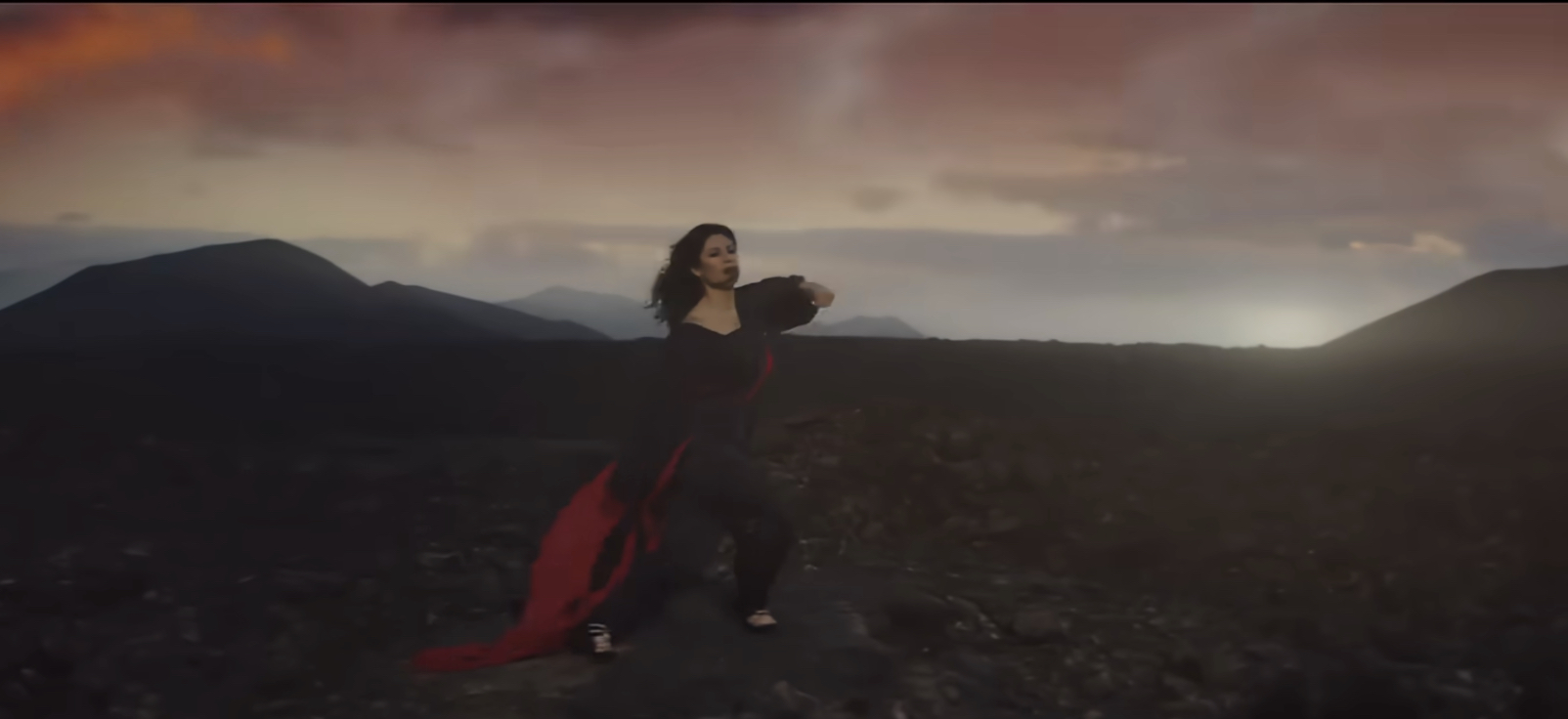
Despite not becoming totally fluent (and who can fault her for that, based on the difficulty of the language?), Diamandis seemed to tap into a part of herself that later shined through on the third single from 2015’s Froot, “I’m A Ruin.” Complete with an accompanying video (directed by Markus Lundqvist) filmed not in Athens (at, say, the Acropolis), but in Lanzarote (considered a part of the Canary Islands). To be sure, the volcanic landscape is the crux of the “ruinous” vibe MARINA wants to convey, with a quarter of the island having been covered in lava during the 1730s. Hence, the unique appearance of the soil, which gives it an ashy, gray-black sort of tone.
As for filming in this particular location, it was no doubt done to underscore the ruin-themed lyrics of the song. Lyrics that liken MARINA’s uncertainty about giving herself fully to someone just because they love her (because she’s still got to feel free). And, in a sense, that’s what ruins, whether structures or landscapes, reflect back to the people that love them (or once loved them) so dearly. For they also can’t agree to give themselves fully (a.k.a. promise to stay intact forever) just because they’re loved by another.
Thus, MARINA compares herself to a “ruin” while also suggesting that because of her tendency to do so, she’ll turn whoever dares to love her into ruins themselves. Emotional ones, that is. Regardless, she tries to cushion the blow to her erstwhile beloved with the assurance/warning, “You still mean everything to me, to me/But I wanna be free/I’ll ruin, yeah, I’ll ruin you, I’ll ruin.”
Her flair for the dramatic (as is the Greek way) is heightened by not only her interpretive dancing style in the video, but the accompanying cape, of sorts, that she wears during it. Allowing her to put her hood up over her head and generally maneuver around like she’s Madonna in the video for “Frozen.” And yes, Madonna herself filmed that video in something of a “modern” ruin (by American standards), the Mojave Desert. Indeed, there are certain parallels to the landscapes MARINA and Madonna find themselves in (in addition to the many other parallels MARINA has offered in the years since when it comes to Madonna homage). Mainly the barren look of both settings—an aesthetic amplified by the fact that there’s only one person in the frame, set against a vast abyss.
Nonetheless, MARINA (looking like a member of a Greek chorus who has lost her “flock”) dances amid the barren tableau as if the place is as vital as ever. And in its way, it is. For new life can be given to something considered “dead” or “ruined” by those willing to imbue it with their own vivacity. This, too, echoing MARINA’s sentiments about wanting to move on so that she can offer that “vivacity” to someone else, explaining to her loved one, “It’s difficult to move on/When nothing was right and nothing’s wrong/You still can’t look me in the eye/‘Cause you’ve been bitten once and now you’re twice as shy.” She then kind of adds a bit of a flex in by noting, “I’ve had my share of beautiful men/But I’m still young and I want to love again.”
The same goes for any ruin (for ruins are “young” in respect to the entirety of Earth’s history) that might one day be “revived” by being “visited upon” by fresh meat, so to speak. Case in point, the tens of thousands of people that visit Pompeii every day to marvel at such ruins. To bask in the sheer magnitude and implications of them.
Addressing something that would become a bit of a running motif later on Ancient Dreams in a Modern Land (especially on songs like “Pandora’s Box” and “Flowers”), MARINA touches on how even though it might feel easier not to “ruin” someone by staying with them, it only yields more ruinous results for oneself in the future. So it is that she MARINA sings, “It’s difficult to say goodbye/And easier to live a lover’s lie” and “Babe, I’m gonna ruin you if you let me stay.”
And so, by the end of the video, MARINA has decided to take advantage by a part of the island that isn’t “ruins.” This done by placing both of her hands into the ashy earth, whereupon, suddenly, the sea rushes all around her hands and she’s now submerged in the water, serenely floating with the other creatures (depicted in shiny neon) down below. Whether this ultimately means MARINA would rather drown than ruin someone else or that she would rather flit away like a fish than stay in a banal relationship for the sake of sparing a man’s feelings is left to one’s own discretion. Either way, it has all the tragicomic flair and symbolism of Greek myths and plays. Further reminding audiences that, even if she was born in Wales, MARINA is a Greek girl through and through.


[…] Genna Rivieccio Source link […]