


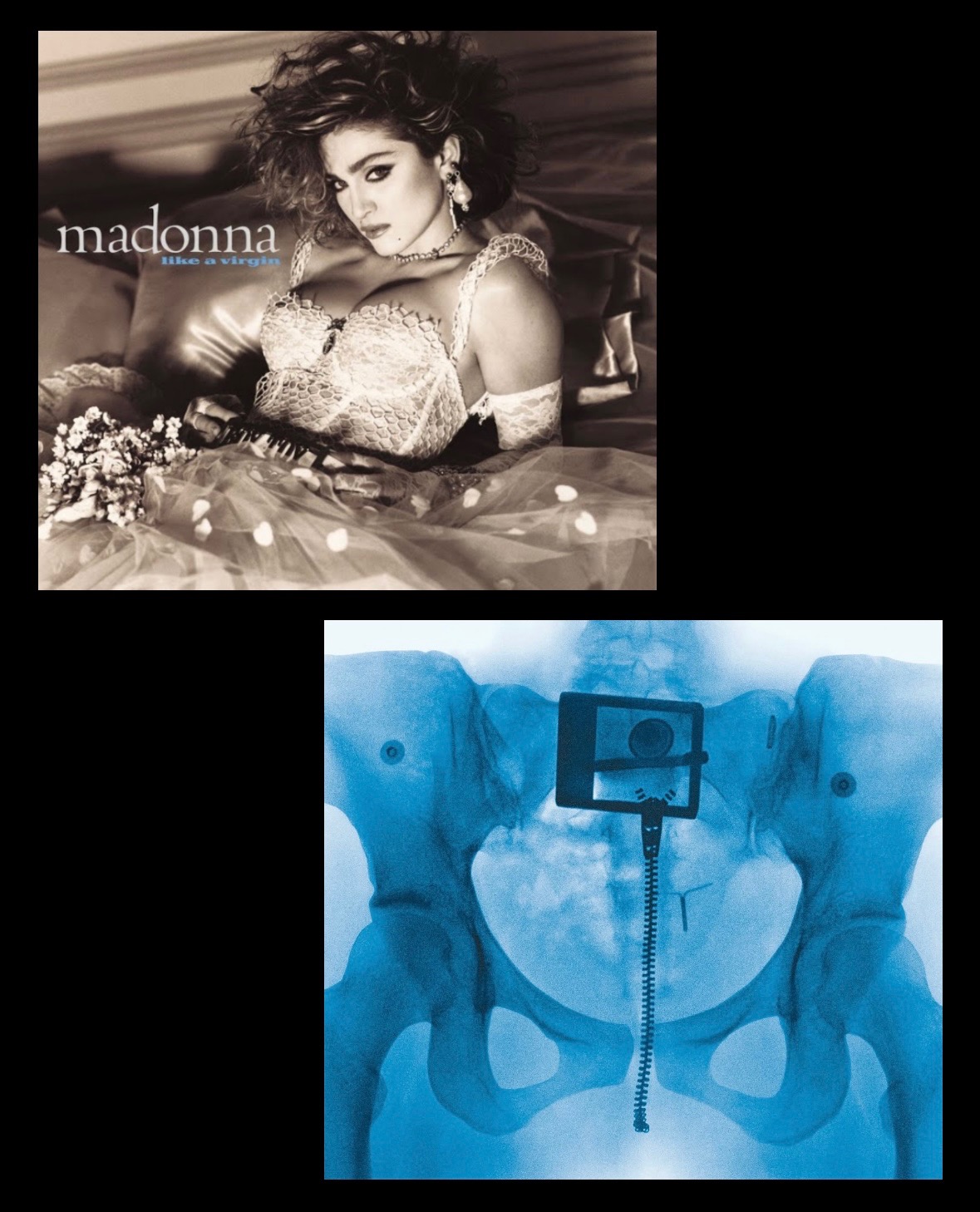
The announcement of Lorde’s forthcoming album title, Virgin, on April 30th was met with a reaction that was more focused on the artwork itself rather than the name. For, in keeping with Lorde’s increasingly “salacious” covers (with Solar Power still unmatched on that front), Virgin’s is an X-ray of a pelvis showing a belt buckle with an attached zipper and an IUD off to the right of it (with one person commenting that they were “worried about that IUD placement”). Apart from destigmatizing IUDs, Lorde’s intention with the X-ray cover, as she herself remarked, was to make reference to “see[ing] myself, all the way through. I was trying to make a document that reflected my femininity: raw, primal, innocent, elegant, openhearted, spiritual, masc.”
Highlighting the fact that femininity can also have masculine elements is also on-brand for another pop superstar: Madonna. Indeed, M recently reminded people at the Met Gala that she’s not just the OG of pop music (barring Cher), but the OG of gender-bending fashions and aesthetics. Long a believer in playing with and subverting gender tropes (see also: her ode to feminine masculinity, the “Music” video), Madonna inarguably got her first taste of inspiration on that front from Marlene Dietrich (who, among other Old Hollywood stars [Marilyn Monroe included], Madonna has paid homage to repeatedly throughout her career)—with David Bowie coming in second after she caught his Diamond Dogs Tour at the Cobo Hall in Detroit.
During the apex of her gender-bending explorations circa 1992 and 1993, it was Dietrich that Madonna returned to. First, in a photoshoot wherein she dresses like an ultra-powerful business mogul smoking a cigar (one of these images becoming the cover for the “Deeper and “Deeper” single), and then during The Girlie Show, her tour in support of the Erotica album. It was on this tour that Madonna opted to include a segment called “Weimar Cabaret,” at which point she did her best impression of Dietrich in The Blue Angel, even going so far as to sing “Like A Virgin,” the opening song of the segment, with a German accent (hence, “wirgin” instead of “virgin”).
Returning to this Dietrich-drenched masc approach for her Tom Ford-branded fashion statement at the Met Gala, it seemed cosmically aligned that Lorde, also in attendance, would comment to Emma Chamberlain of her Thom Browne ensemble, “I just love the open back, to me it, like, really represents where I’m at, gender-wise. Um, I feel like a man and a woman.” With this in mind, Lorde’s remarks about why she chose to title her album Virgin tie in seamlessly with her current state of “gender duality.” This because the word “virgin” does not necessarily have the definition that everyone thinks it does. Something Lorde alluded to by posting an excerpt to her Instagram story that read, “There is also evidence that the word ‘virgin’ derived from the combination of Latin words ‘vir-’ (for man, as in ‘virile’) and ‘-gyne’ (for woman, as in ‘gynecology’)—a man-woman or androgynous person.”
For a long time, at least since the post-Melodrama era, Lorde has been keen to embrace a certain “androgynous person” look, underscored by her body’s curveless shape and her face’s perennially makeup-free appearance (a far cry from the days of the “goth” Lorde circa Pure Heroine). With the advent of Virgin, however, it appears as though Lorde is ready to fully lean into her masc side (after already emphasizing it on “Solar Power” by pronouncing, “I’m kind of like a prettier Jesus”).
This, of course, is something that Madonna has already done for decades. But it was by embracing her femme side in 1984 with Like A Virgin that she secured international fame a.k.a. favor with the mainstream. Surely not a coincidence in terms of how society only accepts and lauds women who veer toward a “conventional” appearance. And while Madonna’s take on the “sexpot” may have been a then avant-garde 1980s one (complete with tousled hair—“after sex” hair, ironically enough—and “junk jewelry”), she was still showing herself in a way that pandered to the conventional male gaze…even as she was performing, ultimately, to herself (as her earliest videos, like “Burning Up” and “Lucky Star,” reveal).
Lorde, too, despite coming of age and being famous in the “progressive” twenty-first century, admits in her Document interview with Martine Syms that she has frequently pandered to the established standards of “being a woman”—more to the point, looking like a “woman.” This done for the majority of her career. As she puts it, “I had made my body very small, because I thought that that was what you did as a woman and a woman on display. I thought, I’m small. This will communicate to people that I’m taking my position seriously.”
Thus, one of the key lyrics in “What Was That,” “Since I was seventeen, I gave you everything,” relates to something else Lorde mentions to Syms: that she “sacrific[ed] [her] body to [her] career since [she] was sixteen or seventeen.” To her fans, to her critics, to society at large. Which, yes, is a very feminine thing to do in that it’s rooted in the incredible pressures and beauty ideals placed squarely on women’s shoulders from an extremely young age. When Madonna arrived onto the scene, she established an entirely new precedent for “unconventional” beauty. That is to say, she wasn’t blonde and wispy (in fact, she herself has called those mid-80s days her “chubby” or “zaftig” era). She was, by Hollywood standards, even “swarthy.” Owed to her Italian heritage, of course. And so, her material(girl)ization onto the scene was a landmark event for a number of reasons. Not least of which was simultaneously catering to and subverting expectations of what “sex appeal” meant. With “Like A Virgin,” Madonna was both “playing” the virgin and saying she wasn’t virginal at all. What’s more, she took a “masc” song (in that it was written by two men, Billy Steinberg and Tom Kelly) and made it hyper-feminine—right down to what people then referred to as her “Minnie Mouse” vocals.
And while the visuals and ostensible subject matter surrounding Like A Virgin and “Like A Virgin” might have made those who took it at face value assume that it was “raunchy,” Madonna was adamant that, “When I did the song, to me, I was singing about how something made me feel a certain way—brand-new and fresh [e.g., a lover that treated her right]—and everyone else interpreted it as ‘I don’t want to be a virgin anymore.’ That’s not what I sang at all.” Of course, no one was making the assumption that Madonna was a virgin at that juncture (side note: M lost her “V-card” when she was fifteen). Unless what one associated with that word was what Lorde is trying to realign it with in the present, also posting in her Instagram story another excerpt that read, “The word ‘virgin,’ some say, was derived from a Greek word that meant ‘not attached to a man,’ a woman who was ‘one-in-herself.’ Goddesses like Ishtar (Assyrian-Babylonian), Diana (Roman), Astarte (Greek) and Isis (Egyptian) were called ‘virgins’ not because they were inexperienced but because they were strong and independent.” In which case, Madonna is still a very big virgin indeed.
As for Lorde’s approach to the subject of virginity—in both definition and visuals—there’s no denying it’s taken a decidedly less “sexy” turn. At least compared to the more “seductive,” flesh-baring “delights” of Madonna’s “virgin” decade of fame: the 1980s. Or perhaps that’s what is sexy about Lorde’s handling of the topic (insisting virgin’s meaning is “man-woman”—or, as Madonna sings on “Dark Ballet,” “I can dress like a boy/I can dress like a girl”). She wants to reclaim what the word means, repurpose its connotations entirely. To that end, it was also in her interview with Syms that Lorde mentions certain signs from the universe about “becoming more masc” as she made the album, recalling, “…we were working in the East Village, and we walked past this flyer. I think it was for joining a band or something, and it said, ‘Do you have the stones?’ And I was like, ‘Whoa, that’s tight.’ I didn’t understand what it was saying at first. I know now it’s like, do you think you have the balls? But it gave me this feeling that there was a mysticism to it. ‘The stones’ felt like, do you have the sort of touchstones or the talismans to go there? Seeing that as I was also coming into my masculinity a bit more as well.”
By coming into that masculinity, Lorde has, at the same time, more freely welcomed her femininity. Or rather, her version of what that entails. And one thing it definitely does is being unafraid to expose herself—emotionally and physically. As she announced of Virgin, “I’m proud and scared of this album. There’s nowhere to hide.” Not that Lorde really wants to anymore. Something of, that’s right, virgin territory for her.
So maybe some people might view going from the “straightforward sexiness” of Like A Virgin to the visually assaulting—nay, almost unappetizing—nature of Virgin as yet another sign of how society has rendered sex totally unsexy (sexless, if you will). Worse still, clinical. But there is something to be said for Lorde diving vag-deep (literally) into the matter at hand: women can be just as male as any man—and that has nothing to do with their “parts.” That means being independent, uncompromising and unafraid of other people’s opinions. This is something Madonna has emphasized time and time again throughout her own career, often while thumbing her nose at the cliches of womanhood. Building on that work, now, is Lorde. Who, appropriately, shares a religiously-oriented name with Madonna.


