


On the May 20th episode of Ts Madison’s new podcast, Outlaws, Chappell Roan was a guest alongside Sasha Colby. Because, as it is well-known by now, Roan would rather not make an appearance somewhere unless a drag queen (a.k.a. gay man) is present. Much the same as Madonna hasn’t cared for being in spaces without LGBTQIA+ people throughout her career—and at a time when that was deemed extremely scandalous. However, as Roan points out to Madison, Madonna was one of the key women who “walked so she could run.” Someone who wore bridal wear ironically so that she could too. Indeed, she was wearing a bridal getup while recording the podcast, which is part of how Madonna’s name came up.
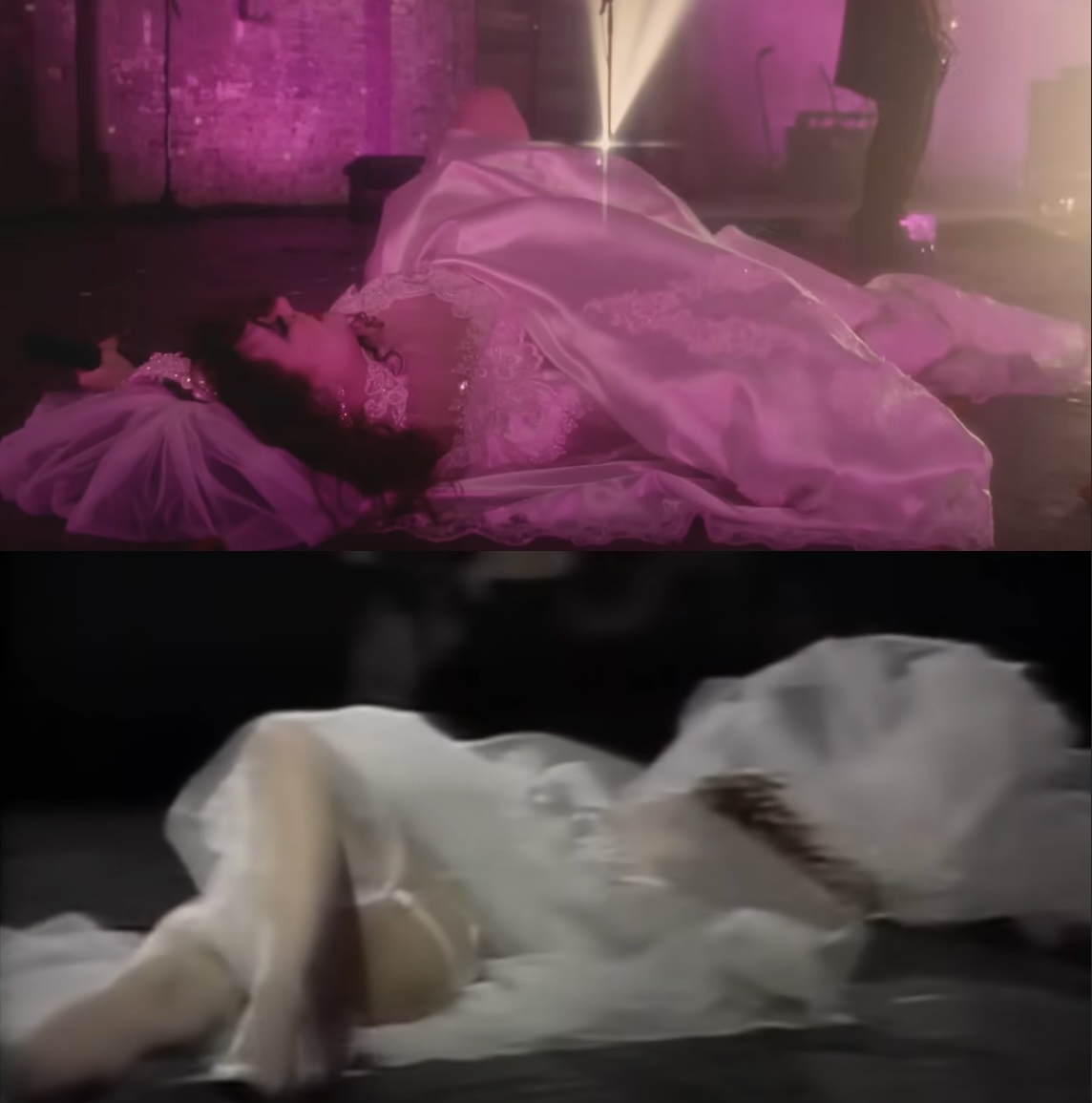
Well before that, however, Roan’s love of rocking the “Like A Virgin” look has been sufficiently documented. Most notably, on a taped 2024 performance she did for MTV Push, during which she sings “Red Wine Supernova” and “Pink Pony Club” in a wedding dress. Albeit a much more conservative one—though still with a very 80s aesthetic—than Madonna’s scantier fit from the 1984 VMAs. This being the performance that launched her into the international spotlight. Before that point, Madonna’s debut album had performed “solidly” enough, with radio-friendly singles like “Burning Up,” “Holiday,” “Lucky Star” and “Borderline” remaining among Madonna’s best-known, most signature tracks.
Incidentally, her debut single, “Everybody,” had less of an impact overall, despite it being the song to officially introduce her and her sound (one that had listeners assuming she was Black, which made the record companies “nervous” in terms of how to market her [and in terms of racism no doubt]). The same could be said of Roan’s earlier body of work—namely, School Nights, the EP that offered audiences an entirely different sound (more in the vein of, say, Adele) from the one that Roan would come to be known for on The Rise and Fall of a Midwest Princess.
Madonna, in contrast, merely built on the sound she carved out on her self-titled album. Fine-tuning and further “pop-ifying” it with the help of Nile Rodgers, the person she tapped to produce her sophomore effort. Titled, what else, Like A Virgin. Needless to say, Madonna built her entire “persona” for that album around the “virgin” construct—hence, wearing a wedding dress on the cover and during performances (particularly while embarking on 1985’s The Virgin Tour). And Madonna wasn’t the only one feeling subversive/tongue-in-cheek about old guard institutions like marriage that decade. It also seemed that Billy Idol was on the same wavelength as M, releasing one of his best-loved hits, “White Wedding,” in 1982. But it was, of course, Madonna who became most associated with all things bridal during the Decade of Excess. That much secured by her immortal, writhing performance on the VMAs—though she would later attribute said writhing to losing her high heel and trying to get it back (one of those things that feels categorizable as “a likely story”).
Starting out on top of a wedding cake next to a mannequin groom, Madonna gradually descends the “steps” (a.k.a. tiers of the cake) until reaching the bottom. Sitting down at one point with her hair pinned up at first, Madonna undoes it so that she can tousle it for an ultimate “just got deflowered on my wedding night” effect. That’s when things give way to her “no artifice” dance moves, similarly rough-hewn and freestyle to the ones Roan offers up during her duo of MTV Push performances.
At the end of “Red Wine Supernova,” she falls to the ground, lying on it in a way that immediately makes the Madonna connection even more noticeable. As does the camera panning up to one of the disco balls at the center of the ceiling. To be sure, even the many disco balls above her harken back to Madonna in the video for “Everybody,” her “maiden voyage,” as it were, into the music video scene. As such, it was an expectedly low-budget affair. Not least of which is because music videos themselves were still an entirely new medium, therefore, not one that everybody felt compelled to make a viable investment in. So it was that Madonna rallied the artistic community she had become a part of in New York, with her friend, Debi Mazar (a friend to this day), doing her makeup and gathering some of her own crew to serve as audience members watching and dancing to Madonna up on the stage of Paradise Garage.
Roan’s own background of becoming part of a community of drag queens “down in West Hollywood” also served as a launching pad for her to go mainstream—and take those “fringe” elements with her the same way that Madonna did with the Downtown NY scene. Thus, perhaps in some sense, Roan’s decision to start rocking the bridal look, dredging it up again when one least expects it, is a nod to Madonna (a fellow Midwestern girl, to boot). Not just for paving the way for female pop stars, women in general and what it means to be a true ally, but also in regard to acknowledging some of the similarities in their “coming up” stories. With Madonna not only forging her musical path based on the community she encountered in New York, but achieving a similar kind of “slow burn” fame after slogging it out with her “sleeper hits” of 1982 and 1983 before becoming a household name in 1984. That gradual “burst” echoes how Roan’s “Pink Pony Club” was released in 2020, but didn’t reach its chart peak until 2025, after Roan at last got her flowers, becoming practically omnipresent in the wake of releasing “Good Luck, Babe!” in spring of 2024.
Thus, although one of the most frequent comparisons that Roan gets is to Lady Gaga (herself an imitator of Madonna), there’s no denying that the OG of pop stars as we known them is a strong influence on Roan’s sartorial and visual choices. As she summed it up on the Outlaws podcast, “I can wear this right now, this like bridal… Madonna fuckin’ sacrificed herself on that MTV fuckin’ stage.” “Like a virgin,” Madison quips, finishing Roan’s sentiment that Madonna was the first to tread on this territory of being so “outrageous” and “disruptive” in the way she paired her aesthetics with her messaging. Something that Madonna has been passing on the courage for subsequent generations to wield in their own way (though some do just outright replicate) ever since she “walked down the aisle,” as it were, to marry fame.


[…] it’s the veil Addison wears on the cover that again conjures a nod to Madonna. Specifically, her Like A Virgin era (something Chappell Roan is fond of referencing as well). But the person she seemed to be referencing the most with “Diet Pepsi” is Lana Del Rey, […]