


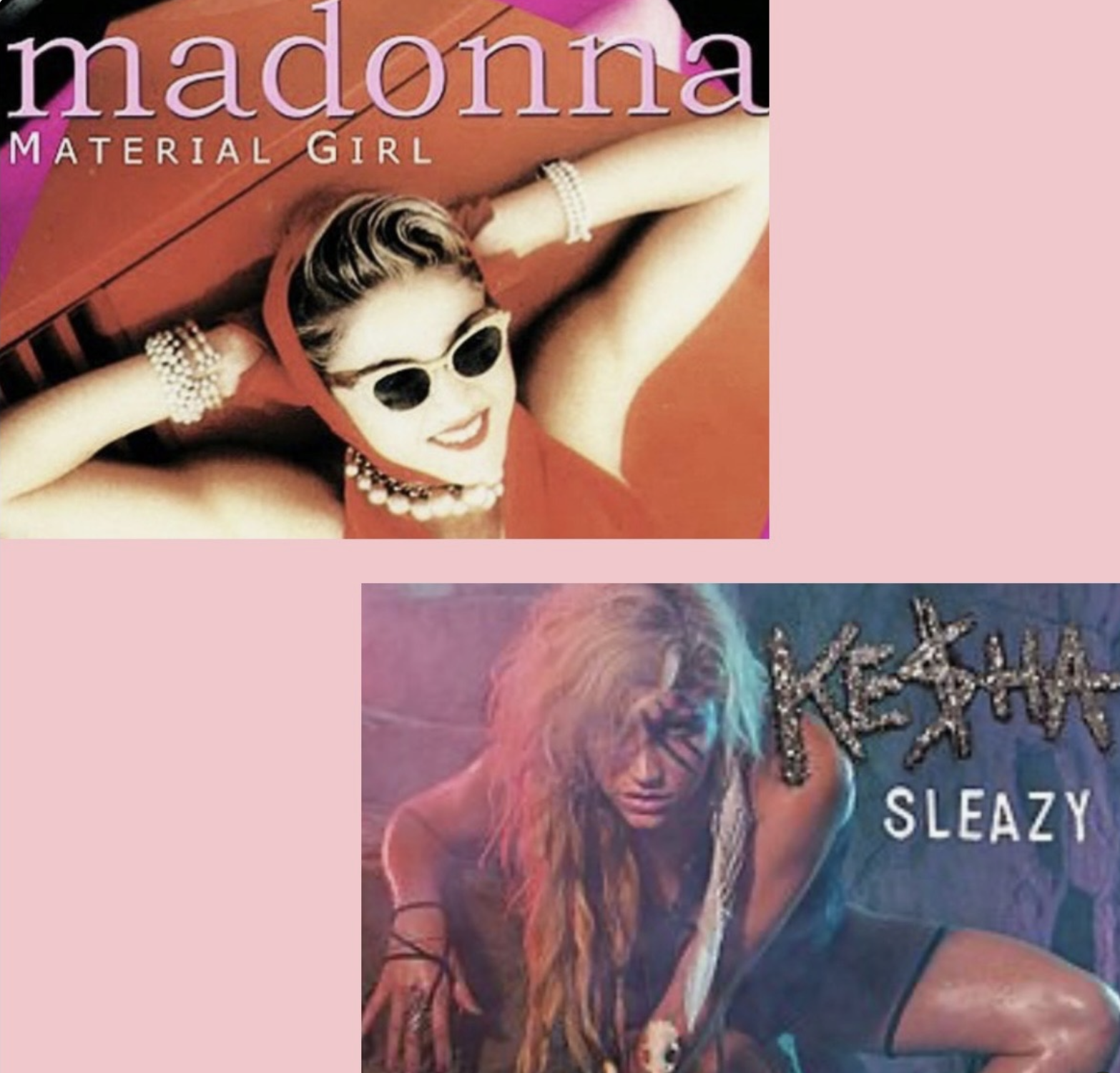
For those who would question how Kesha has become synonymous with the term “recession pop,” the reason goes far beyond the success of her dance floor-ready rhythms and lyrics championing having a good time no matter what (and at all hours of the day) during times of economic decay. And perhaps there’s no better exemplification of that than the thesis statement of her still underrated 2010 single, “Sleazy,” from the Cannibal EP. Released two years after the 2008 financial crisis, Kesha exhibited the kind of braggadocio and I-don’t-have-to-pander-to-you-because-you’re-one-of-the-few-with-money behavior that was not common among women who were otherwise more willing to, let’s say, pimp themselves for profit (see also: Hustlers).
In this sense, the woman Madonna plays in her 1985 “Material Girl” video is all over a “Sleazy” verse like, “I don’t need you or your brand-new Benz/Or your bougie friends/I don’t need love lookin’ like diamonds/Lookin’ like diamonds.” For while Madonna might have shruggingly confirmed, “We are living in a material world/And I am a material girl,” she wanted to ensure, with the accompanying Mary Lambert-directed visual, that her fans knew she was being ironic. An ironic and playful tone she’s spoken on multiple times over the years, including in a 2009 interview with Rolling Stone, during which she explained her attraction to both “Material Girl” and “Like A Virgin” as follows: “I liked them both because they were ironic and provocative at the same time but also unlike me. I am not a materialistic person, and I certainly wasn’t a virgin, and, by the way, how can you be like a virgin? I liked the play on words, I thought they were clever. They’re so geeky, they’re cool.”
The same, too, could be said of Kesha’s more over-the-top wordplay on “Sleazy,” particularly when she sing-raps, “Rat-a-tat-tat on your dum-dum drum/The beat’s so fat, gonna make me cum (um-um-um)…/Over to your place.” However, if she does decide to, er, come, it isn’t going to be because the guy in question is rich. As she’s sure to underscore that with the lines, “You can’t imagine the immensity/Of the fuck I’m not giving/About your money and manservant/At the mansion you live in/And I don’t wanna go places/Where all my ladies can’t get in/Just grab a bottle, some boys/And let’s take it back to my basement and get sleazy/Sick of all your lines, so cheesy/Sorry, daddy, but I’m not that easy.” Madonna’s sentiments exactly. That is, if the premise of the “Material Girl” video is anything to go by (again, not the lyrics). In it, Madonna is described at the outset as “the biggest star in the universe, right now, as we speak.” As such, she’s managed to attract all manner of hangers-on and would-be suitors, expressing discontent with all of them at the beginning of the video when she tells a friend over the phone as she looks disinterestedly at a diamond necklace, “Yeah, he’s still after me, he just gave me a necklace. [pause] I don’t know, I think it’s real diamonds. [pause] Yeah, he thinks he can impress me by giving me expensive gifts. It’s nice, though. You want it?”
And so, in effect, what Madonna really wants is a guy who will understand that “the best things in life are free” (though The Beatles’ cover of “Money [That’s What I Want]” would beg to differ). Or, as Lana Del Rey puts it on “Violets for Roses,” “God knows the only mistake that a man can make/Is tryna make a woman change and trade her violets for roses.” Of course, once she finds the man who understands that, it doesn’t mean she would necessarily rebuff his more lavish gifts here and there. So long as he knew that, like the winning suitor in “Material Girl,” it’s ultimately a bouquet of hand-picked flowers that can win a girl’s heart over far more than something as cold and hard as diamonds.
In both singers’ case, the decision to parade this message at a time in history when money was especially valued—in the 80s, the overarching “greed is good” message touted by Gordon Gekko was everywhere; at the start of the 2010s, everyone seemed to have amnesia (partially drug-fueled) about how much capitalism fucked them over in 2008—felt like a ballsy move. And, needless to say, both women are known for being just that. It was daring because it defied the brainwashing messages of the day, the ones that reemphasized even more—in spite of all valuable evidence to the contrary—that money was the only thing that mattered. Not just in general, but in terms of “selecting” a partner. Particularly for women attempting to “find” a man (“‘Cause the boy with the cold hard cash/Is always Mr. Right”). And sure, it seems that humanity is doomed to remain forever stuck in a society that only places a premium on how much money a person makes, therefore can “contribute” to a relationship. Or, as Mark Fisher, paraphrasing Fredric Jameson and Slavoj Žižek, put it, “It is easier to imagine an end to the world than an end to capitalism.”
Yet both Madonna and Kesha, at two peaks of capitalism-worshipping (even though both respective eras glaringly revealed the perils of worshipping this particular “god”), dared to imagine that there could be a world that continued to go on without placing all faith in the “power of money” to solve everything, including the issue of securing lifelong “romance” (which can never be true romance if money is at the heart of it). Or, as Kesha so succinctly sums it up on “Sleazy,” “Your money’s not impressing me, it’s kinda weak/Th-th-that you really think you’re gonna get my rocks off/Get my top and socks off by showing me the dollars in your drop box/Me and all my friends, we don’t buy bottles, we bring ‘em/We take the drinks from the tables when you get up and leave ‘em/And I don’t care if you stare and you call us scummy/‘Cause we ain’t after your affection/And sure as hell not your money, honey.”
Funnily enough, Kesha now openly states she’s looking for a sugar daddy. The difference between her and another “ordinary” girl saying it is that she doesn’t actually “need” that sugar daddy to take care of her financially. But she does want someone who embodies the sugar daddy spirit to put her on the kind of pedestal that sugar daddies so often do with their sugar babies (at least at the outset of a relationship). Madonna, on the other hand, well, she’s the one who is always the sugar daddy in relationships. But only to boys who “raise her interest” in an entirely different way than what she originally meant in “Material Girl.”


