


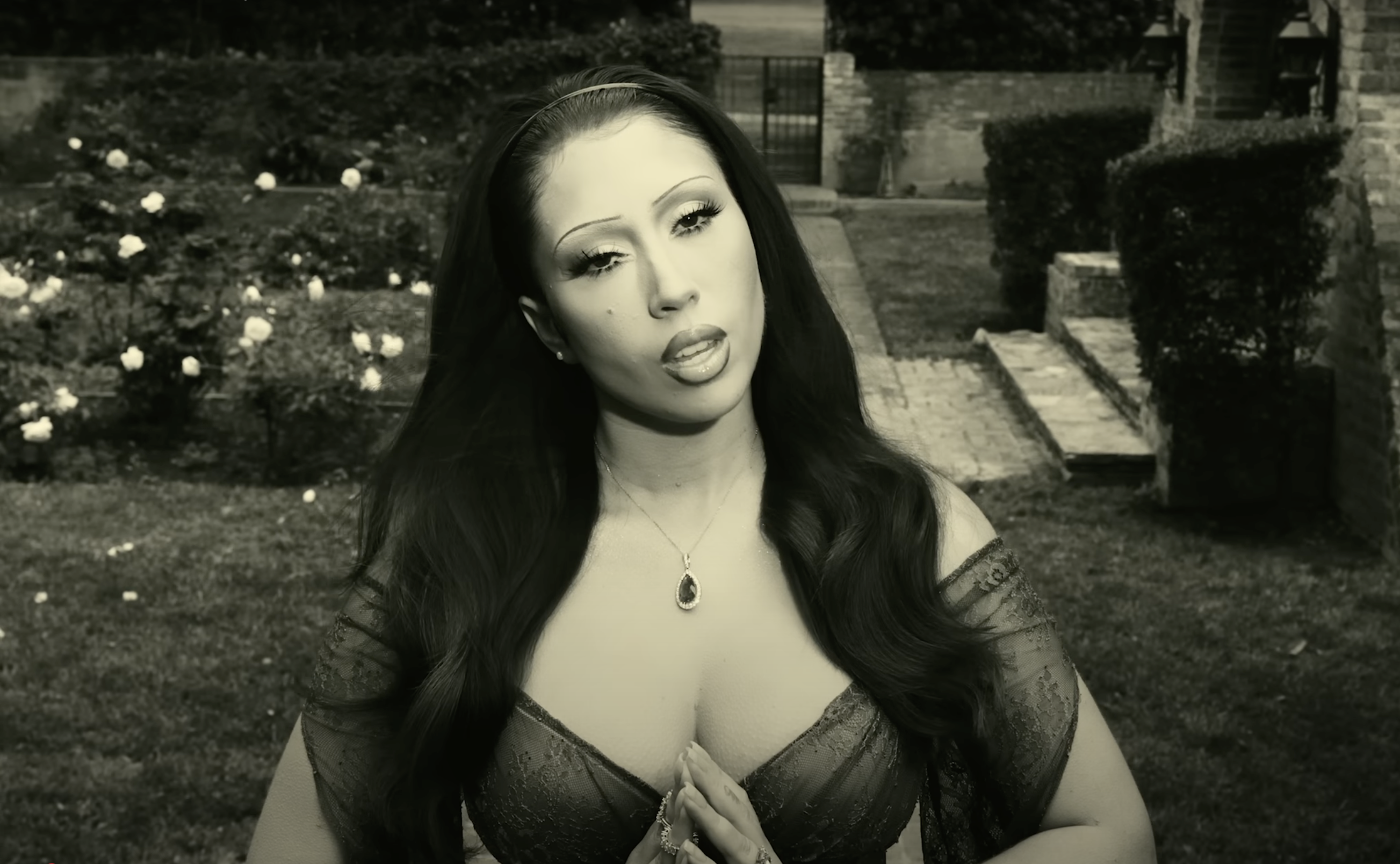
To commemorate Sincerely, Release Day, Kali Uchis offered another single and video from the album, “All I Can Say” (which does, indeed, bear certain similarities to Mary J. Blige and Lauryn Hill’s 1999 track, “All That I Can Say”). And all that Uchis can seem to say, in essence, is that there’s beauty in everything—even the saddest and/or most bittersweet of moments. Which is in keeping with the idea that Sincerely, is an album that’s entirely about “not avoiding pain” in order to experience the full breadth of what love means. And to be able to love (or at least not despise) even those who are hateful toward you.
To capture that “zen” sort of spirit, “All I Can Say” has a naturally dreamy tone (complemented by the video being shot in soft black and white—a black and white that almost has a sepia tone), imbued with elements of doo-wop and an overall sound that channels 1960s girl groups like The Shangri-Las. To mirror that sonic landscape, Uchis embodies a “retro aesthetic” (à la Morticia Addams-meets-L.A. chola) as she walks down a fog-saturated street in a pastoral-looking area. This opening scene is one of the only instances where her walking appears to be “regular.”
As the video goes on, however, the camera makes it seem as though Uchis is actually floating through life. An image that ties in seamlessly to the theme of the song, which is that a dreamer must dream—or else risk having their soul crushed and their heart broken. Which is why Uchis insists, “All I can say/Is that you belong with me/And a dreamer should dream/How else would dreams turn reality?”
Uchis floats through a gate that closes behind her, entering another outdoor space with myriad couples dancing contentedly in the background—the women dressed in white dresses and the men in suits, connoting a very matrimonial vibe. The feelings of love being “all around” are, in this way, effortlessly conveyed. The infusion of various “do-do-do-do, do-do” and “la-la-la-la” layerings also heighten the “old” (read: classic) feel of the song, channeling the type of sound that Amy Winehouse—a key influence on Uchis during the making of this record—was also aiming for on Back to Black. And yes, Winehouse, too, was an artist and a dreamer that allowed herself to feel all the feelings when it came to love—even the heartbreak-related ones.
This is surely why she could relate to the chorus, “No, I’m not sorry for the way that I am/I’m not sorry [said in a very Shangri-Las/Skeeter Davis lilt] for the way that I love or the heart that I have/No, I’m not sorry for the dreams that I dream/Or the life that I live ‘cause it all belongs to me.” However messy or imperfect it is.
During another part of her “walking on air” journey, Uchis picks a flower and rubs it serenely against her face as she continues, “And my peace of mind/No, it will not be destroyed/By lost souls on the decline/Who only strive to divide.” Picking a single petal from the flower in a gesture that briefly makes the viewer think she might be playing a round of “he loves me, he loves me not,” she then tosses the entire flor aside, too.
Soon after, a cowboy on a white horse materializes in the background (adding another flourish of “fantasy” and/or the fantastical to the visual tone of the video) before we see Uchis walking on solid ground for only the second time in the next scene. One in which the steam/fog follows her again (as it did in the beginning) as she passes by a backyard pool (something about it recalling the illustrious one from Sunset Boulevard). A couch—or rather, “day bed”—conveniently situated near the pool gives Uchis the chance to pause and sit down a.k.a. lounge around. And, though one might have briefly thought she had been brought back down to Earth, the fancy seating option proceeds to ascend toward the sky with Uchis on it.
Hovering above the pool, Uchis persists in reminding anyone who would try to make her live without her “head in the clouds” (an expression often derisively thrown at artists) that she’s not sorry in the least for being a dreamer. In fact, she seems well-aware that dreamers are becoming increasingly endangered, which is why it’s more important than ever to preserve them. To nurture their nonlinear, “nonsensical” (to society at large) approach to existence. And that’s just what Uchis is doing for the other dreamers out there with this particular song and video.


[…] Kali Uchis Goes On an Ethereal Jaunt in “All I Can Say” Video […]