


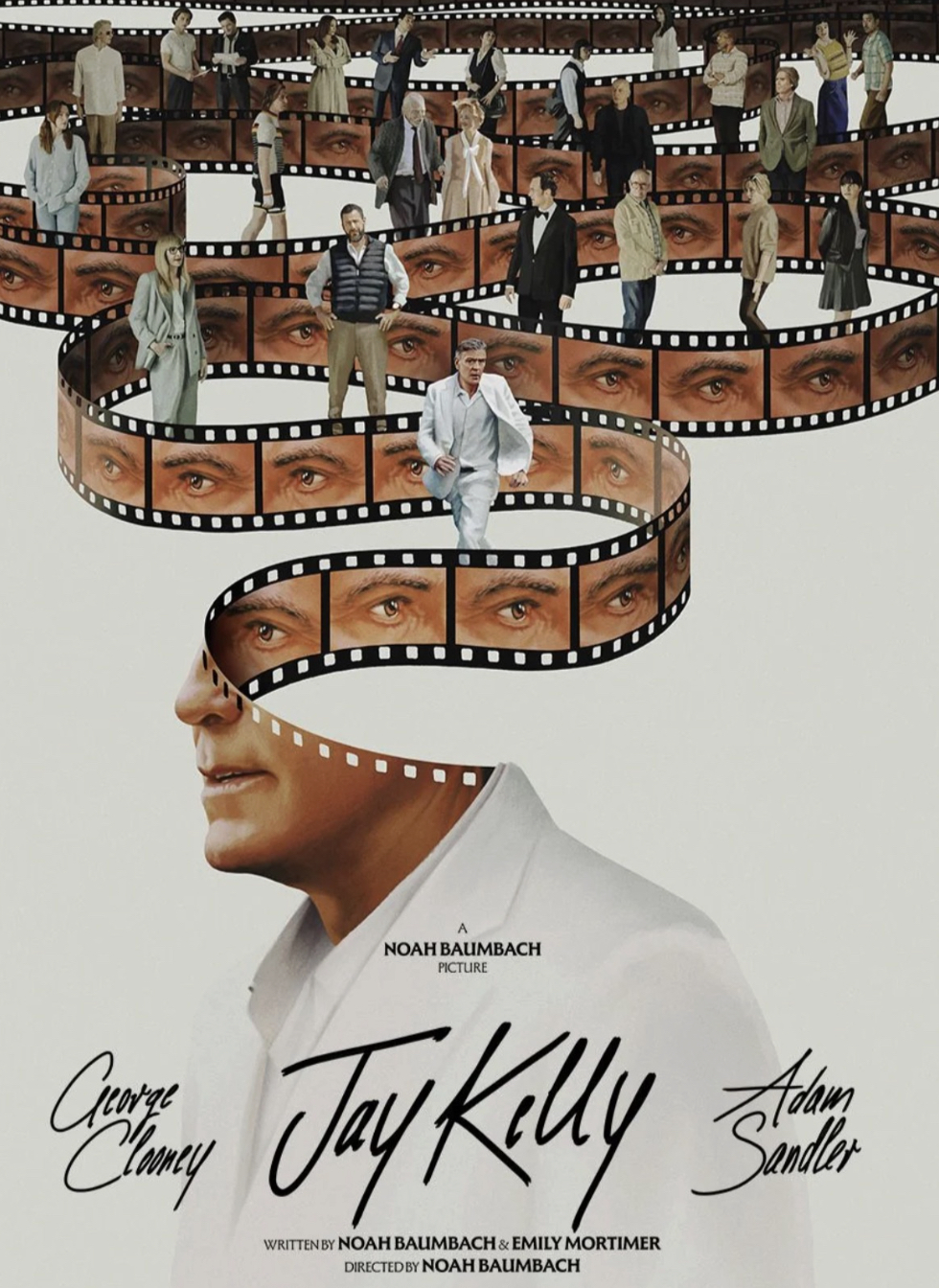
While the genericness of the title might fool one into believing that Noah Baumbach’s latest film (co-written, unexpectedly, with Emily Mortimer), Jay Kelly (not to be confused with Ned Kelly), is nothing special, in truth, it is one of his best offerings to date, particularly when framed against what now composes his “Netflix quartet,” also consisting of The Meyerowitz Stories (New and Selected), Marriage Story and White Noise. Indeed, perhaps before everyone else saw the writing on the wall that Netflix would somehow manage to take over the entire film industry, it was announced in 2021 that “under the partnership, Baumbach will exclusively write and direct films for Netflix for the next several years.”
And here we are, several years later, with Baumbach showing no signs of slowing down that partnership (save for a Barbie blip in between—and yes, Baumbach’s wife/Barbie co-writer, Greta Gerwig, also has a part in Jay Kelly, though not anything as major as her part in White Noise). Perhaps because, unlike other “auteurs,” Baumbach has been able to make his usual brand of film without sacrificing too much to the corporate overlord/overall “Netflix-ification” of film aesthetics. Granted, there are those that might argue Jay Kelly is Baumbach’s most saccharine film to date. These people are likely heartless automatons. Maybe of the sort that Jay Kelly (George Clooney) himself is presented as—which is to say, a hollow man.
After all, that’s what it is to be an actor, no? At least, that’s the notion that gets bandied about repeatedly throughout the film. For while Oscar Wilde might have assured, “Be yourself; everyone else is already taken,” it’s an entirely different aphorism that kicks off Jay Kelly. Specifically, Sylvia Plath’s quote, “It’s a hell of a responsibility to be yourself. It’s much easier to be somebody else or nobody at all.” So it is that Baumbach and Mortimer establish the nature of what it means to be an actor and, worse still, a “movie star.” Forced to play, as one of Jay’s first acting teachers tells him, not just the role they’re currently inhabiting for a movie, but also the role of themselves whenever they go out to promote it.
Fittingly, Baumbach commences Jay Kelly at a moment when a movie Jay is starring in is about to wrap. Set amidst the hullaballoo of shooting the final scene, the intent is to accent, from the outset, just how much of Jay’s life has been about playing pretend. Against the backdrop of it all, the dialogue of various crew members can be heard, including someone saying, “…it’ll be the last movie for all of us. They’ll turn out the lights and that’ll be that.” A somewhat eerie and prescient soundbite considering what’s happening with AI and the potential Netflix takeover of Warner Bros.
Then, of course, there’s Jay’s various “handlers” in the midst, like his hairstylist, Candy (Mortimer), and his manager, Ron Sukenick (Adam Sandler, who Baumbach trusts endlessly with dramatic roles—perhaps even more than Paul Thomas Anderson did). And yes, as much as the viewer is given a glimpse into Jay’s life, they’re also given one into Ron’s while he tries to juggle his work responsibilities with being an emotionally available father, speaking to his daughter, Vivienne (played by Sandler’s real-life daughter, Sadie), about an upcoming tennis match she’s stressing over. Jay, meanwhile, is requesting to do yet another take for the movie, called Eight Men From Now (directed by “Nick Dietz”), which requires him to perform an onscreen death with a dog at his side. The dog comes into the shot too soon, however, prompting Jay to say a line that will sting far more when he says it again at the end of film: “Can we go again?” His eagerness to do another take isn’t as much about perfectionism as it is about wanting to delay the picture from wrapping, as if, by making it last just a little bit longer, he won’t have to return to what is ultimately his empty life so soon. Thus, he asks the director, “Can we go again? I’d like another one. I think I could do it better. Different. I don’t know.” Of course, this sentiment, the viewer will soon learn, will apply to his life in general, which he increasingly seems to be watching like some disembodied figure from afar, almost like an audience member in a movie theater seeing it all unfold like a car crash up on the screen.
For Jay, that car crash is, more than anything, his parenting skills. Or rather, lack thereof. This is also, in part, why he’s been dreading the wrap of Eight Men From Now—because it means having to face the reality of what’s going on with Daisy (Grace Edwards), the only daughter of his who’s still living at home. Though, not for long—after the summer, she’s meant to be going off to college. But Jay still assumes she’ll be around L.A. while he films another movie during these three months before fall. Daisy corrects his assumption, reminding him that she already told him she was going to Europe with some friends of hers, and it’s happening this Saturday. Between realizing that he blinked and missed his daughter’s adolescence and, now, that the director who gave his first acting break, Peter Schneider (Jim Broadbent), has died, Jay is sent into an emotional tailspin. As though, suddenly, he understands that there is life to be lived outside the frames of a movie, but that it’s too late for him to do so. Worse still, Jay starts to see scenes from his own life flash before his eyes, with the first being his last encounter with Schneider, who all but begged Jay to lend his name in some way to a movie that he wanted to make so that he could get back in the game. Yet even though Jay wouldn’t be the star he is today without Schneider casting him as the lead in a movie called Cranberry Street, he flatly declines his early mentor’s plea.
The sense of foreboding that keeps closing in around Jay begins to intensify when, out of the blue, he sees a former friend/erstwhile acting aspirant (the two took the same class together) outside Schneider’s funeral: Timothy Galligan (Billy Crudup). Inviting him out to have a drink sometime, Jay, in a rare mood, says he’s free now. So it is that he meets Timothy at, of all places, Chez Jay in Santa Monica. It’s there that Timothy starts to say things to Jay that gradually set him off balance. For example, the notion that, as one gets closer to death, “power and success become completely unreal because they’re no longer relevant. But, like Peter said, all that’s left…is love.” Although Jay can’t fully see it yet, his life is filled only with power and success, but not really love. In fact, the only person in Jay’s entire world who really loves him is Ron. But he takes that love for granted, assumes that Ron knows what Liz (Laura Dern), Jay’s publicist, has to tell him: “We’re not to him what he is to us.” And that, while Ron can tell himself that he and Jay are “family” all he wants, when push comes to shove, everyone is replaceable in a “star’s” world. For what is the “star” but a void that needs to be constantly served only who and what will make them the biggest and shiniest of all? Hence, Timothy’s question outside of Chez Jay, after freely admitting that he actually can’t stand him: “Is there a person in there? Maybe you…don’t actually exist.” It’s a speculation that applies not only to the nature of the actor who can only reflect other characters yet never seems to reflect any of their own, but also to the idea that, once an actor transcends into a “celebrity,” they’re nothing but a husk just waiting to be filled by whatever others—corporations, managers, agents, etc.—want to stuff them with.
To be sure, Jay has been playing a “hero” in his movies for so long that he doesn’t know any other way to see himself, any other way to “be.” This is part of why his daughters’ view of him, paired with Timothy’s takedown, has sent him on a spiral. And also part of why he sees fit to chase a purse thief off a train that’s heading from France to Italy, running through a field and eventually cornering him in a small, dilapidated-looking cemetery (another symbol/reminder of death that is ongoing throughout the film). As a number of people from the train catch up to the melee, they applaud Jay for his valor as the thief, a cyclist (and dressed accordingly), says, “Stop looking at me and talking about me all the time.” As if he were the famous person in this scenario. Jay takes note and observes him almost as though he can recognize himself in this person. Especially when another cyclist that’s traveling with the “thief” explains that the man just needs his medication, and that “this is not who he is.” Jay appears to want the rest of the world to know the same, especially his oldest daughter, Jessica, who is far less forgiving of his physical and emotional absence than Daisy. That Riley Keough is the person playing this part is also a stroke of casting genius in that who, apart from Lisa Marie (RIP), could better get to the core of a larger-than-life-to-others father essentially abandoning his family for fame than the granddaughter of Elvis?
One particularly gut-punching scene between Jess and Jay takes place over the phone while he’s walking through the woods. Only Baumbach shoots the scene in such a way so that it looks like Jess is walking right there next to him as he pleads with her to come to the tribute being paid to him at the Tuscan Arts Festival. Jess makes it clear that she not only does she not want to go, but that she doesn’t forgive her father for his abandonment, which is why his attempts to make amends now are useless, with Jess pronouncing, “I’m gonna have a good life, just not with you.” When the call is over, Jay is left standing alone again in the woods.
So it is that, when all is said and done, his manager, the one he’s treated so dismissively the past few days while having something akin to a nervous breakdown, is the only one still left in town—even though he, too, is about to leave. To give Jay what he thought he wanted—to not have to make movies anymore—before he realized the only thing he actually has is his career. So it is that Jay attends the tribute with the only person who has always loved him (whoever he “really” is), with or without the fifteen percent.
But, to Jay, it’s an ostensible reminder that the one person who has stuck around, remained unwavering is also the most well-paid to do so. The bittersweetness of this is heightened by the full-circle moment of the ending, which makes the viewer recall the beginning of: seeing Jay film an onscreen death. And then, watching him die a metaphorical death upon coming to the realization that his life—his real (a.k.a. personal) life—has been squandered. Thus, the uncanniness of the lines he speaks during that scene he films with the dog: “In a way, I already died. I’m lucky. My time passed while I was still alive. I got to see it end before it ended. That’s a crazy thing, when you die… Everything you thought you were…isn’t true.” This, of course, is a revelation that need not only apply to an actor. Nor the bleak trope of blinking and missing your child’s entire eighteen years spent under your roof and wondering if choosing to focus more on your career was worth it. In this sense, Jay Kelly is as universal (no movie studio nod intended) as it is specific.


[…] Genna Rivieccio Source link […]
[…] Edgar Wright’s The Running Man (another remake), Osgood Perkins’ Keeper and Noah Baumbach’s Jay Kelly (though it wasn’t released in theaters). And as the month drew to an end, studios pulled out a […]