


The last time Hilary Duff released an album, it was just days before anyone knew that Donald Trump would make his intentions to run for U.S. president known (Breathe In. Breathe Out. was released on June 12, 2015, four days before the Orange Creature’s announcement). In this regard, and many others, her eleven-year absence from the music industry feels like a lifetime ago. As if to emphasize that, Breathe In. Breathe Out. has all the hallmarks of a “2010s album,” what with its EDM-infusions on tracks like “Sparks,” “Confetti,” “Arms Around a Memory” and “Outlaw.” All while maintaining the “bubblegum pop” sound that the nature of her voice can’t avoid.
With Luck… Or Something (since she loves some punctuation in her record titles), Duff’s sixth album (suck on that, Lindsay Lohan), she toes the same line between that semblance of being “of the current” time and being decidedly of the 2000s. This is made apparent from the first track, “Weather for Tennis”—surely ripe for a mashup with Lily Allen’s “Tennis.” Because, naturally, both songs wield “tennis” as the longstanding euphemism it’s meant to represent: having sex. Not only that, but as a metaphor for back-and-forth bandying. Whether of psychological games or insults. As for Duff, she starts to realize that if she and her significant other aren’t “playing tennis,” then they’re left far more vulnerable to “argu[ing] until dinner time.”
Going back to Allen, who coincidentally talks about tennis on her latest album after taking a similarly long break from music, it bears noting that both are women associated with millennial youth. Indeed, every article detailing Duff’s comeback paints her as a “millennial icon” and consistently brings up that it’s the generation she’s from (with Allen managing to sidestep such a classification perhaps because she wasn’t a teen idol to millennials coming of age in the early 00s). The description of Luck… Or Something on Apple Music even goes so far as to pronounce, “Duff’s voice is madeleine-like [how odd, another Allen correlation] to the millennial, triggering Proustian memories of butterfly clips and Laguna Beach reruns.” But now, she’s trying to trigger something else in women her own age, noting that part of the reason she wanted to return to music—a far more personal medium to her than film or TV—is to share what her life has been like during this past decade, and have some of it resonate with the fans who grew up with her and are now experiencing the same things (even though many a millennial hardly has their shit together enough to lay claim to owning a home or having children). The same, let’s say, newfound growing pains. One of them being the unwanted epiphany that your sig other has become more like your roommate, as things become more sexless over time. This addressed on “Roommates,” the Taylor Swift-sounding (specifically, “Anti-Hero”) second single from the album that maintains a similarly jaunty musical tone to “Weather for Tennis,” despite the lyrics being rather lamenting.
To be sure, there are many lyrics on this album that, despite the “happy timbre,” convey a sense of regret and despair. This goes even for the third track, “We Don’t Talk,” which, arguably, unpacks the most sensitive subject on the album: Duff’s estrangement from her older sister, Haylie. While the rumors of their feud have long been brewing—especially since the pair haven’t been pictured together since 2019, at Hilary’s wedding—the release of this song cements it. Along with Duff telling Glamour for her cover story promoting the album, “Just because you’re born into a family doesn’t mean that it always stays together. You can only control your side and your street…” Though the subtext of that statement seems to be Taylor Swift-inspired as well, with the latter declaring on “Karma,” “I keep my side of the street clean/You wouldn’t know what I mean.”
Haylie, indeed, appears to have no intention of making amends with her sister, regardless of the earnest pleas contained within “We Don’t Talk,” including, “‘Cause we come from the same home, the same blood/A different combination but the same lock” and “People ask me if I’ve seen you/And honestly I hate it/‘Cause the truth is that I need to.” Here, too, the Lily Allen connection flares up again in that Allen also wrote an apology-type song to her older sister, Sarah, called “Back to the Start” on 2009’s It’s Not Me, It’s You. Granted, hers was met with more success in prompting an emotional mending. Where the Haylie/Hilary rift is concerned, it looks as if Haylie is more of a Jamie Lynn Spears type, preferring to undermine/talk shit about her more successful sister (if her recent cozying up to Ashley Tisdale is any indication) than bother with trying to repair what’s been broken.
Hilary, on some level, seems to know it’s hopeless, being bold enough to also say, “Emotional eviction/No more sentimental overlap/And if it’s ‘cause you’re jealous/God knows I would sell it all/Then break you off the bigger half.” This blatant allusion to Haylie being bitter about her younger sister’s fame and financial success being far more brutally honest than anything Charlie Puth and Selena Gomez said on “We Don’t Talk Anymore” (the obvious song that comes to mind when hearing this one…and seeing its more “abridged” title). And perhaps Duff’s producer/husband, Matthew Koma, sensed his wife’s combination of yearning to rekindle the relationship while also knowing the probability is slim. So maybe that’s why, on the musical production front, there’s a hint of a sound in the song that feels like a slight nod to Gotye’s “Somebody That I Used to Know.” Clearly, an anthem for lament that’s been back on everyone’s radar ever since Doechii’s “Anxiety” went viral.
And, speaking of anxiety,” that’s what “Future Tripping” is all about. As the most sonically “fun” song on the album, this is what makes it only more ironic that the lyrics are all about being in the throes of a panic attack. One that, as in real life, comes on out of nowhere as Duff opens the track with the verse, “Kiss me on the lips/With your eyes open-ish/And that’s enough to send me off/On a future trip.” Except that, what a “future trip” means here has nothing to do with flashing forward to fairy-tale visions of marriage and kids, but instead tripping on all the things that could go wrong in that future. Thus, Duff’s barrage of internal questions, “Are we having enough sex?/Are there exes you miss?/And do I nail you to a cross/On some bogus shit?” Duff then succinctly sums up precisely what an anxiety attack feels like when she says, “I’m not dying/But I’m dying.”
The upbeat rhythm not only betrays how stressful and scary these types of attacks are, but also channels a decidedly Jack Antonoff sound, picking up when Duff chirps, “I’m worried about/Shit that hasn’t happened yet/Entertaining every doubt/Oh, here I go again/Future tripping out.” Among the things Duff expresses concern over is the idea that her husband might one day decide to “skip the headache” that is her emotional roller coaster and instead “settle somewhere out of state/With a younger heart” (though the concern isn’t a younger girl’s heart, so much as her vag). Continuing to paint a picture of this midlife crisis she’s anticipating from him, Duff sings, “Will your crisis be a car/Or some bitch at a bar/Who’s singin’ she loves Bon Iver?/Calls him Bon Ivar.” Something about that shade toward younger women echoing Swift’s own on “The Black Dog” when she says, “And I hope it’s shitty/In The Black Dog/When someone plays The Starting Line and you jump up/But she’s too young to know this song.”
But it’s likely that, if nothing else, Duff and Koma will remain forever bound by their shared musical taste. And, considering their unabashed love for Third Eye Blind, it’s not surprising that they have love for Blink-182 as well. Hence, the blatant sample of their 1997 single, “Dammit,” which many listeners probably already thought should be called “Growing Up” instead of that. Well, now Duff is here to “correct” that title with her own take on one of the band’s earliest hits (though not to the extent of the singles released on 1999’s Enema of the State). From the outset, the sample is made clear through the use of the same signature chord progression, but Duff builds up to the chorus by first describing, “Alana [likely a nod to Alanna Masterson] came over and we talked shit for hours/About everything and everyone we know/Just drinking orange wine/Hysterical laughing until we cry/‘Cause anything, yeah, anything goes.” That is, when you have a viable friend to turn to, whether in times of joy or sorrow.
So it is that after this verse, Duff leads right into her own take on Tom DeLonge and Mark Hoppus’ vocals with, “And it’ll happen once again/I’ll turn to you, friend/‘Cause I know you’ll understand/You will until the end/And when everybody’s gone/They got busy and moved on/We’ll face it on our own/And guess this is growing up.” It’s certainly a sweeter take (both in vocal delivery and lyrical rewriting) than what the Blink boys originally proposed: “And it’s happened once again/I’ll turn to a friend/Someone that understands/Sees through the master plan/But everybody’s gone/And I’ve been here for too long/To face this on my own/Well, I guess this is growing up.” Indeed, the tweaks Duff and her co-writers, Koma and Brian Phillips (also the only other producer on the album besides Koma), make to that chorus transform it into something markedly softer, and maybe even more bittersweet.
Elsewhere in the song, Duff once again refers to her familial rift with the lines, “How do you stay on your family’s side/When no one shows and nobody cares?” Then later, she’ll mention the boon of being able to turn to a “chosen family” instead. This via the lyrics that cover decades of devoted friendship: “Handshakes and tattoos/Heartbreaks and bad news/First kids and hard truths/Family you can choose.” To be sure, Duff’s enduring heartbreak over the state of her family relations are peppered rather consistently throughout the album, continuing on “The Optimist,” which stands out for being the longest song on Luck… Or Something at four minutes and twelve seconds (whereas most of the other tracks average around three minutes—after all, as it keeps being mentioned, Duff is a millennial, which means she has a stronger attention span and does not subscribe to the two-minute or less track “philosophy” that has plagued Gen Z thanks to TikTok).
Wasting no time in getting to the emotional core of “The Optimist,” Duff is telling her listener about forty-three seconds in, “I wish I could sleep on planes/And that my father would really love me/He’d show up on my wedding day/And tell my family they’re all so lucky/He’d tell me how he wished he stayed/And that he never meant to disappoint me.” The mention of her father’s absence from a major milestone like her wedding also goes back to his absence during her childhood, choosing to stay behind in Houston to run his convenience stores while the Duff sisters and their mother moved to Los Angeles to pursue both girls’ respective dream of being in the entertainment industry. And even though Robert admitted to being unfaithful during the marriage, he didn’t end up divorcing from Susan until 2008. The sentiments expressed in “The Optimist” also go back to one of the more cutting lines in “Weather for Tennis”: “Keep the peace/‘Cause I’m a kid of divorce.”
As the most deeply personal song on the album, it makes sense that it’s the slowest jam on offer, wielding minimal guitar strings that make lyrics like, “My door is open just in case/You don’t even have to say you’re sorry/I already forgive you for all of it/But it’s hard to exist as the optimist” stand out more prominently so that they can hit like even more of a gut punch. As a matter of fact, one would be remiss if another song about a fraught father-daughter relationship from a certain teen idol wasn’t mentioned: Lindsay Lohan’s “Confessions of a Broken Heart (Daughter to Father).” For while Lohan and Duff might have been portrayed as rivals in the tabloids during the early 00s, it’s obvious they share some common ground with regard to their emotionally negligent patriarchs. As for Lohan, who was nineteen in 2005, when she released this single, she was perhaps ahead of her time in telling off her father with such lyrics as, “I dream of another you, the one who would never/Never leave me alone to pick up the pieces/Daddy to hold me, that’s what I needed/So, why’d you have to go…/Daughter to father, daughter to father/I don’t know you, but I still want to.” Later, she’ll also question her dad’s love by asking, “Tell me the truth, did you ever love me?”
That a coterie of millennial stars who found their fame at a young age—Britney Spears included—seem to be questioning whether they ever had genuine love from their father doesn’t feel like a coincidence, with all three—Duff, Lohan and Spears—being spurred to pursue their passions a little too much. Undoubtedly for the sake of some financial gain on the parents’ part (which is definitely confirmed in Spears’ nightmarish scenario).
From lamenting the situation with her father, Duff pivots back to lamenting how, when it comes to romantic relationships, it’s so often the case that, sooner or later, passion gives way to apathy. So it is that “You, From the Honeymoon” shares plenty of thematic similarities with “Roommates.” It also, again, channels Lohan’s song motifs from the 00s. Namely, “Black Hole,” which, like “Confessions of a Broken Heart (Daughter to Father),” is also from A Little More Personal (Raw). And it’s during this song that Lohan bemoans, “You’re not who you used to be/And I wonder where you’ve gone/Have you fallen in a black hole?/Somewhere there’s a universe of missing stuff/What happened to the good times?/What happened to the moments where we had so much?”
Throughout “You, From the Honeymoon,” Duff is similarly left wondering where the “good-time guy” from the beginning of their relationship went. Back when “your kinda freak matched my kinda freak” (further evidence that Duff has entered the 2020s by referencing Tinashe’s 2024 hit). And while Duff can appreciate the deepening of connection that arises from being with someone for so long, she also yearns for the “salad days” of their romance, when the ardency was at a peak. So it is that she summarizes the bittersweetness of her relationship’s evolution with, “In some ways we’re closer that we’ve been ever/In some ways, I miss us then.”
Wanting to, in some way, “recapture” the early days, Duff later suggests, “Let’s drink too much, put on Japanese House.” A musical reference that seems almost as weirdly specific as Swift saying, “We declared Charlie Puth should be a bigger artist” on “The Tortured Poets Department.” And another lyrical parallel to Swift in this song is that Duff appears to be telling a story about “someone else” à la Folklore and Evermore. For surely Koma wouldn’t be all right with her describing the following if it were actually true of him: “…I’m flying with you/In a black limo, back to the you from the honeymoon/Where you’re emotionally gentle/Without the sleeping pills or the benzos.” Along with the allusion to domestic abuse that has her drawing a contrast between the past and the present with, “Slipping out a dress like on our wedding day/Before you knew, a hand slap across the face.” But, then again, Duff could be talking about herself and a past relationship (like the one with her first husband, Mike Comrie).
On the following track, “Holiday Party,” the motif shift toward Duff’s ostensible paranoia about losing her significant other (whether because of things simply growing stale due to the passage of time or because she’s afraid he’ll find what Selena Gomez would call “someone younger and hotter than me”) persists with a vengeance. And, of course, it would be foolish not to bring up Love Actually (released the same year as Duff’s debut album, Metamorphosis) when talking about this particular track, which seems so clearly to be borrowing from the common trope that served as a major source of drama in the presently polarizing Richard Curtis film. Framed in this way, Duff puts herself in the Emma Thompson a.k.a. Karen role (for this was back before “Karen” meant something so stigmatizing). Therefore worrying about her Alan Rickman a.k.a. Harry husband falling prey to some minx like Mia’s (Heike Makatsch) charms at the holiday party, where liquor and “good cheer” have a tendency to loosen inhibitions…and restraint.
Duff wastes no time in addressing her fears that her husband might be inclined to cheat on her, opening “Holiday Party” by announcing, “In my head you live another life/Where you fuck all your friends/And wish someone else could’ve been your wife.” Talk about being candid (something she surely couldn’t have learned from the far more “interior” Lizzie McGuire). Letting her thoughts run wild about all the things that could happen between her husband and another woman (presumably a co-worker), “In my imagination/She’s there with her eyes so starry/Holding your car keys/In my imagination/I’m another victim of the holiday party.” Again, just like Karen in Love Actually, forced to watch Mia latch onto her husband for a dance from afar.
In Duff’s storyline, she’s at least only envisioning what’s happening, rather than having to be there to witness it, singing, “I imagine you in a corner booth getting way too cozy/In my head you got touchy at the holiday party/In the charcoal suit that I bought for you.” And it really must be a “story about someone else” song, since Koma is hardly the type of person who would be at a holiday party, which is usually limited to being put on for those with the misfortune of working in an office. What’s more, it’s difficult to buy into a line like, “When I look at that body/I’m not trusting nobody” being about Koma, whose physique is, shall we say, “standard-issue indie boy.” Even so, from Duff’s perspective, any woman would find him irresistible (much like Beyoncé inexplicably feels that way about Jay-Z and Lana Del Rey about Jeremy Dufrene).
Just as someone, many years ago, found Duff irresistible largely because of her age. This being yet another personal subject matter that Duff explores on the lead single from Luck… Or Something, “Mature.” While the mostly unanimous speculation is that the track refers to her relationship with Good Charlotte’s Joel Madden, who had just turned twenty-five when he started dating sixteen-year-old Duff in 2004, Duff recently told Anthony Mason of CBS Sunday Mornings that it’s “too much fun” to let people on the internet keep guessing who it might be about. Whoever she might really be talking about (though, to be sure, Madden appears the most obvious/logical subject), Duff has patently moved on with Koma.
Even so, that doesn’t mean her fears of losing what appears to be the healthiest relationship she’s ever had aren’t constant. Luck… Or Something has made that much apparent, with “Tell Me That Won’t Happen,” the penultimate song of the record, also addressing not only a fear of losing Koma, but, once again, a fear of losing him to the phenomenon of “complacent coupledom,” the same thing she can’t stand in “Roommates.” Echoes of the themes on “Future Tripping” and “Holiday Party” also materialize in the form of such questions as, “Are we eighty years proof?/Are we really immune?/Will I want something new?/Will you want something new?” (that’s right, she rhymed “new” with “new,” like 50 Cent with “nympho” and “nympho”). Whether or not they are (“immune,” that is), Duff still insists, “Promise me some things can stay just the same/And promise you’ll lie if they ever change.” Ah yes, that’s where she lets her true millennial colors shine through—because, for this generation, hiding from reality is so much more pleasant than facing it (as many a millennial was forced to as a result of Quiet on Set: The Dark Side of Children’s TV).
As for having “lived so many lives” at this juncture, Duff additionally makes it known that, “I’m worried that I’ve felt everything I’ll ever feel.” You know, “butterflies”-wise. Hence, commanding of her significant other, “Give me some first times like we still got ‘em.” And yes, perhaps it’s thanks to an inherent sense of Peter Pan Syndrome in the average millennial that there will always be some “first time”-type feelings.
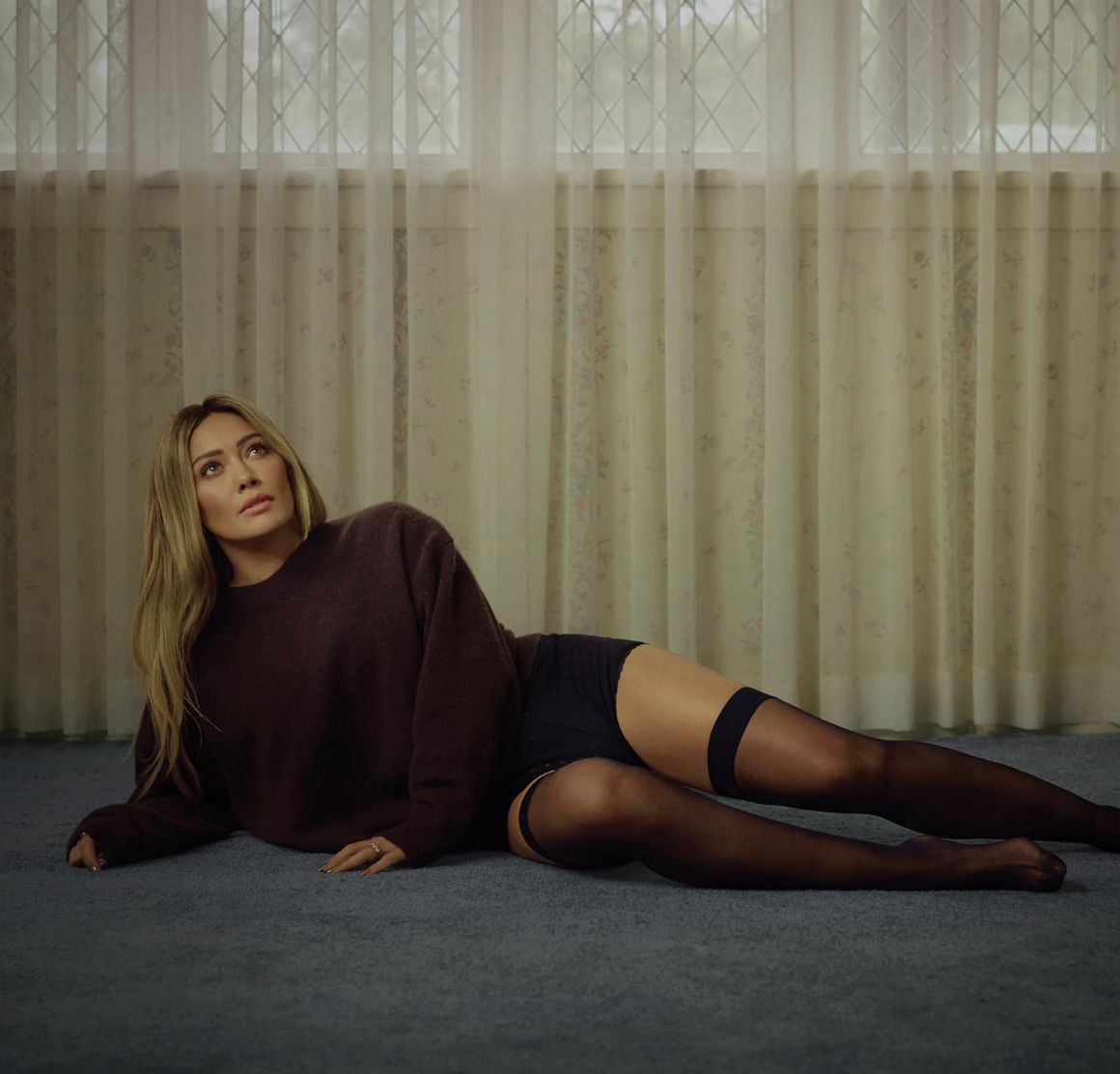
It’s also thanks to that Peter Pan Syndrome that a millennial can often think to herself, “The twenty-year-old me [is] still in here.” A line that comes from the last offering of the album, “Adult Size Medium” (a contender for one of the strongest tracks). A song with lyrics that bring one back to the cover for Luck…Or Something , which perhaps best visually encapsulates what Duff is saying throughout her grand finale. Which is that she’s still “just a baby” on the inside. Accordingly, on this album cover, Duff appears in sheer black thigh-high tights with black bands at the top, black shorts and an oversized brown sweater. It’s the latter garment in the ensemble that lends the overall look of being “caught in between.” As in, caught in between being staid and sexy a.k.a. “childlike” and “womanly.” In other words, it’s a cover that feels almost like a photographic response to Britney Spears’ “I’m Not A Girl, Not Yet A Woman.”
In Duff’s case, being “not a girl, not yet a woman” is mainly because some part of her “girl self” will forever be frozen in time in her mind’s eye thanks to being immortalized as a “teen idol.” That phrase that keeps coming up in all the press surrounding this record’s release. Along with, as mentioned, “millennial icon.”
And unlike other such “icons,” Duff doesn’t seem afraid to embrace it, ergo acknowledging her age in doing so. Instead, she relishes the chance to reconnect with the fans who grew up with her, commenting to Glamour, “I just felt really ready to share. One, I wanted to stretch creatively, and two, I wanted to make something that I could connect with people again on the level of who I am now. I felt like people have definitely gone through some of the similar large strokes that I have in the past ten to fifteen years.” Even for those who haven’t—and even for the “non-millennial”—Luck… Or Something taps into the kinds of earnest human emotions and insecurities that should resonate across generational divides. Either that, or no one else except millennials are prepared for Duff’s sincerity on this album.


