


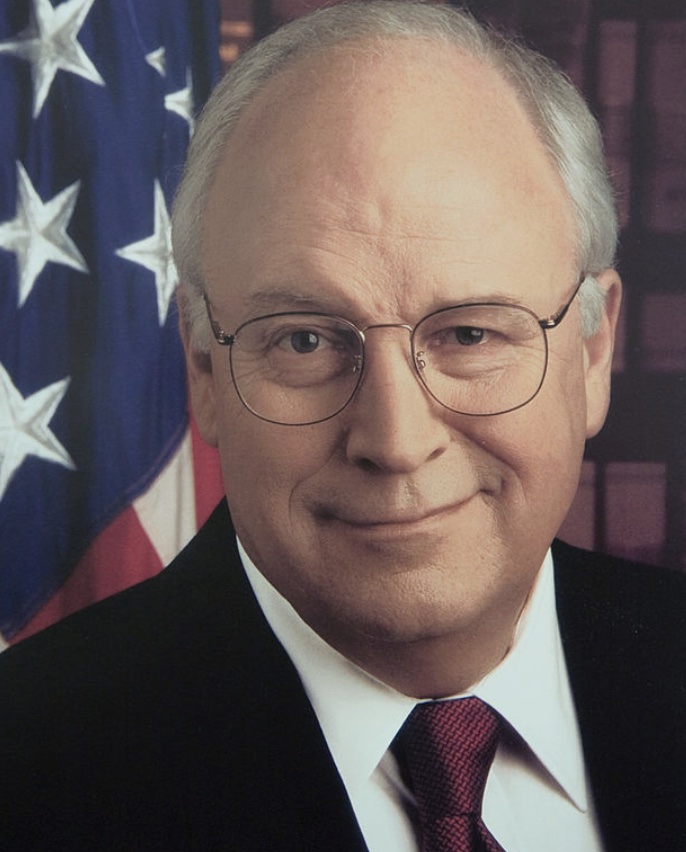
In a series called Mondo Appropriato, Culled Culture examines how “on the nose” something is in the pop cultural and/or political landscape.
Sometimes, in life, the poetic, full-circle moment of an event just can’t be ignored. One such moment, it must be said, is the death of Dick Cheney on November 3rd, with the announcement made the following day, which also “just so happened” to mark the New York City mayoral election. An election with the kind of candidate at its forefront that never would have been “permitted” in the era of 9/11, when Cheney reigned supreme. Far more supreme, in fact, than the erstwhile president himself, George W. Bush.
To be sure, one of the ongoing jokes (apart from Cheney being a kind of vampire-robot who would likely never die) amongst the public was that Cheney was the true “brains” behind the operation (naturally, this wasn’t saying much when surveying the rest of the cronies in the administration, as well as “GW” himself). The one running the show…and often to secure his own Halliburton-related interests. For, although he might have “stepped down” from his role as the chairman and CEO in order to “ethically” fulfill the criteria to become the U.S. vice president, Cheney blatantly kept his hand in that pie while in office, and profited immensely when the second Iraq War (in addition to the war in Afghanistan) began just as the 2000s did.
In fact, Cheney was very much a part of shaping how the rest of the century would unfold as he puppeteered the political machine to his advantage. The irony being that, while he opposed the creature that is Donald Trump, Cheney is said to have undeniably “lit the path” for someone like him to gain control and use his unchecked power for evil. This done during the height of the so-called War on Terror (though it was really, at its core, mostly about consolidating government power and fulfilling Bush Jr.’s wet dream of “defending Daddy’s honor”). For it was Cheney who bypassed all the conventional “rules” in the name of “protecting America.” He who, as Julian Borger of The Guardian put it, “undermin[ed] the independence of the intelligence agencies and U.S. adherence to international law,” ergo setting a new and dangerous precedent that even Richard Nixon hadn’t. Indeed, until the Orange One took office at the beginning of 2017, the Bush administration was a difficult benchmark to top in terms of corruption and incompetence. Now, compared to Trump and co., that administration comes across as positively angelic.
But in their time, Bush and his henchmen (or, more accurately, Cheney and his henchmen) were the very epitome of diabolical. And it was their unwavering political message—“My administration has a job to do, and we’re going to do it. We will rid the world of the evildoers” (a very “catch-all” sort of term oft repeated by Bush and clearly geared toward one ethnicity in particular)—that sowed the seeds of hatred and xenophobia (and, more specifically, Islamophobia) when it came to Muslims. Discrimination didn’t always take place in “overt” ways (e.g., beating the shit out of someone), but could also take shape in more insidious forms, including when it came to being hired (a.k.a. not hired) by a workplace. The documented number of hate crimes against Muslims also experienced an uptick in the aftermath of 9/11. Along with the “necessary” discriminatory practices frequently employed at airports by the TSA. In other words, the “random” screenings weren’t so random at all, but based on one’s skin tone and mode of dressing. And, of course, their first and last name would be the “cherry on top” of “evidence of wrongdoing” if their appearance didn’t automatically give it away. And so, this is part of why Zohran Mamdani’s election feels 1) incredibly poetic in relation to Cheney’s death and 2) an indication of how far we truly have been “thrust into the future” since the Islamophobic era of 9/11.
Of course, this isn’t at all to say that Mamdani won’t still be met with his (un)fair share of discrimination and narrow-minded people. In truth, it would be naïve of Mamdani to not have some extremely deft, ready-to-pounce bodyguards in the event of an assassination attempt. But still, it’s progress. Especially when contrasted not only against the general sentiment toward “his kind” (Muslims and far-left politicians) in the 2000s, but also the person who served as mayor when 9/11 happened: Rudy Giuliani. And yes, in yet another stroke of pure luck and chance for his political career, Giuliani’s approval ratings soared from where they were compared to before 9/11. His leadership “skills” even garnered him the nickname of “America’s Mayor” (bequeathed by none other than Oprah). All of this happening just before he was bowing out of his second and final term, theoretically securing a respectable political legacy—and then along came the Orange One… (And yes, Trump has repeatedly insisted [among many other fallacies] that he knew bin Laden was going to do something destructive to the U.S., but that no one would listen to him about it.)
Funnily enough, one of the many speeches Giuliani gave during the immediate aftermath of the September 11th attacks was this: “Tomorrow New York is going to be here. And we’re going to rebuild, and we’re going to be stronger than we were before…I want the people of New York to be an example to the rest of the country, and the rest of the world, that terrorism can’t stop us.” In the present context, it would be more fitting if, in that last line, the word “terrorism” was replaced with “Republicans” or “the Old Guard.”
Whatever Mamdani does end up actually achieving in terms of his various campaign promises (many of which do sound like trying to lure children away from their stodgy parents with “candy and rainbows”), a change is undeniably palpable. A small seismic shift detectable. And that, along with the “ding-dong, the warlock’s dead” vibe of Cheney’s death the day before, has just got to mean something slightly less bleak is on the horizon. Either that, or this is the tipping point moment for all-out political violence. But as, Enya says, “Who can say where the road goes?/Where the day flows? Only time.”


