


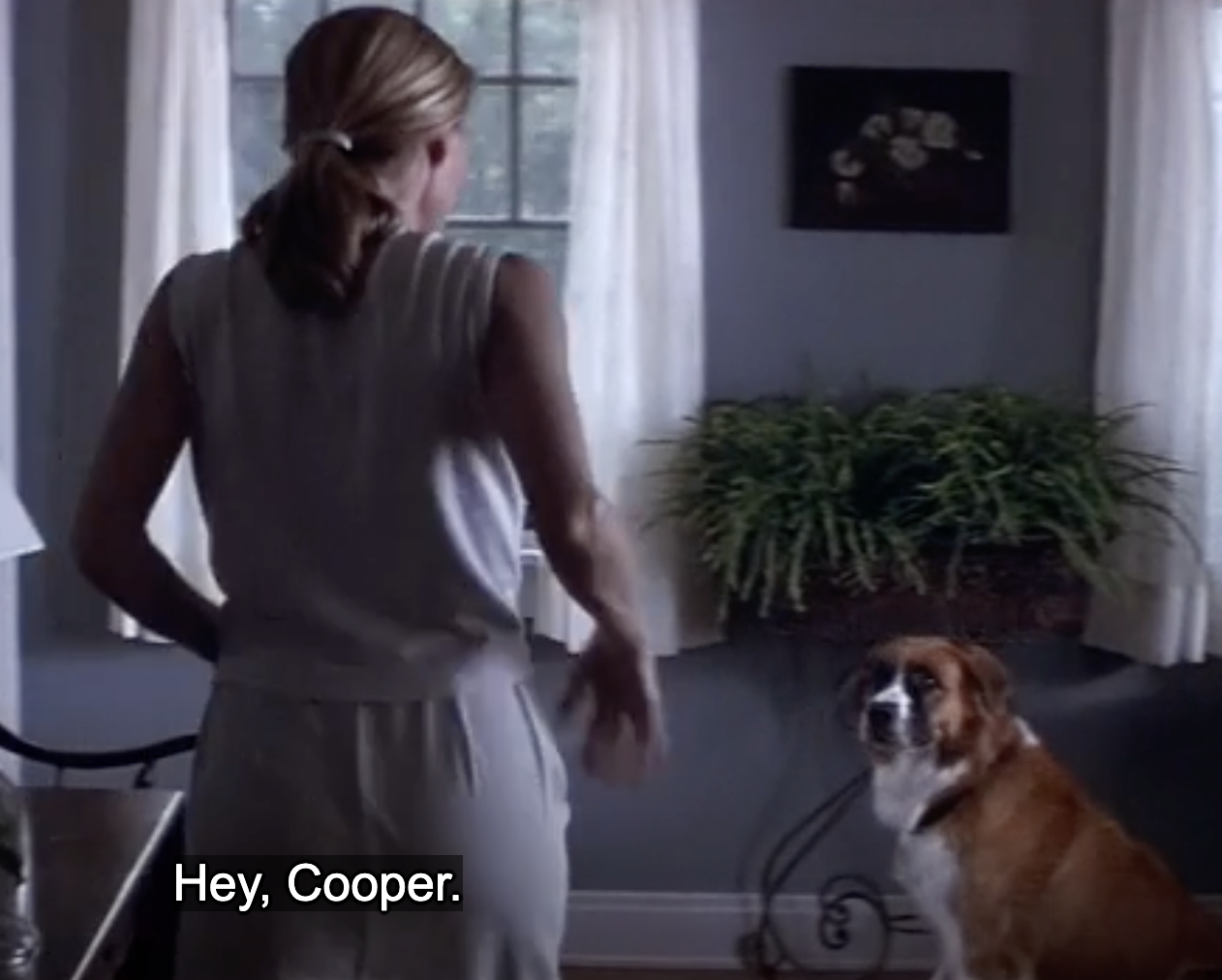
In the annals of “movie dogs,” there was perhaps never one so underused (and undervalued) as Cooper in What Lies Beneath. Written by Clark Gregg (who might still be best remembered as the faux surgeon in the “Don’t Ask, Don’t Tell” episode of Sex and the City), the movie was directed by Robert Zemeckis in between filming the first and second portions of Cast Away. In other words, waiting for Tom Hanks to grow a beard and lose weight for his “stuck on the island” segment of the movie. This wait proved to be a boon for movie audiences, as What Lies Beneath remains a gem of the supernatural thriller genre. But one aspect of it that has remained puzzling is Cooper’s presence in the film. For it’s usually the case that when a dog—especially a dog with such charisma as this—is written into a script, its existence entails some “higher purpose,” if you will. An endgame. An “oh, that’s why you’re here” moment that makes the pet’s presence come together and fully crystallize.
What’s more, seeing as how Cooper is introduced within the first five minutes of the movie, the viewer is led to believe that his role is going to be much more relevant than it actually is. However, at best, his presence is designed to imbue the viewer with more anxiety while watching What Lies Beneath as they fret over whether or not the dog is going to die (as is the usual vexing trope in horror/thriller movies). And one supposes if there is any “reason” for Cooper to exist in this film (apart from just being very cute), it’s solely for that purpose. Or is it simply that Zemeckis and Gregg wanted to lend further authenticity to the notion of the “perfect” American family? Because, aside from projecting this image (and providing a brief instant of comic relief during a scene in which a séance doesn’t go as planned), Cooper has little to offer (again, apart from being très mignon, which, of course, has its own kind of value, but still). Not even as a proverbial “sounding board” for the lead character, Claire Spencer (Michelle Pfeiffer), as she starts to feel like Paula Alquist (Ingrid Bergman) in Gaslight. In other words, that she’s going crazy as a result of all the fucked-up shit she’s seeing in their “quiet” Vermont home after their only daughter, Caitlin (Katharine Towne), leaves for college. In these instances of insecurity, talking to Cooper for comfort would have had emotional resonance in the same way that Andie Walsh (Molly Ringwald) talking to her dog, Ace, does in Pretty in Pink. Though it appears John Hughes is more empathetically inclined than Zemeckis when it comes to incorporating dogs into a narrative.
In any case, Claire’s “encounters” begin almost immediately after Caitlin leaves, with Claire having her first truly unsettling sighting on the pier located in the backyard of their house (as she’s trying to call Caitlin, incidentally). This is slightly after the twenty-minute mark, and also signals the second appearance of Cooper. However, if one wants to “reach,” his second “cameo,” of sorts, is just before, when Claire calls out to him in the night, “Cooper! Cooper!” That’s right, she only calls his name twice before giving up on him and angrily saying, “Fine, have it your way.” Not exactly the picture of a devoted dog owner.
And so it is that the next time Cooper physically appears onscreen (as opposed to just in name), his function is to use his dog-like “sixth sense” to detect that there’s some kind of “essence” out there, in the water, as Claire stands on the pier. Which is why he refuses to go fetch his ball when Claire throws it in. Stunned by this turn of events, Claire then remarks, “Well, that’s a first. Cooper, come on. Get your ball. What’s the matter with you? Cooper, it’s your favorite ball.” But Cooper continues to refuse going anywhere near those creepy-ass waters to retrieve his so-called favorite ball. ‘Cause it ain’t that special if it means being attacked by something that’s lying in wait.
Realizing that Cooper isn’t going to change his mind about this, Claire grabs a metal pole that’s (conveniently) lying on the deck and proceeds to try to fish the ball out herself. As she does so, she can just make out a corpse-looking woman beneath the surface of the water, staring concentratedly at it as though to make sure her eyes aren’t deceiving her. And yet, what actually makes her gasp isn’t this vision, but the sound of the cordless phone in her hand suddenly ringing. Claire’s gasp sends Cooper running for the proverbial hills. He’s not having any of this. And he’s not having it to the point where he doesn’t feel obliged to show up onscreen again until almost another thirty minutes in the movie have passed in order to relieve the tension of the abovementioned séance scene. Said séance “thrown” after Claire sees the full-on corpse-y reflection of Madison Elizabeth Frank (Amber Valletta). Which leads Claire to start going to a therapist named Dr. Drayton (Joe Morton)—mostly at the urging of her villainous husband, Norman (Harrison Ford), whose name is just one of many details in the film that serves as part of an overarching Alfred Hitchcock homage.
Alas, Norman’s advice to “seek help” ultimately backfires on him when Dr. Drayton (and, honestly, why not just “Dr. Dray” at that rate?) is the one who suggests that Claire figures out what the spirit wants. The best way to do that? With a Ouija board, obviously (de facto, a séance). So it is that Claire invites her best friend, Jody (Diana Scarwid), over to conjure this spirit and ask what the hell it wants so that it might then “move on.” After a few minutes of “nothing cooking” apart from an eerily brightening and then dimming candle, Claire and Jody see the bathroom door start to slowly open right at the moment when Cooper pops out from another door located behind them, leading both women to scream in terror. Such an unfortunate reaction to sweet, dear Cooper trying to get even a kernel love and affection from these clearly negligent owners. Indeed, the only time Cooper is shown getting a genuine pet from someone is Claire in that opening scene featuring his initial appearance, after which she dusts herself off like Cooper has “diseased” her with his nonexistent shedding.
Once Cooper causes such “offense” with the fright he gives Claire in the bathroom, he then doesn’t show up again for even longer, with about forty minutes going by until his next appearance, this one even briefer than the others. And it is during this appearance that the lack of love Cooper receives is even more prominent, for he’s been relegated to the back of Norman and Claire’s truck (“tossed” there, for all intents and purposes), which now has their boat hooked onto it. And who knows where Cooper was when the two were actually on the boat in the scene that preceded this. Plus, in all the time he’s just standing there, Claire and Norman ignore him, wrapped up in their own proverbial white people problems (affairs, secrecy, “being the best,” etc.). It’s at this moment that it becomes truly cogent just how much Cooper deserves to be with better caretakers. People who will pay attention to him and not take him for granted.
And yet, despite all of their neglect, Cooper still materializes for one final “close-up” during the scene when Norman places a paralyzed-by-his-injection-of-halothane Claire in the bathtub. A concerned Cooper pops his head over the tub as a sociopathically calm Norman says, “Hey Coop.” Then, he does pet the dog—but it’s not genuine. It’s a placating tactic to get him to stop staring at Claire with such earnest concern, fully aware that something is very wrong with this picture. Norman guides him away and insists, “Let’s go get your ball.”
A whimpering Cooper is then yanked away by the collar; yet another clear-cut example of the abuse he suffers in this household. And why? For being a loyal, caring dog, apparently. Even though some viewers might argue that Cooper’s perennial absence is more a sign of his total disinterest in and/or disloyalty to the Spencer family. But, based on everything the viewer comes to know about Claire and Norman, can they really blame Cooper for his chronic absenteeism? Besides, perhaps he’s stealing his pets and expressions of affection from somewhere else in the interim periods when he’s not around.


