


Among the many “anti-pop stars” making interesting music “these days” (hear also: ROSALÍA’s Lux), Allie X continues to challenge norms and expectations with her latest record, Happiness Is Going to Get You (given the “cutesy” acronym of HIGGY). As her fourth studio album, HIGGY is the fastest that Allie X has ever put something out in terms of following up her previous release. In this case, Girl With No Face, an 80s-inspired, synth-drenched wet dream. Prior to that, there was a three-year break between CollXtion II and Cape God, and a four-year break between Cape God and Girl With No Face. Thus, for those wondering what spurred Allie X on so quickly this time around, she remarked, “This album is what I would the ‘deep breath’ after the hysterics of Girl With No Face. The labor and intensity of writing/producing GWNF seemed to open some sort of space in me for something novel to form. I honestly couldn’t believe how quickly I wrote and produced these songs. The easiest way to explain HIGGY is to say it is about time. It plays with the idea that someone can exist in more than one place in time.”
In order to convey that concept, Allie X takes on the persona of what can be described as a futuristic Victorian woman, often existing inside a glass box (“The concept is brought to life and explored at length through The Infant Marie, who is my alter ego and the hero of the story”). Yes, it’s certainly more of a niche persona than, say, Charli XCX’s “brat.” But just because it’s more expensive to pull together an Infant Marie costume doesn’t mean that the material isn’t entirely relatable. Because, as Allie X phrased it, “This is a commentary on the moment I find myself currently in—caught between nostalgia, hope and dread.” And who can’t relate to that at this particular point in history? Along with wondering, “Is Anybody Out There?” A question that serves as the title of Allie’s X’s lead single from the album, and a boppable rumination on loneliness, solipsism and a general feeling of unease amidst this apocalyptic climate. Both figuratively and literally. For X was also impacted by the devastating wildfires that ripped through Los Angeles in early January, an event that finds itself rehashed in the verse, “Santa Ana winds, they came, they scorned us and we burned/Now the insurance brokers got morose and taciturn’d.”
Mentioning another traumatic event that befell her of late, X alludes to Bram Inscore, who co-wrote and co-produced the song in its early stages before committing suicide in 2023. So it is that X calmly declares, “Genius that I wrote this with said, ‘So long,’ took his life/If I stay here too long, I don’t think that I’ll survive.” The feeling X conveys here is twofold. On the one hand, she won’t survive emotionally; on the other, even if she decides to endure through the pain, there remains the question of whether she can even survive physically, further layering the meaning of that line by pairing it as follows: “A million Yogi tea bags got recalled for pesticide/If I stay too long here, I don’t think that I’ll survive.”
In spite of the fundamental gravity of her lyrics, Allie X pulls a bit of a Lily Allen (as she also does on “Reunite”) by keeping the tone “blithe,” as it were. The same goes for the second song on HIGGY, “7th Floor.” Wielding an up and down ride on an elevator as a metaphor for being, for all intents and purposes, “trapped in time” (which is often how it feels in any liminal space), Allie X—presumably as the Infant Marie (who is so often in a box)—describes watching everyone else pass her by, getting on and off the elevator, as she remains inside. So it is that she describes, “Elevator people with their own affairs/We go up and down the building, we don’t take the stairs/There’s five, there’s six, therе’s eight, there’s morе/ETA twenty-four minutes to the seventh floor.” And yes, that counting element does bring a certain Dr. Seuss-meets-Schoolhouse Rock! vibe to the track. In the best way possible. Apart from commenting on how the elevator isn’t as “fast” as it’s cracked up to be when someone is getting on or off at every floor, X gets across a feeling of being “stuck” as everybody else around you keeps moving. This being most apparent in the lyrics, “Boys and girls have come and gone now/I keep on going up and down/Doors are sliding, who’s out there now?/Please step in, I won’t get out” (side note: she does also seem to be commenting on a “Sliding Doors moment” with that turn of phrase, “Doors are sliding”).
At around the twenty-five-second mark, X brings some good old-fashioned whistling into the song, further heightening the misleading sense of “jolliness”—and also slightly recalling the sound of Peter Bjorn and John’s 2006 hit, “Young Folks.” But make no mistake, there is nothing “carefree” about “7th Floor,” which serves as a mirror of anxiousness for the current era. As does the following song, “Down Season.” A fitting title to appear on an album released just after the end of daylight savings time. In other words, the moment when most people (at least those with any sensitivity) go into full hibernation mode (that is, as much as capitalism will allow). For the Infant Marie, such hibernation seems to last a thousand years, if one is to go by her urging, “Wake me up in a thousand years ‘cause it’s down season again.” Opening with “in a reverie”-type piano notes, Allie X establishes a tone that’s both Edgar Allan Poe and Florence Welch (particularly on Florence + the Machine’s latest, Everybody Scream) as she describes, “Vultures [a recurring image that will also show up on “It’s Just Light”] coming again, heard a knock at the door/Dead banquet of flowers scattered over the floor/Blow the wick of the candle out, there’s a change in the wind.”
The soft, soothing piano notes soon give way to harsher instrumentation as X delves into the moody chorus (delivered with a kind of Gwen Stefani lilt), “In down season, all the tears are in bloom/It’s down season and it’s coming for you/And in down season, you know you’ll never win/Come on, come on, come on, come on, it’s down season again.” The “Is There Anybody Out There?” motif of solipsism also returns with the line, “No escaping from my mind, I might as well embrace it.” Incorporating a harpsichord into the sonic landscape to get across the full effect of “Infant Marie” in her time and place, Allie X doesn’t hold back with her “wintertime sadness” aura as she sings, “Send the hanging man in, clip the rose at the stem/Nurse told me that I’ll never grow without my medicine [this lyric standing out the most in terms of how much “Down Season” shares some DNA with Cape God’s “June Gloom”]/Instead of fighting the heaviness, I’ll just let it descend/Wake me up when I’m beautiful, it’s down season again.”
However, when Allie X a.k.a. Infant Marie is “risen” again, it’s likely she’ll be more than ready to “Reunite.” The song that falls at track four on HIGGY, and also sustains the use of the harpsichord that listeners heard on “Down Season.” As the second single from the record, “Reunite” has a somewhat divergent theme from “Is Anybody Out There?” in that Allie X is keen on connecting with someone she knows is out there. Depending on one’s interpretation, this could refer to a former lover or best friend, or, as X herself has suggested, to her own self. As she told Euphoria magazine, “From my perspective, ‘Reunite’ is a truly wholesome and very personal song about coming back together as a person when life has broken you apart. It is a celebration of growing up and understanding that my body has always been on my side, despite feeling the opposite for most of my life.” So it is that X can happily admit, “I know it wasn’t your fault/And though it might have been mine/We were just doing our best/Maybe you and me can reunite.” In other words, maybe Allie X can disassociate no more from her body.
Whether the listener chooses to hear the song as a love letter to self-acceptance and not treating oneself so unkindly (for there is often no harsher critic than oneself) or as a “getting back together” anthem (again, with an ex-lover or ex-friend), “Reunite” provides the kind of sweetness and sincerity that works well in both cases. Alas, that sweetness doesn’t last too long as a small interlude, of sorts, sets the tone for the macabre once more. Called “A Glitch in Marie,” it almost sounds like the opening to Kanye West’s 2010 song, “Runaway,” with the same repeated piano note for most of the twenty-six seconds of the song. Of course, the repetition is meant to mimic, in its way, the idea of “glitching out.”
As one might when they realize that “Happiness Is Gonna Get You” isn’t a “positive” or “encouraging” statement, per se, so much as a warning and a harbinger of doom. For that’s certainly how Allie X makes it seem from the very start of the track, which commences with the kind of “dark” piano notes that both Fiona Apple and Tori Amos are well-known for. Indeed, Allie X channels both women on this song even in terms of her vocals, promising, “Happiness is gonna get you/Happiness will make you pay/Like a satellite in free fall/Like a seizure on the floor/Happiness is gonna get you/Better let it in, happiness is at/Your door.” It doesn’t exactly sound like a “good thing” when she phrases it like that. Not to mention the way she sounds when she says it. Almost as if she can’t wait to take her revenge by letting karma do its job and allow happiness to get you. For, usually, when it does, there’s some sort of “karmic balance” tradeoff that makes something terrible happen soon after.
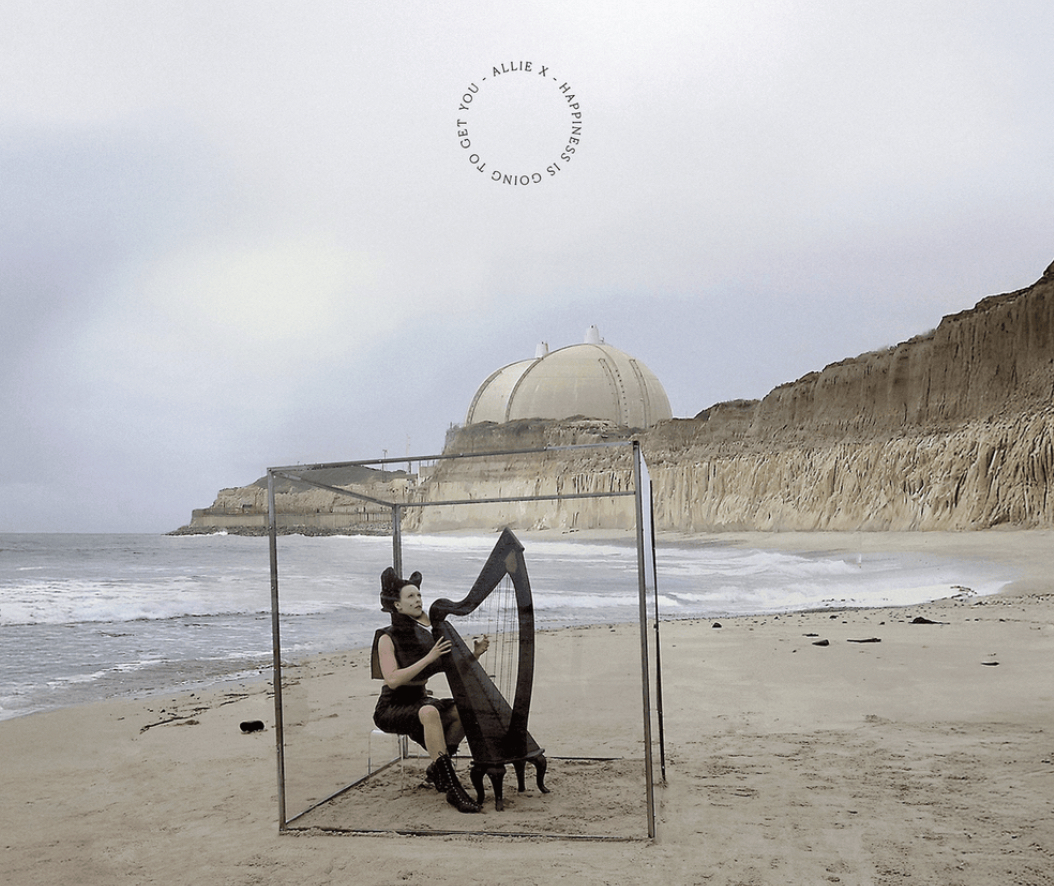
Perhaps, as if to highlight that point, Allie X’s album cover for HIGGY features her dressed in full “Infant Marie” attire as she sits inside her “usual” glass box with a harp in front of her. And while the glass box is theoretically positioned on a “picturesque” beach, the nuclear power plant (specifically, the San Onofre Nuclear Generating Station, which spells out the “convenient”—even if misleading—acronym, SONGS) that looms above her is part of Allie’s tongue-in-cheek way of accenting what she said about how this record captures the feeling of being “caught between nostalgia, hope and dread.” It is the latter sensation one feels when realizing that the title of the next track, “I Hope You Hear This Song” isn’t exactly coming from a place of “wishing someone well” either (much the same that “Happiness Is Gonna Get You” isn’t). That much is immediately clear about twenty-four seconds into the song, when X drones, “I hope this melody starts to haunt you endlessly.” And so, here again, she proves herself to be quite the Poe referencer, with such a “hope” echoing the kind of haunting that occurs in “The Tell-Tale Heart.”
As for something else Allie X likes to reference, Los Angeles is all over this track as well, especially in the opening lines, “I hope you hear this song in a Gelson’s or a Vons/Or at a shopping mall getting coffee at the stall.” In other words, in one of the many LA-specific milieus that might auditorily assault someone with a song. The irony, of course, is that a song like this—despite the wishes she expresses herein—would never enter into kind of “Top 40” rotation fit for places like these that tend to play only, let’s say, “mainstream slop.” Nonetheless, it doesn’t prevent Allie X from having her fantasy play out—one that allows for a very unique form of revenge that only a successful singer could truly understand, in terms of the glory and satisfaction felt. This much shining through in such lines as, “I know you didn’t forget, and neither did I/So I’ll make you remember for the rest of your life” and “If we never meet again, at least this song will never end.” And yes, that is the tune of The Verve’s “Bitter Sweet Symphony” one hears as she chants, “I wanna make you remember” as the track comes to a close (this mimicking Richard Ashcroft singing, “I’ll take you down the only road I’ve ever been down”).
Switching to her dreamiest sound yet for “Uncle Lenny,” the “dulcet” tone of it belies the fact that Allie X a.k.a. Infant Marie is not showing much affection for Uncle Lenny as the track progresses. Though, even from the outset, it’s clear she doesn’t have a lot of love for this deadbeat, commencing with the verse, “Uncle Lenny/What kind of uncle bets my money away?/Now I got nothing/What’ll I do with no utilities paid?/I guess I needed a father figure, someone with a beard/A dianetic text to follow till I disappear.” So it is that with a single word—dianetic—Allie X reminds anew where her head is at: Los Angeles. For what else could one associate with that term but scientology? Besides that, Uncle Lenny reeks of the sort of no-good uncle that is something of a trope in the LA area. The type to make Allie X assess, “But you’re just slowing me down/Always slowing me down/Everyone loves a clown/In this town Uncle/Oh, how you love to talk/Everyone loves to talk/Then throw you out to the dogs/Uncle, I’ve had enough.”
The dreamcore sound of it lends an eerie, ominous effect, with Allie X also painting a picture of Uncle Lenny’s sketchy backstory (e.g., “You used to do lines at the Sunset Marquis/That’s why they love you/All of the other uncles from the 80s/And the 90s”). Then, around the two-minute-twenty-two-second mark, the dreamcore-ness of it shifts back to the harpsichord and synth-driven sounds of tracks prior. Except, in this instance, Allie X opts to throw in a child-sounding choir repeating, “La, la, la-la-la, la” to close out the oddly affecting ditty—along with some “subliminal” backwards speaking/speaking in gibberish that sounds like it would be right at home on The Beatles’ The White Album. Indeed, The Beatles flicker in on the album more than a few times (most noticeably on “Is Anybody Out There?”), but in particular their sound on that aforementioned record. That influence (whether “subconscious” or not) reaches another peak on “It Gets Better (It’s Worse Than Ever),” which acts as something of an addendum to “Uncle Lenny” as it transitions seamlessly into a childlike, sing-songy voice that chirps, “In a way it gets better/In a way it’s worse than ever/Love is fickle, love is fleeting/Oh, I took a beating/But they say it gets better/I suppose it does forever/And I want to say I’m sorry/You have lived this story/Guess that I’ll be getting on my way.” This being the extent of the complete lyrics, it bears the brevity and whimsy of certain The White Album tracks like “Wild Honey Pie,” “Martha My Dear,” “Piggies” and “Why Don’t We Do It in the Road?”
With “Learn to Cry,” however, Allie X abandons the whimsical in favor of a more serious subject: the emotional repression of men. So it is that she segues into this dreamy piano ballad that expounds on how important it is to learn to cry. Especially for men. To be sure, this is a track that shares a strong thematic similarity with MARINA’s own 2021 ballad, “Highly Emotional People.” A powerful song on which she urges, “And you don’t need to hide/Sometimes it’s hard to tell me how you feel/I never see you cry/I never see you cry/All of the weight that you’ve carried around/Feelings come up and you push ‘em back down.” Allie X reworks such perspicacious observations into, “You don’t weep/You won’t whine/Must be strong to provide/But your heart’s/Getting tight/How will it ever change/If you don’t learn to cry?”
Elsewhere in “Learn to Cry,” X also engages with the aspect of her songwriting that she does best, which is getting to the “root cause” of one’s behavior and trauma (as she also does on Cape God’s “Love Me Wrong” and “Learning in Public”). In this scenario, she sums up the majority of this man’s emotional stuntedness as follows: “Nobody was there/When you needed someone most.” As a result, “By some miracle/You made it on your own/Decades long ago/You left the boy behind.” This assessment is also emphasized at the outset of the track via the verse, “Memories that you hold/Deep within your mind/You keep them to yourself/Away from prying eyes/Who could understand/That part of you has died?/To make it to the man/You had to kill the child.” So it is that MARINA has met her match in terms of dissecting emotionally crippled men in a pop song format (which makes sense, considering Allie X was MARINA’s opener for the Love + Fear Tour in 2019).
Concluding with a lush string arrangement, “Learn to Cry” is then contrasted by the up-tempo pace of “Stay Green.” As a song that speaks to that element of nostalgia—of longing for the assumed simplicity of the past—Allie X mentioned being a key part of the album’s chemistry, “Stay Green” is both a bittersweet rumination on the loss of youth, as well as an earnest reminder, “Erase your nerves/Soften your heart/This life, it makes/You hard enough/You gotta stay green as long as you can/Keep dreaming until the end.” It’s a tender and much-needed entreaty in a world that, increasingly, all but forces people to lose their innocence as soon as possible, with fewer and fewer children even getting to relish a childhood for as long as they possibly can. But X’s insistence isn’t just for “the kids.” In truth, “Stay Green” is for adults more than anyone. For the etymology behind the saying about being “green” has its roots in how the freshest and most alive plants and fruits are just that. Greenness a sign of being unwizened and unmarked by the ravages and “tells” of time. Something Allie X also speaks on when she admits, “And bones they creak, they snap and break/My eyes get weak when there’s just too much to take/You know your hair gets coarse, your hands get dry/It’s hard to ignore the harshness of time.” Or, as Allison Reynolds (Ally Sheedy) in The Breakfast Club once put it, “When you grow up, your heart dies.”
But if one can fight it, occasionally remember the inner child screaming, “So try your best to stay forever green,” it just may increase one’s longevity. The positive significance of embracing one’s inner child also goes back to the abovementioned line in “Learn to Cry” about how “to make it to the man/You had to kill the child.” And this is what society continues to condition people to believe. That they must be hardened and tough in order to succeed. That to embrace childlike vulnerabilities and joys is somehow weak, an indication of failure.
As for the New Order-y sound of “Stay Green,” perhaps it’s intentional, done for the purpose of connecting it to the title, “Everything’s Gone Green” (even if, by the end, it’s New Order’s “Regret” that “Stay Green” is sonically most reminiscent of). Reiterating the importance and dual meaning of greenness throughout the song, it is the opening verse of “Stay Green” that establishes this with the verse, “Been missing the way the world used to look.” It’s a declaration that applies not only to wanting to see the world through her “child eyes” again, but of wanting to see the erstwhile greenness of Mother Earth before she got so utterly blackened by industrialization. Thus, here, too, an added layer of nostalgia is present. Hell, Allie X can even make death sound nostalgic. Just as she does on HIGGY’s final track, “It’s Just Light.”
Indeed, that’s how she summarizes death, shrugging, “The light, it gets you in the end [a phrase not unlike “Happiness is going to get you”]/We all turn into stars as we fade away.” The baroque-esque backing music punctuates the “gothic” (just another word for “realist”) nature of Allie X’s surrender to “the light” (“Go into the light,” as they say when someone is at Death’s door). Including her operatic delivery of one of the concluding verses, “Bend, I will bend with the light in the end/Oh, bend, I will bend to the light/It’s the end/Light.” That’s right, not darkness, but light. When she puts it that way, maybe Death doesn’t sound so terrifying. Then again, the sinister image she paints with the line, “Bet one day soon the bell will toll/The vultures circle through the sky” (those vultures previously appearing on “Down Season”) doesn’t exactly comfort or console. Nor does the song’s big finish: the same familiar stabbing piano note that can be heard on “It Gets Better (It’s Worse Than Ever).”
Yet this is where Happiness Is Going to Get You’s greatest power lies, in being unafraid to be “unpleasant.” Downright eerie at times, as a matter of fact. Because Infant Marie isn’t here to tell you things are hunky-dory. Though she will hold your hand as she reminds you that they aren’t.


