


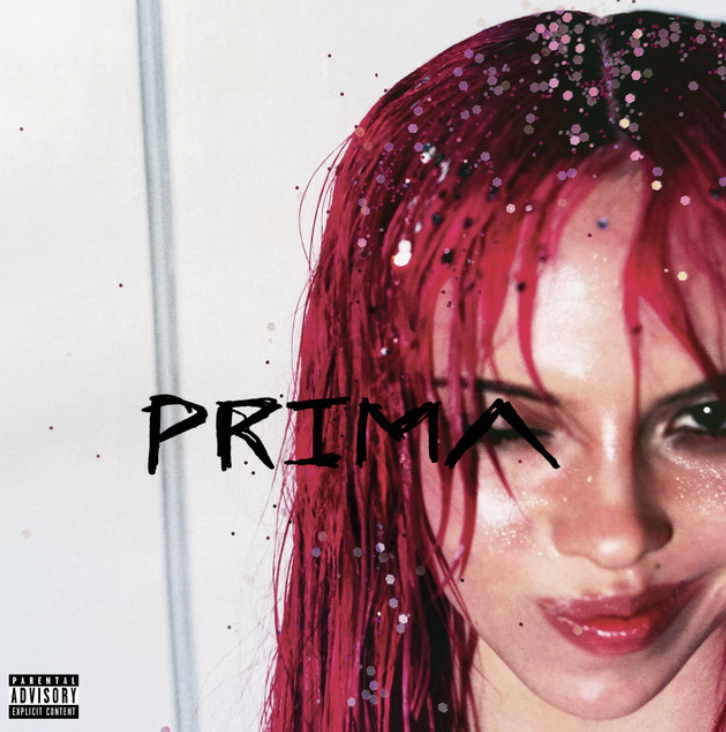
Although Adéla is proudly Slovakian, she opted for an Italian word to characterize her debut album: Prima. A word associated with “first” (as in, this is her first album and, presumably, she wants to be a “number one” kind of pop girl) and, well, prima donna. A phrase that literally translates to “first woman.” Or, more accurately, top bitch. In the American lexicon, the term evolved away from its opera association (though Adéla associates it with ballet: prima ballerina) and came to refer to a diva (you know, a real Mariah Carey type; fittingly, Carey probably could have been an opera singer). So it is that, with the title alone, Adéla is expressing her lofty career ambitions. Ones that she’s been chipping away at since at least three years old, when she first started taking ballet lessons in Moscow. The same age Britney Spears was when she started taking dance lessons. The correlation clearly being: if you want to be a zygote pop star the way “the industry” expects, you’ve got to start working at it real early (so it was that Addison Rae started “late” at six years old).
And Adéla was more than willing to do so, gobbling up a steady diet of American pop culture that spoke to her in the kind of way that only furthered her desire to become famous. Indeed, watching Hannah Montana when it first came out in 2006 (when she was, again, three) was also formative. For, as she told Elle in an interview from 2025, “As soon as I saw Hannah Montana, which was when I was three years old, I was like, ‘Ooh, this is what I’m gonna do.’” Yet, strangely, it isn’t Miley Cyrus’ sound that colors most of the record, but rather, an “equal parts” blend of Ariana Grande and Addison Rae (who was rocking pink hair in the video for “Obsession”—and then brought it back again in an even bigger way for “Headphones On”—long before Adéla arrived). It’s the latter who prefers looking to Britney Spears and Madonna for sonic and visual inspiration, as her debut, Addison, confirmed. But, like Adéla, Rae also chose to introduce her sensibilities to the world with an EP. Albeit one that didn’t fare quite as well as Adéla’s The Provocateur. Still, AR wasn’t without its enthusiasts, including Charli XCX, who has a feature on one of the tracks, “2 die 4.” It was also XCX who encouraged Rae to trust her instincts and further elevated her into the mainstream with a feature on the “von dutch” remix.
But Adéla, despite not having the millions of TikTok followers that Rae did when she pivoted to pop stardom, seemed to possess more confidence about her musical path from the start. Because, like Rae, being a “student of pop” was her ticket to standing out, to “transcending.” And, as she admitted to Elle, “I’m a mosaic of all of the content, all of the girls that I’ve studied as a kid, right?” That much is referred to in her album’s kickoff track, “KGB.” As her requisite “I’m an immigrant track,” Adéla alludes to a childhood and adolescence spent “sleeping with the enemy,” so to speak. Or rather, soaking up American pop culture like a sponge, complete with studying the language through TV and becoming fluent in it by nine years old. So it is that she touts, “I’m like a spy, I studied this shit/Call me the K-G-Bitch.” Of course, the audience she appeals to that’s in her age group and grew up in America will not know what the KGB really means. Even after Adéla tried to adopt a more serious tone with a title card after the Rachel Dunkel-directed video that reads, “Growing up in Slovakia, it was impossible to escape the harmful influence of the Soviet Union. ‘KGB’ and its video are not an endorsement of the organization and their actions, but an acknowledgement of where I’m from. I do not support the Russian government and stand with the people of Ukraine.”
On Prima, however, it’s obvious that Adéla stands with the people of America. Or rather, the girls and the gays of America who are most known for not only driving pop culture, but “studying” it in the same way that Adéla did (and does). Just as she shows herself doing in her video for “SexOnTheBeat,” directed by 91 Rules (the duo that recently helped Tinashe bring the visuals for “Crash Out” and “Melatonin” to life). Eyes fixed on a laptop where she’s watching a “MasterClass”-type video with Christina Aguilera speaking (and yes, Aguilera actually does have a MasterClass). The title of her “class” being, “Get Dirrty: Christina Aguilera’s Definitive Guide to Achieving Superstardom on Your Own Terms.” As images of her “looking sexual” play, her voiceover “instructs,” “You’ve been doing it all wrong. Master your body, harness your sexuality and become pop royalty in eight weeks.”
In many ways, the Adéla timeline truly does feel that rapid, even though she’s been slogging it out since well before appearing on Dream Academy in 2023, what with the dancing and vocal training that came before, paired with “spying” on American pop stars for so long. Or, as she puts it during the first verse of “KGB,” “Staring at a TV screen till I got bloody eyes/Just a little European girl, was plotting on my rise.” And her plotting most definitely paid off, with Prima being a fully realized manifestation of her “pop star self.” Which, as she said to Elle, is a mosaic of the many pop girls she studied before becoming famous. All of whom, in some way or another, were maligned for their sexuality. More to the point, being “too overt” with it. Yet, the more time has gone on, perhaps the more desensitized audiences have become, with someone like Sabrina Carpenter having far more leeway than, say, Britney Spears to dress like she was spat out of Frederick’s of Hollywood.
Even so, that doesn’t stop the so-called moral majority from the usual cries of, “Slut!” and “Bad role model!” Adéla summed up the phenomenon to Elle by remarking, “I mean, I think artists now have been blessed with a lot more freedom and autonomy, so we get to fight back. But it’s like, [this has] been a thing. Madonna has been fighting this her entire career. There’s always, always, always the same conversation happening. I laugh because, even under my videos, like the ‘SexOnTheBeat’ video, people are leaving comments like, ‘She’s just a slut,’ and ‘She’s just spreading her legs for fame.’ I see people saying like ‘Madonna would have never [danced like that] with a guy.’ I’m like, Madonna literally simulated an orgasm on her Blond Ambition tour every night? People just like to get mad about the same shit over and over again. It’s quite funny. People have short memories.”
Adéla, however, does not, seeming to have filed away every useful piece of pop girl imagery and soundscape to weave Prima together. An album where her “Addison Rae nature” not only shines through, but also her Ariana Grande vocal stylings (hear also: her cover of “Into You” for Spotify), which are referred to in, again, the Elle interview, when she says, “I grew up learning from the best. My baseline was like Madonna and Lady Gaga and Beyoncé and Ariana Grande.” It’s Grande’s “lilt” that starts to flicker in on “Nicole Kidman,” but not before her Addison-by-way-of-Britney vocals get the better of her for about the first forty-one seconds of the song. It’s during that “period” that Adéla chooses to adopt some of the same “sexy” stylings Addison wields on, say, “Aquamarine” and “High Fashion.” But it’s all Grande once she starts musing, “Ooh/Spent a couple hours in my room/Should I wear Louboutins or Jimmy Choos?/Try ‘em in the mirror fully nude [a nod to Kidman in Eyes Wide Shut]/Like, ooh-ooh, ooh-ooh, ooh/My bra should prolly be a bigger size/Maybe that’s why they can’t look me in the eyes/Maybe that’s why they can’t look me in the eyes.”
It isn’t just the Grande-esque vocal tone that’s noticeable here, but also the sexual suggestiveness (which Grande recently played up on “Big Feelings” from Petal). When she returns to the chorus, though, it’s strictly Addison again as she flexes, “Every single night/I pray that my tits are sittin’ right/Moulin Rouge/My corset is so tight/Babygirl in control/I feel like Nicole.” As for another “subtle” reference that shows Adéla’s pop culture studying skills, there’s more than a hint of Kanye West’s (back when he was called that) “Bound 2”—specifically, the part he samples from the Ponderosa Twins Plus One. During an era of his career when he could have still made grand claims of, “I’m the Man.” Which happens to be the title of the next song, and in keeping with the braggadocio Adéla expresses throughout “Nicole Kidman.”
And one would have to be confident to risk making Taylor Swift somehow think the song has anything to do with 2019’s “The Man.” But no, in contrast to that, Adéla’s take on the double standard of being a woman is that, fuck it, she’s the man in the relationship. The one who embraces the so-called masculine role of “taking charge” and paying for things. But she slow-builds to that assertion with an intro that finds her reflecting (once again in an “Ariana voice”), “I answer to nobody/On my knees for nobody/But I love ‘em down on me/Sometimes I wanna switch positions.” Or, as Grande would say, “‘Cause I’ll be/Switchin’ the positions for you.”
The mid-tempo beat, co-produced by Blake Slatkin and Cashmere Cat, is also part of what lends a certain “Ariana-ness” to the track (particularly of a Positions era sound). Though even Grande has never been “kinky” enough to admit something like, “His face is so androgynous/We kinda look alike/I’m kinda into that/Is that weird?” and “It’s true, I like my boys a little feminine/Where we both understand I’m the man, I’m the man, I’m the man.” At another point, Adéla remarks, “It really takes a confident boy/To give in and enjoy, and you do.” Which is an interesting stance to take considering that most people view men who “give in and enjoy” a woman taking care of him—the way a man is usually expected to of a woman (though rarely ever has)—as, colloquially, a “bitch” or a “pussy.” Not someone who is actually quite feministic. Of course, it is difficult to find the sort of man who falls into the latter category and not the former. But Adéla seems to have unearthed one…along with quite a few other “Boys.” A song that continues the male-centric motif of “I’m the Man.”
As for the sound and title of “Boys,” naturally, anyone that’s a fan of Miley Cyrus is a fan of Britney Spears, who released her own “Boys” in 2001 on Britney. Though its single version, “The Co-ed Remix” became more well-known in 2002, when it was released on the Austin Powers in Goldmember Soundtrack. It’s the latter version that Adéla sonically channels (once again thanks to Blake Slatkin and Dylan Brady) as she paints the picture, “I came to dance/Just me and my girls/I see ‘em starin’/It’s nothin’ new.” Spears and her girls, however, are the ones doing most of the staring in “Boys” as she describes, I spotted you dancin’/You made all the girls stare.” So it is that Adéla creates something of a more “generationally relevant” version of this song in that she’s not “allured” or much attracted at all to any of the boys “tryna holler” at her at the club. In fact, she’s more annoyed than anything as she brags, “I got boys like a vending machine/I just press the right buttons and they fallin’ for me/I got boys, and they’re stuck in my teeth/I try to [insert Britney-esque panting noise here], but they stay stuck onto me.”
Something that can be rather irritating when a girl is trying to go to the bathroom. Which becomes a part of the song for the “girl talk interlude” portions of “Boys” that feature Katseye’s Lara Raj chiming in with phrases like, “Oh my girl, that motherfucker was, like, chasing after you.” So while there are a lot parallels between this “Boys” and Britney’s, let’s just say that Adéla’s account of seeing boys at the club is slightly less rose-colored than Britney’s.
Perhaps after coming across as so “aggressive” (“for a woman”) on “I’m the Man” and “Boys,” Adéla sees fit to pivot to her more vulnerable side on “Red Bottoms” (bearing all the songwriting hallmarks of a Julia Michaels ballad, as she’s one of the co-writers), which served as her second single after “KGB.” Offering up a “softer side” to the previously “stolid Slovak” image, Adéla concedes to showing emotion only if she “can talk in fashion.” Because, as she also admits, she “can’t talk in feelings.” That would be far too ick (yet somehow, she doesn’t see the ick in using designer shoes as an analogy for a relationship—as Carrie Bradshaw probably would). Thus, she wields “metaphor,” both lyrically and in the accompanying video (directed by Emma Drew), during which she toggles between walking on hot coals (which smacks of Billie Eilish’s brand of self-flagellation in her music videos) and wearing her worn-down red bottoms in front of the man that “want[s her] for life/But it’s only when [she’s] leavin’.” Or rather, threatening to leave. Because every time she does, the man in question acts all into her again so that she’ll keep being duped into staying.
In many regards, there’s a certain Lana Del Rey slant to the track as well, with Adéla addressing being treated as a side piece (à la Del Rey’s cover of “The Other Woman” from Ultraviolence) via the lines, “Cuts like a knife, call me your wife/But it’s only on the weekend.” Elsewhere, Adéla is even vulnerable enough to concede, “My worst fear, you’ll disappear after one disagreement.” So it is that she compares herself to the famed breed of Christian Louboutins in that, “You can’t wear me out too many times, too many times.” In other words, there are limits to the abuse Adéla can take—even if those limits are higher than most other people’s. But it’s the fear of abandonment motif that Adéla concludes with by inquiring, “I’m like my red bottom sole/If I’m not perfect, will you say goodbye? You say goodbye.”
The melancholic string arrangements that conclude “Red Bottoms” transition into “Hitachi,” which is thematically linked in lament (much as “I’m the Man” and “Boys” are linked by Adéla’s “have sex like a man”-level callousness). Even if it alludes to the illustrious vibrator, the Magic Wand, manufactured by Hitachi. Though said company insisted it was intended for “sore muscles and tension” when the product was first released in the late 1960s. Recently sexually liberated women, however, did not see it solely for that purpose, and its association as a vibrator eventually led Hitachi to stop selling the product with its name attached to it out of, one supposes, shame. The brand even considered discontinuing the manufacture of the product altogether until its distributor, er, Vibratex, suggested they could still sell it without adding Hitachi to the phrase “Magic Wand.”
This little detail doesn’t seem to matter to Adéla, who still freely refers to it as such when she deplores, “You used to wanna turn me on, wanna turn me on just like my Hitachi does.” Indeed, the entire song is about Adéla’s regret over her relationship going from white hot to stone cold (which is probably why she needs that Hitachi more than ever), comparing/contrasting the beginning to the present state with such verses as, “Baby, yeah, we couldn’t even stop to turn the lights off/Now you’re sleeping next to me with your clothes on.” Ah, but such is the way of “passion.” It so often runs out. And far too soon.
Speaking of “passion,” Adéla brings that word immediately into the following track, “Fantasize,” which is something of her “recovery from being a sad girl” response to “Hitachi.” Opening with the verse, “Lately, I’m lackin’/A sense of reciprocity in your passion” (on a side note: Lauryn Hill still has the monopoly on using the word “reciprocity” in a song—namely, “Ex-Factor”). So it is that she must say, “Excuse my distraction/I’m findin’ other people strangely attractive.” And all mostly because this dude has been ignoring her physical needs so regularly that her Hitachi is the only thing she has to keep her “warm” at night. As for the more standout sound of the up-tempo beat, it can perhaps be attributed to Count Baldor being a co-producer with the usual duo of Slatkin and Brady. For there is a, let’s say, zanier aspect to the backing track as Adéla dives into the chorus, “This is the part where human nature/Fills me with need and sways my mind/This is the part where I’m no better/The more that I fantasize” (and JADE has some similar thoughts on “Fantasy” from That’s Showbiz Baby!, when she sings, “Passion, pain/Pleasure, no shame”).
While women of previous eras might have expressed more than a tinge of guilt (like Rihanna on “Unfaithful”) about this “fantasizing” that’s so clearly about to be acted upon, Adéla insists, “And why should I feel bad about it?/If I was satisfied/Why would be my eyes/Be wandering?” Fair point. And maybe they wandered right over to the “Starving Artist” of the next song. The person she addresses right out of the gate with, “Sure you’ve heard by now/That I am, I am no longer locked down” (not after all that fantasizing come to life). As such, she’s “circling back,” “back on his block now.” The implication not necessarily being that she’s still a starving artist—or perhaps she started to write some of the lyrics back when she still was. Either way, it seems that Adéla has a penchant for “broke boys” (despite Tinashe advising against it on “No Broke Boys”)…regardless of her newfound status as “rich and famous.”
So it is that she faux-coyly asks, “Hey, do you still got the same apartment?/No bedframe, we can do it on the carpet/Nothin’ in the bank but you’re making deposits/Eat real good for a starving artist.” Of course, Adéla is hardly the first pop star to provide a double entendre about “eating,” with Madonna being the trailblazer (as usual) on that front. To be sure, in the spirit of Madonna’s own “eating out” song, “Where Life Begins,” Adéla urges, “Babe, it’s free, just take a bite, ha ha/Finger food is what I like, ha.” Phrases that get their DNA from Madonna sing-speaking, “But let me remind you in case you don’t already know/Dining out can happen down below” and “Colonel Sanders says it best, ‘Finger-licking good.’”
As for another underlying meaning of the track, it appears Adéla wants to make it known that, so often, the jankest of men are the best at sex (and its “tertiary acts”). And that, more often still, it’s the rich dudes who are bad in bed (relying on that monetary wealth to make up for being poor in the boudoir department—or just sex trafficking to get what they want without giving anything in return). At around the two-minute-thirty-five-second mark, the song adopts that “two-in-one” quality that Charli XCX is fond of on Music, Fashion, Film (e.g., “Card Declined” and “No One Lasts Forever”), with the tempo and vocals slowing down to highlight a “grimier” sound. And yes, there’s even a dash of Slayyyter in how that translates.
The tone gets expectedly dreamier on “Marijuana,” which means Adéla is back to her Addison emulation with a cooing vocal intro in the spirit of “Money Is Everything.” Except Adéla’s “mini monologue” is, “Why don’t you roll the windows up?/I can’t smoke, I have to sing, but/I don’t mind a contact high.” The next verse then bursts out for her to continue an Addison-y vibe by offering the name-checking description, “Playing Nirvana, ride you in your Honda/I like how you look at me like I’m the next Madonna” (P.S. SR-71 already “invented” the Madonna/Nirvana rhyme on “1985” [a song usually attributed to Bowling for Soup]). And yes, Addison, too, gives Madonna a shoutout on “Money Is Everything,” singing, “And when I’m out dancing, please DJ, play Madonna.”
In what is perhaps a subtler pop culture nod, Adéla seems to pay homage to that certain scene in Titanic with the lyrics, “PCH, pull over on the right/Windows fog up, write your name with mine.” All of this car sex (as is often the “California way”) leads Adéla to the chorus’ conclusion, “I’m like, ‘I think I like you like you like marijuana, -juana.’” Thus, can “love” be that far behind?
The tone shifts to one of a bit more seriousness again on “Therapy,” a song that’s all talking with sparse piano instrumentation in the background. Written when Adéla was sick, her opening line, “I can’t really sing” feels like it’s not just about having a sore throat, but rather, the insecurity she has about her voice at times. Which is why using Auto-Tune so blatantly has another dual meaning here. For, on the one hand, it’s to mask how she sounds while she’s not feeling well and, on the other, it’s a statement about a pop star’s voice not necessarily being the most “important” thing about them. Something that Madonna noted in 1991’s Truth or Dare, telling her back-up singers, “I know I’m not the best singer and I know I’m not the best dancer. But I’m not interested in that. I’m interested in pushing people’s buttons, in being provocative, in being political.”
Charli XCX has a similar stance about her own voice, making no secret of her love of Auto-Tune. And yes, there is a certain “Brat quality” (specifically, “I might say something stupid” and “I think about it all the time”) to Adéla’s vulnerable spoken lyrics on “Therapy.” And maybe even a hint of Kesha in terms of her candor and contempt for old white men as she says, “I wanna move my mom out here/But I don’t really have the money, so I have to/Talk to the people that I have to talk to/They are old white men and they’re so annoying/But they hold the keys to my future, so I/Have to do it anyway ‘cause that is how life works.”
At another point, the pain Adéla feels gives way entirely to how much she misses her family, especially her younger sister, whose childhood she feels she’s missed out on by moving to L.A. to pursue her own dreams. So it is that she laments, “I miss when my little sister used to call me Mom/‘Cause now she gets a little awkward when I talk to her/When I left home she was so tiny/Now I come back and she is my size/And that’s awful ‘cause she’s my baby/And she grew up here/Grew up without me.” But such is the tradeoff for chasing her big dreams in L.A., a town whose hand she bites despite it feeding her the album’s finale, “Ain’t in LA” (marking the second instance on the record where Madonna is mentioned). A song during which she, funnily enough, makes the claim, “I’d rather be a nobody than to be like everyone.” Yet she does come across like a little bit of everyone with Prima.
Even on the album’s cover, Adéla looks more like Camila Cabello than herself. And the blue lipstick Adéla sports in the video for “Nicole Kidman” has echoes of Cabello wearing that shade on the cover of King Kong or licking a blue lollipop on the cover of C,XOXO. Which, like Prima, doesn’t have Cabello’s name written on it. Though Prima does at least have the title of the album scrawled across the center, with the “A” in the word being crossed in such a way so that it acts as part of Adéla’s eyelash (and the eye that’s winking—indeed, it’s as if she’s saying, “I’m not a bad girl anymore, I promise/Wink, wink”). And, speaking of C,XOXO, which also took plenty of inspiration from Spring Breakers, Adéla told Vogue Czechoslovakia of her debut, “I also wanted the album to be something the girls from Spring Breakers would listen to…” Well, it is definitely that. Including the bonus track version of the album with “Nasty Dirty Gross.” A song that features her declaring to a boy she doesn’t want to shower unless it’s with her, “Let’s be nasty/Let’s be dirty/Let’s be gross, let’s be gross, gross, gross.” In many ways, it has all the similarities of Lady Gaga’s The Fame era (especially “Beautiful, Dirty, Rich”).
On the iTunes edition, there’s also an additional song tellingly called “Kiss Here” (in lieu of “Nasty Dirty Gross”), which goes back to her Ariana vibe with its vocal tone and sexually charged lyrics that act as instructions for how to “eat out” (making it the “companion piece,” of sorts, to “Starving Artist”). Those instructions being, “Kiss here, grip there, you can bite back/If my pleasure is a puzzle, can you solve that?/Circle with your tongue, right, left, make a map/It’s not a race, only win if you finish last.”
As for Adéla, she’s trying to finish prima, announcing to Elle when she was still working on the record, “I think with the album, honestly, I’m just done being niche. I wanna be huge.” There’s no denying that’s going to be the case, especially with a sanction from none other than Nicole Kidman herself. But there’s also no denying that after turning away from “being niche,” Adéla could have at least carved out one of her own. But perhaps that’s a feat better left tended to for the second album.


[…] The “A” List: Ariana and Addison Shine Through the Most on Adéla’s Debut, Prima […]