


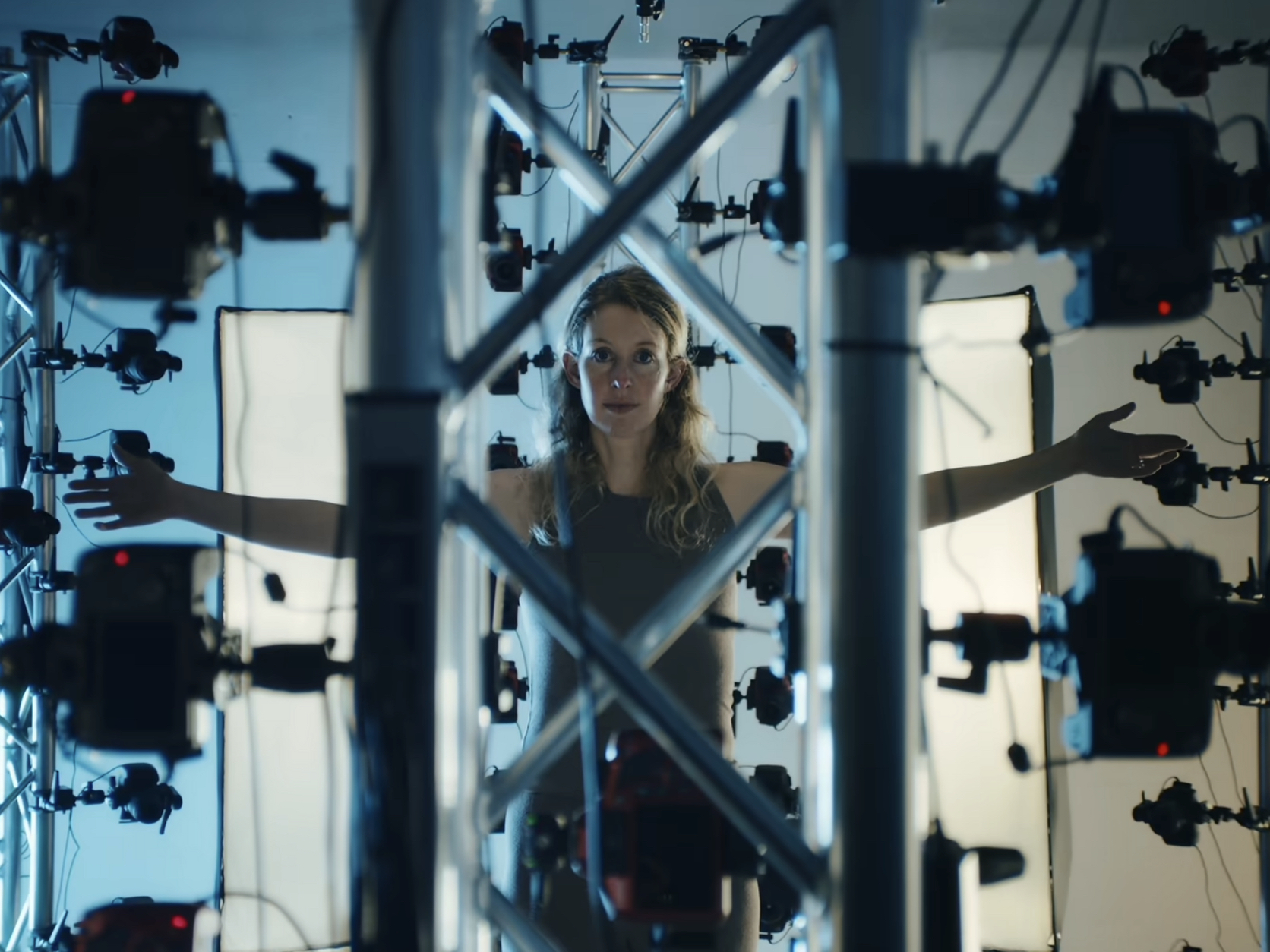
It doesn’t take long at all to get “the ick” from Lance Oppenheim and Nathan Fielder’s You Can See Everything. With an opening first scene that’s a close-up shot of Elizabeth Holmes’ husband, Billy Evans, on the phone talking about her and the public “perception” of her as if she’s not there, it’s clear from the very beginning that the last person who gets to speak “directly” about herself is Holmes. At the same time, it doesn’t truly appear at any point that Holmes is much inclined to speak directly about herself, or even the things that “went down” with her failed, fraudulent company, Theranos. This despite Fielder’s best efforts to “draw her out.” But the question that keeps cropping up throughout You Can See Everything is: can you really “draw out” someone who has turned themselves into a fundamentally unknowable avatar?
And still another question that arises—though none of the critics seem to be saying it out loud—is: does Holmes have autism? Because, apart from believing so staunchly in what she calls “her truth” (therefore, committing to the “bit” of her lie forever), there seems little other explanation for how she comes across in this documentary (unless one instead wants to chalk it up to “being an Aquarius”). Well, in the end, it’s something altogether different than a documentary. Something that needs a new word to define its genre, though maybe that’s not necessary either since the likelihood of a director ever coming across a subject like this—and one so willing to “give access”—is quite slim. Not to mention the confluence of events that leads the actress who played her in a TV series also being willing to participate so unabashedly. And in a way that creates what can be described as the ultimate in “meta-ness.” With Amanda Seyfried watching the scene of Holmes watching her acting as Holmes in The Dropout and reacting quite emotionally to it serving as perhaps the definitive “mind fuck” of the movie.
Both women’s reactions to seeing what they’re seeing onscreen is one of “wrestling with” something. For Seyfried, it’s the concern about the “ethicality” of what she did. Was it really her “place” to “speak for” Holmes in this manner, even if it was made clear the show was fictionalized? For Holmes, it’s having her life and her “character” portrayed in a way that she never consented to (indeed, as Seyfried explains to Fielder, one of the stipulations of making The Dropout was that Holmes could not be consulted with). It’s a kind of torture that Pamela Anderson similarly endured with Pam & Tommy (incidentally, also a Hulu show)—even though, like The Dropout, there’s no denying its merit as a TV series. Though it still begs the question (as You Can See Everything does): just because you can make a “great” piece of art about someone famous/notorious, should you? For it presents a different set of ethics that that many filmmakers and writers have chosen to bypass in favor of creating the project. In this regard, it makes sense that someone like Madonna would be determined to direct her own biopic, commenting, “I’ve had an extraordinary life, I must make an extraordinary film. It was also a preemptive strike because a lot of people were trying to make movies about me. Mostly misogynistic men. So I put my foot in the door and said, ‘No one’s going to tell my story, but me.’”
Holmes, in contrast, has become somewhat known for giving away her power—her story—to other men. Whether that was investors in Theranos or her now notoriously toxic romantic partners in the form of Sunny Balwani and Billy Evans. Before these two, however, it was apparent that Holmes was kind of a “patriarchy girl,” looking to an OG tech bro like Steve Jobs as an inspiration after which to model herself (complete with the black turtlenecks). And with Evans pulling the strings both on and off camera (despite being eight years Holmes’ junior), it doesn’t seem as if Holmes was ever quite the “empowered” woman that certain illustrious magazine covers presented her as. One of those images being what Seyfried herself recreated for The Dropout: Holmes holding up a tiny, pill-shaped plastic vial with fake blood inside of it on the cover of Forbes in 2014.
And, going back to the exploitative connection between The Dropout and Pam & Tommy, funnily enough (or perhaps creepily enough), Evans name-checks Anderson in reference to wanking while Holmes is in prison. Just one of his many grotesque comments that ramp up once Holmes is gone, and Evans’ mask seems to come entirely off in front of Fielder and Seyfried (who has, by this point in the documentary, become a fixture) as he makes crass remarks and offers no attempt to hide the ways in which he’s exploiting Holmes’ image without consulting her (even boasting about how she gave him power of attorney before she went to prison). Not to mention, per a scene that Fielder has Seyfried reenact since it wasn’t filmed (further adding to the “what’s real and what’s subjective reality” conundrum of this documentary), asking A24 executives for a cut of the film’s profits on the backend. When it happened, as the reenactment proposes, Holmes had left the room to go check on her baby. And Fielder can’t help but ask aloud to Seyfried whether that was contrived timing on both of their parts to make it seem like she was unaware of his actions or if she genuinely didn’t know that Evans had asked for a cut (this being a well-known “faux pas” in the “code of ethics” of documentary-making).
Indeed, everything is about “seeming” and “appearing” in this “exposé,” of sorts. Though what it’s really exposing is that perception belongs to whoever controls the narrative. At the same time, it’s almost as if no one is controlling it in this documentary. To be sure, Fielder has met his match in Holmes in terms of besting him at causing a sense of discomfort and awkwardness. Not least of which is due to her constantly bearing this wide-eyed, shit-eating grin (which also serves as the movie poster…that is, the non-blurred version of it). An expression that also commands of the viewer: can anyone really be that naïve after having gone through what she has? Or is there some part of her that’s essentially “checked out” in order to keep functioning? To allow herself to keep genuinely believing in the lies she told about “the device” at the center of Theranos. Perhaps it’s the part of herself that has always gone into “beast mode” when the time comes to “face the music.” Something she’s avoided doing for most of her existence in the twenty-first century.
You Can See Everything is very much a part of that bid for “exemption.” A way of saying, “I can’t be blamed, I’m just a mother of two young children who’s also in an abusive relationship.” The dynamic of such a relationship ostensibly being familiar enough to Holmes to be deemed as “comfortable.” Probably more “comfortable” than a healthy relationship would feel. And, of course, it doesn’t take more than a “psych 101” level of knowledge to know that the model children get for relationships is from their parents. Which brings one to Holmes’ father, Christian, and mother, Noel. While the former seems (that word again) perfectly “affable,” cooperative and concerned during his brief scenes in You Can See Everything, it should say something that her mother is never once shown speaking. A silent witness to the terrors around her. Including watching her daughter continue to insist she did “nothing wrong” and really shouldn’t be facing jail time at all.
There comes a moment when Fielder and Oppenheim opt for a telling close-up scene of Christian and Noel holding hands as if “strapped in” for the ride that is their daughter. The ride that is continuing to stand by her even though it’s quite obvious (or should be anyway) that she’s part of a unique sect of “A-list” millennial con artists, the likes of which also include Anna Delvey (who also got her own TV series treatment in the form of Inventing Anna, released the same year as The Dropout). In fact, the comparisons between the two have been so long-running that even Delvey weighed in on You Can See Everything via an article she wrote for Air Mail. But where Delvey and Holmes fundamentally differ is in how much more visibly “in touch” Delvey is with her crime of fraud. How she instead chose to own the “being a bitch” of it in a manner that continues to evade Holmes, who instead prefers to play the “innocent lamb” trope for all it’s worth. And, as the box office has shown, it’s been worth quite a lot. But the thing is, when it comes to Fielder making both Holmes and Evans look rather, well, batshit, can one really be branded as the “innocent lamb” when they expressly invited the wolf in? And no, it isn’t “bravado” or even “stupidity” that led Holmes and Evans to do this, so much as, it would seem, an attempt to rebuild Holmes’ brand from the ashes it crashed and burned in after the death of Theranos.
Hence, Evans being sure to talk up “Theranos 2.0” in the documentary a.k.a. a company they’re billing as Haemanthus (named after a species of plant called the “blood lily”—one supposes that’s better than a mashup of “therapy” and “diagnosis”). In fact, there comes a moment in You Can See Everything when Holmes is held up as a kind of Elon Musk “type.” Because, after all, he had many failed business ventures before becoming the world’s first trillionaire one sees before them today. And this is where the argument of a “double standard” has been coming in a lot lately as a result of this film. A “reevaluation” of just how grave Holmes’ crimes have been compared to, say, a certain Orange Creature (once a failed businessman before becoming a failed president). This is, in no small part, due to Fielder being visibly “charmed” by her as the “narrative” unfolds, even as he likens her to David Blaine performing the “magic” of his icepick-through-the-hand trick. The “trick” being that there isn’t one: he is actually driving that icepick through his hand (granted, Holmes could never perform the magic of making her “billion-dollar idea” truly functional).
This is the analogy Tyler Shultz, a key whistleblower on the Theranos scam, brought up in his CBS Mornings interview after seeing the film for himself. That Holmes genuinely is in a toxic relationship for the sake of, it would appear, amplifying the victimhood persona that has been serving her rather well in the wake of this documentary’s release. That she really did have this man’s children knowing full well what kind of person he is (and, lest anyone forget, the birth of each of her children was conveniently timed to delay the trial for her sentencing, as well as delay entering the prison system to start her sentence).
And perhaps, like Delvey, she would have gotten more sympathy sooner if she had “played her cards right.” With Inventing Anna suggesting a kind of “what’s the big deal, it’s only stupid rich people she was defrauding?” angle. As for Holmes, it isn’t even defrauding already rich people (including Rupert Murdoch) of millions of dollars that makes her a villain. It’s, as Shultz would remind, the emotional havoc she wreaked on so many patients because she rolled out a product she knew wasn’t operational. A product that allowed perfectly healthy people to be told they had HIV, or cancer, or had such high levels of potassium in their system that they should probably be dead. There was no concern for them or their well-being (emotional or physical), only Holmes’ narcissistic aim to become the Steve Jobs of the medical world.
Yet, for whatever reason, Fielder and Oppenheim can’t help but be as hypnotized by her as the media and her investors were at the peak of Theranos’ clout. This in part because she puts on such an “earnest,” “nothing to see here, but you can still see everything…if you want” display. Nonetheless, there’s so much of You Can See Everything that comes across as inauthentic. None of the “emotions” displayed seem genuine, so much as a put-on because everyone knows there’s a camera around. Even when it comes to a seasoned actress like Seyfried, who talks about having her own sympathy for Holmes, while also immediately envisioning playing her post-trial after Fielder shows her the now famous clip of the exchange where she says, “Why would I deceive you?” Seyfried gets that chance with these reenactments. Though she doesn’t have the same knack for coming across as autistic that Holmes does.
At one point, Holmes even tells Fielder that she’s “literal.” Yet another telltale sign of the autistic mind. As she further evidences when Fielder has to break down a comedy bit from Abbott and Costello (their most famous, “Who’s on First”) to explain to her why it’s funny. And maybe it’s this “childlike” way about her that Holmes never once drops during the filming that finally endears a skeptical Fielder to her. To be sure, You Can See Everything finds Fielder, as Seyfried points out, warming to a woman that has managed the impossible magic trick (a nod to that David Blaine reference Fielder makes): rebranding. Better still (for her), having people call into question whether or not she really is guilty of any crime. Which, yes, of course she is. There’s absolutely no doubt about that. Yet the “brilliance” of Holmes is as much in her “scientific mind” as it is in her ability to make those around her question reality. To wonder if maybe she somehow lives in the “real” world and they don’t.
And her delusional certainty (or incredible acting job, depending on who ask) of that prompts her to text Fielder, “You can totally see everything” after encouraging him to stay 24/7 at the house she and Evans are renting in Del Mar. In the end, though, people will only see what they want to see. A “redeemed”/“changed” woman, a psychopath, a half-gone woman tortured by those around her or a woman so far gone she really believes in her con.


+ There are no comments
Add yours