


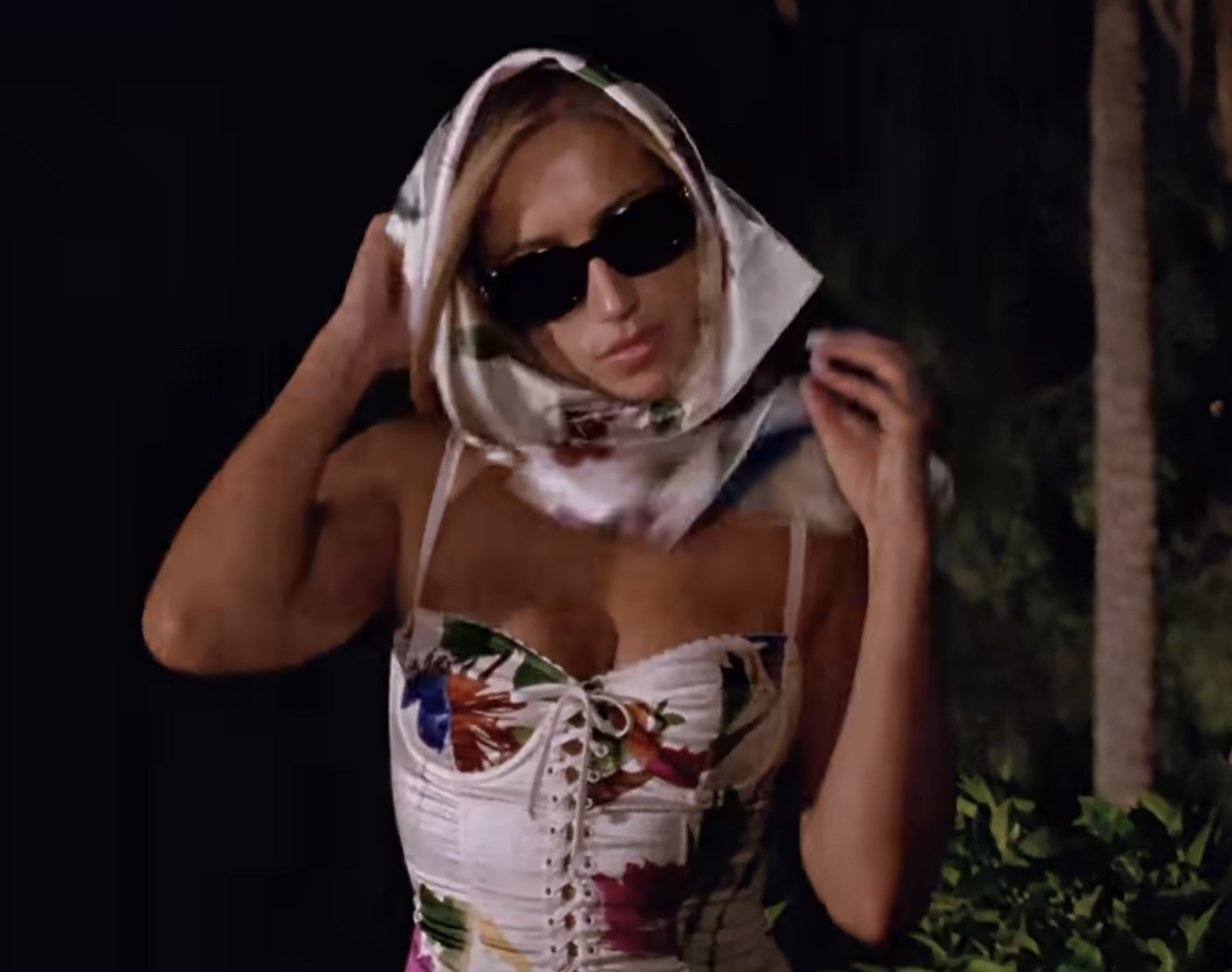
There’s a mark of a true “pop icon.” Not just a pop star, but an icon. And that mark, invariably, is being beloved by the gays. More to the point, getting them excited to attend club nights devoted to a single pop diva’s oeuvre. With this in mind, the thought of any gay man “clamoring” to attend a “Tate McRae Night” at his bar/club of choice doesn’t exactly seem likely. At the same time, there are certain kinds of gays—like the ones who fuck with Katy Perry—that might have no issue admitting to being a McRae fan. However, her latest single, “Housewife,” and its accompanying video, do little to endear the “non-Katy Perry” gay to McRae. Mainly because there’s absolutely nothing intelligent or camp to what she’s saying in the lyrics or doing in the music video, directed by Pierre-Ange Carlotti (who must have had some extra time while in the South of France after completing his debut feature, Forty Love, and thought, “Sure, guess I’ll direct this since Tate McRae is here too”).
A video that opens with McRae ostensibly trying to channel some Lady Gaga-in-the-“Paparazzi”-video energy with the whole “posh”/rich bitch-living-in-a-villa shtick as she then delves into lyrics that more than slightly veer toward being a jank iteration of Lana Del Rey-circa-Born Die as McRae sings, “Think my paradise is tabloids and flashing lights/Truth is it’s more like loads of cash.” Already, the “height of profundity.” And yes, McRae thinks it’s endlessly clever/“a serve” when she struts around the garden of her villa pushing a pram in a bikini only to reveal that what’s in the pram is not a baby at all. Or, well, it kind of is—except McRae’s version of a baby happens to be money (and, in a sense, there’s an unwitting dual meaning here in that all babies are money pits). As is the case for most hyper-capitalist people who don’t want to merely “have enough,” but have “more, more, more”/“it all.” And ever since the brand of second-wave feminism that Gloria Steinem biffed by making it all about becoming “like a man” in terms of conditioning women to want to be just as money-hungry (that is, if they truly wanted to be “equal”), pop stars like McRae have been getting their message of so-called empowerment all wrong.
In fact, “Housewife” is one of the worst examples in recent memory of a woman trying to sing about being “empowered” while simultaneously touting all of the “ideals” that has made modern society so fucked. Most glaringly, the chorus itself, which bluntly declares, “I just wanna make a lot of money, be my own housewife.” The latter part of that sentence designed to somehow cushion/“make right” the vacuity of the former part of it. Never mind that such a proclamation doesn’t even make sense—or rather, doesn’t mean what McRae and her bevy of co-songwriters (namely, Grant Boutin, Jasper Harris, Julia Michaels [good that at least one other woman could be included in a song about “female independence,” no?], Pablo Diaz-Reixa and Ryan Tedder) want it to mean. Yes, McRae is trying to say she doesn’t need a man—reemphasizing the Cher aphorism, “Mom, I am a rich man”—but there’s no logic or wit to her saying that, as a result, she can be her own housewife. Especially since when one is a housewife (and there are many women who still are, often in the face of having no other choice), the potential to make a lot of money isn’t really there. Hence, this somewhat antithetical analogy that’s trying to be clever when it’s just plain daft (and, in truth, a line like Amy Winehouse’s “I should just be my own best friend/Not fuck myself in the head with stupid men” is more aligned with what’s McRae tries and fails to say).
As is the non-concept around the “Housewife” video, which also finds McRae gleefully running toward her yacht, named “Tati.” An homage to her alter ego, “Tatiana,” which she describes as the “character” that allows her to feel liberated and uninhibited onstage. Though one will note that Britney Spears—who McRae is often inexplicably compared to—never felt obliged to make up any bullshit like that when she was shaking her ass in often next to nothing onstage. Yet she, too, subscribes to the notion that her “off-duty” personality is far more introverted and awkward (dweebish even). In any case, while “Tati” is on Tati the yacht, she frolics around with her proverbial “hot boyfriend” (played by Thijmen Oerlemans). In another scene, she throws punches at a man (played by Ruben Moreira) that could either be her “boxing trainer” or another love interest or both. And, not surprisingly, he will also appear on the yacht when McRae seemingly gets bored enough of the other guy and also bored enough to read (specifically, Colette’s The Vagabond, which at least seems to be a better attempt at making this song “mean something” based on the plot of said novel).
As if to keep making her point that she is fulfilling the entirety of the abovementioned Cher aphorism (which stemmed from Jane Pauley reading back another quote of Cher’s to her: “A man is not a necessity, a man is a luxury—like dessert), McRae adds another “male option” (played by Simon J.Lööf) into the mix on her yacht. Because if men truly are a “luxury,” then McRae is parading them as a status symbol throughout “Housewife.” Even if “Nobody’s Girl,” the obvious companion piece to this song, touts, “I am nobody’s girl, I love it so much/It’s exactly what I wanted, oh” (though it seems, based on how often she keeps saying something of this bent, “the lady doth protest too much, methinks”). At another point in said bonus track from the deluxe edition of So Close to What, McRae offers still more uber-capitalistic sentiments in the form of a lyric like, “Gotta put myself second to none” (yet almost immediately afterward admitting, “It’s a little sad”).
Something she continues to do and display in “Housewife” as she mostly prances about by herself while showing off some of her signature erstwhile backup dancer moves (let’s put it this way, despite her extensive dance training, Addison Rae still takes the cake on being an extensively trained dancer-turned-pop star—particularly because the latter has far more of a tangible identity). So if this is what it is to be “liberated,” it doesn’t look all that scintillating. In fact, it only seems to underscore the longstanding cliche that women are frivolous even when (and if) they manage to secure power (again, something that is presented as only being possible through extreme wealth). Such frivolity further underscored by other wannabe-clever “isms” like, “Go into my garden, pick the money off the tree/I don’t pay for nothing, baby, people pay me” (said in a very Taylor singing, “I don’t trust nobody and nobody trusts me” intonation).
And then, as if to add to the arbitrary and nonsensical nature of it all, McRae starts getting into fights with her “desserts”—almost as if she’s doing it solely because she’s feeling bored rather than stifled or oppressed by her male company. The ones she tells, “You could be the one I’m calling honey, be my sex on the side” (in short, she might as well put an ad out for a cabana boy). Thus, throwing objectification back in men’s faces when that isn’t exactly the point of feminism.
With that in mind, in contrast to other fairly recent mainstream “feminist” anthems like, say, Jennifer Lopez’s “Ain’t Your Mama,” McRae does little to espouse ideas of true equality or present women with anything resembling a “radical” vision about how to live. Instead reinforcing the tired notions that money is power and so you should pursue it mercilessly to gain independence as a woman. In other words, by emulating the cold, machinating stereotype that “successful” men have cultivated for centuries.


+ There are no comments
Add yours