


Since, evidently, calling something a “visual album” is now so 2013 (yes, a nod to Beyoncé “chang[ing] the game with that digital drop”), it appears that Madonna set the precedent this year with officially calling a visual album “: The Film.” And in her case, it was Confessions II: The Film. Even if its runtime of about ten minutes and seventeen seconds (which gets boosted to thirteen minutes and fifty-four seconds with the credits) makes it more of a “short film” or a “long music video.” As for Charli XCX—who is quite aligned with Madonna this year—following in this new tradition of calling a visual album a “short film,” the runtime of hers really does put it into that category (for it’s even longer than Ariana Grande’s Brighter Days Ahead). And, also like Madonna, she opted to show “the film” in a few select theaters. Which is why it starts out with her talking like she’s in “confessional” mode and telling the audience,
“Hey, it’s me. Um, Charli. Thank you all so much for being here. I’m, uh, really grateful that you came and I can’t wait for you to hear my new album, Music, Fashion, Film, particularly in this setting. Um, throughout this album process, I’ve been making things with my friends and I’ve been loving every minute of it. Um, I made the whole album with A. G. Cook and Finn Keane, who are, uh, two incredibly important people to me. Two people who have become my close, close friends through working on music and creating things together. Um, I’m so excited for you to hear this album and, uh, yeah, that’s it. This is Music, Fashion, Film.”
A title card then announces, “Music, Fashion, Film 30:05.” That latter number being the runtime. At least for the duration of the songs themselves. The in-between bits where she’s talking to or “riffing” with others isn’t factored in. Nor is the time for another title card to also announce this is “Directed by Charli XCX.” In other words, she’s not only laying the groundwork for her acting career, but also her directing one (sort of like her nemesis, Taylor Swift, who’s been directing her own music videos for a while now, but the truth is, Billie Eilish is the real “queen” of doing this).
And, as the director, XCX opts for another “transitional” scene of her roaming the streets of Paris (for she recorded the album at Rue Boyer) as she offers the voiceover, “Well, I love music and I love fashion and I love film and it’s not that I’m, like, an expert in any of those fields, it’s more just that they’re so intrinsically what my life is about.” Another voice offscreen then tells her, “…for better or worse, it’s kind of the meaning of your life.” She agrees, “Yeah.” This then leads into “Rock Music” (allotted a time of 1:55 on the preceding title card). Except that Charli already has a video for this song, one that was, quelle surprise, directed by Aidan Zamiri. So in lieu of just putting the same one into this “film,” XCX decides the best approach is to show the behind-the-scenes portions of making the video (kind of like her own version of MTV’s Making the Video).
This means showing quite a few scenes of her being photographed or filmed, in addition to highlighting the “extras” involved in the headbangers/mosh pit scene. There’s also plenty of “insight” moments about the level of detail that goes into filming, like Charli learning “choreography” for moving about the hotel room with a cigarette that she pantomimes having in her hand until the scene is going to be shot and she’ll use a real one. Like the actual “Rock Music” video, this one intersperses occasional scenes in color amidst its predominantly black-and-white ones. The decision to mostly reveal the “mechanics” behind creating the visuals for “Rock Music” is ostensibly meant to remind viewers of the intricacies that go into making even the shortest of “mini films” (a.k.a. music videos). Thus, the intricacies that go into making art in general.
In the next “interlude scene” that follows, XCX walks down another Parisian street chatting with Cook and Keane as they walk toward the studio. Her voiceover then announces, “It was really fun recording in Paris. There’s a je ne sais quoi about it, I suppose.” She then giggles, knowing how stupid it is to say something so on the nose, but doing it anyway. And, talking of “on the nose,” “SS26” (allotted a time of 2:46 on the preceding title card) is sure to play up the fashion show angle of the track. Albeit from a new perspective this time around since “SS26” also already got a “real” video directed by Torso (with XCX momentarily “shafting” Zamiri from work). Incidentally, the directing duo, consisting of David Toro and Solomon Chase, also helmed Madonna’s Confessions II: The Film. For Music, Fashion, Film: The Film, however, “SS26” is all about showing XCX in her least glamorous mode as she tries on different couture outfits (with an Ann Demeulemeester and Balmain label getting some especial close-ups) and gets photographed while wearing them so that she and her team can then select which ones to use from a board of Polaroids.
In truth, when she sings on “Camera,” “Daring to fail and being ugly,” it’s as if that line could apply to her aesthetic during this “trying-on” portion of working to make the real “SS26” video come to life. What’s more, XCX shows off her knack for multi-tasking by not only trying on the clothes and shoes, but also practicing some of the choreo she’ll need to know for this video as well, which has her strutting down the runway à la Carrie Bradshaw in “The Real Me” (complete with the tumble that Carrie takes while walking so that Stanford Blatch can’t help but shout from the sidelines, “She’s fashion roadkill!”).
Once the dress-up segment concludes, another interlude scene of Charli being shot from an overhead perspective as she sits in a stairwell occurs. Setting the tone for “Card Declined,” she remarks, “I like to shop in London, I like to shop in Paris, um, I like to shop in New York. It’s not really about shopping, I suppose. It’s more about shopping for, I don’t know, like, a new identity. You know how, like, things and clothes can make you feel kind of like a different person sometimes? Um, and sometimes you can feel, like, lost until you found them. Which in a way is kind of sad I suppose.” Charli’s musings are then cut off by the title card for “Card Declined” (allotted a time of 3:28), her moodiest, most 1970s post-punk-inspired track on Music, Fashion, Film.
Commencing with a scene of someone’s hand (presumably Charli’s) switching the sign of a shop from “Open” to “Closed,” the entire “premise” of this part of the “film” is Charli, once again, trying on clothes. Or, more specifically, lingerie. More specifically still, Agent Provocateur lingerie. Hence, the paparazzi photos of Charli outside the store earlier this month with speculation that she was shooting a video there. Little did they know, it was all part of a larger project—this film. To boot, Charli is no stranger to the Agent Provocateur brand, having served as their spokesmodel for the 2019 holiday lookbook that had a Western theme (ergo, Charli’s cowboy hats and fringe—in fact, it looked a lot like Madonna’s Music era). Maybe that’s why she looks so at home in the shop, prancing around in various states of undress in between brief scenes of things like a close-up on a pair of handcuffs or her lifting her fishnet-attired legs into the air against the backdrop of the ceiling.
With each new item she tries on, XCX does appear to embody some kind of new persona that has even more “attitude” than her ordinary Leo self. And when the song starts to transition to what fans first came to know as the B-side to “Rock Music,” “I Keep Thinking Bout You Every Single Day and Night,” that’s when Charli reverts to the same footage (shot by Aidan Zamiri in some Kyoto dojo—since dojos are quite happening ever since Lily Allen’s “Pussy Palace” was released) she already released for that very song. Or “B-side” that’s also part of the A-side that is “Card Declined.”
Up next is an abrupt shift to a color scene of Charli in all the glory of her Daniil Antsiferov outfit that’s only shown in black and white for the true “Camera” video, which features Vincent Cassel as the main attraction (and XCX scarcely revealed in it, albeit in the role of the director—despite it being directed by Zamiri). The “true” video, as it were, was inspired by a picture of James Dean on the set of Giant, looking as XCX describes, “…so exhausted, so fed up, so over it. It triggered [me and Aidan] into thinking about push and pull of emotions when making something—the idea of putting yourself through something uncomfortable in pursuit of art and performance. It’s something that we really connected to. Even though it can feel hard and sometimes humiliating, there’s a burning passion to get to this place where you feel something powerful and indescribable.”
With that image and concept as their “jumping off point,” XCX then personally reached out to none other than Cassel to ask him to embody this feeling so unique to artists, and particularly actors (an art form that requires putting yourself through the kind of humiliation that Charli herself has come to know all too well as she embarks on her newfound career as an actress). Playing the voice message she sent Cassel, this version of “Camera” starts out with her saying,
“Hey Vincent, I hope you’re good, um, okay I’m gonna try and explain this, uh, video idea and I’ll try and keep it brief. So, the song is called ‘Camera’ and it’s kind of about the relationship between, like, performer and camera that is sometimes really, like, tempting and exciting, but also can sometimes be unbelievably, like, vulnerable and actually, like, a bit embarrassing. Even though it can feel embarrassing and frustrating or whatever, it’s like you still are kind of like pulled towards it. So the idea of the video, it’s this one-shot video in black and white and it’s based on this James Dean image, and we sort of see this actor, the kind of main character—ideally, you [laughs]—um, move to set and stand on a mark and then be, like, kind of constantly interrupted as he is trying to perform this sort of like emotional, um, take.”
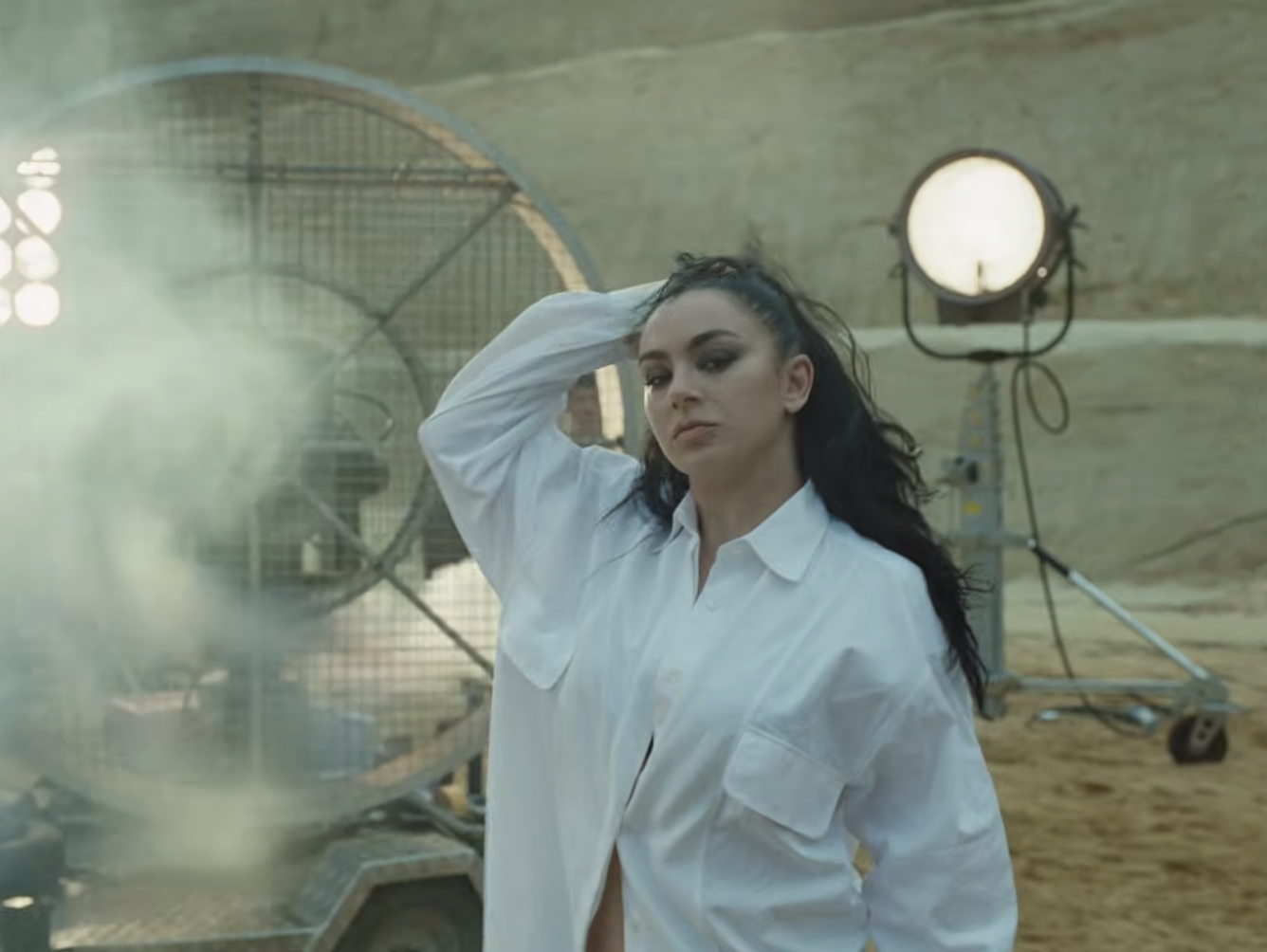
Cassel’s much more succinct response to XCX’s pitch is what then gets played as she continues to pose for the camera: “Charli, it sounds great. Super exciting. I totally understand what you mean, and what you want to talk about. What’s the next step?” With that, the title card for “Camera” (allotted a time of 2:31) appears and Charli is allowed to then take center stage in this version of the video, making the most of the wind machine behind her that blows plenty of dust in her general direction as she prances around in a button-front white shirt and black underwear. An overturned crashed car behind her further adds to the feeling that there’s something of a callback to the “White Mercedes” video here, including the desolate, dirt-filled setting. And when she finishes telling the camera, “And maybe this is it, maybe it’s what I need/‘Cause it’s the only way to feel like I’m not actually me,” it leads back into a black-and-white shot, this time of A. G. Cook showing her a pedal that says, “GRUNGE” on it.
Charli instructs, “Okay, tell us about the pedal.” “Well, okay, so this isn’t the original, original version… It always looked kind of like this, but there was one that was made specifically to piss Kurt Cobain off.” This is followed by another cut to Cook fiddling on his guitar in front of his laptop before the two very briefly find themselves outside and Charli notes, “I’ve always thought it was cool to make a song about making TikToks.” Back inside again, Cook keeps fiddling with the guitar and “GRUNGE” pedal in front of his computer as he begins to fine-tune the musical backing for “2007,” Charli’s homage to those simpler pre-fame days when she was just tinkering (in much the same way as A. G. in this scene) in her bedroom and imagining herself as a Britney Spears-level pop star (even as Spears clearly hated the year that was 2007) while coming up with songs and uploading them to MySpace.
When the title card for “2007” then comes up (allotted a time of 2:04), it’s no surprise that Charli opts to make her dream somewhat come true by showing viewers nothing but a mass of her various TikTok videos onscreen. Perhaps the second-best thing to “mak[ing] a song about making TikToks.” Many of the videos are recognizable from recent months, including the one of Charli standing in between the movie posters of The Moment and Wuthering Heights at a theater and bopping around with some popcorn. Others go further back though, like to the days of 2022 when XCX was making the video for “Good Ones” at the outset of her still underrated Crash era. Alas, none of the videos can go back to 2007 itself, a time still simple enough that TikTok wasn’t even so much as a germinal idea in anyone’s brain. And MySpace was still experiencing “internet supremacy” (though not for much longer, for the same year, the release of the first iPhone would pave the way toward changing everything, and shifting it toward a more “app-centric” internet existence).
So even without TikTok, Charli is correct in her “2007” assessment, “All from your apartment you can shine bright like a star.” Hell, it worked for her then idol, Lily Allen. And, in its way, worked for Charli as well. For, were it not for MySpace, she might never have been contacted by that club promoter that wanted her to play at warehouse raves (thereby establishing her early Brat period). And if that hadn’t happened, who knows if she would have ever found her way to George Daniel, the subject of “I’m Afraid,” with a black-and-white segment that shows Charli walking into a building with Cook and Keane as she delivers the voiceover, “There’s something very Jonathan about this song, you know,” admitting, “It’s a sad song, yeah. Um, kind of avoidant, I suppose. It talks about my avoidance [laughs]. Yeah, um… George likes it though, I think he understands.” Or so one would hope. Not that there’s anything “bad,” per se, said in the song, whose title card (allotted a time of 2:11) comes up next.
Unless George finds it “bad” for Charli to admit things like, “I’m destroyed, I’m a bitch/I’m too drunk, I can’t sleep/I can’t feel, I’m afraid/I’m afraid, I’m afraid” and “I’m nothing without him/What if I ruin it?” All of these things laid bare in video form as she stands in front of Cook (wielding an acoustic guitar) and Keane (wielding an electric one and standing in front of a keyboard) singing into a microphone in the studio for another black-and-white video. And while this song’s rendering in visual form is among the simplest of Music, Fashion, Film: The Film, it’s also among the most earnest and heartfelt. Stripped entirely of any sense of XCX’s usual irony.
That, however, is not the case for the “vignette” that follows, with XCX introducing it by way of a conversation with Cook and Keane outside the studio (presumably) where she admits of “Yeah,” “We were in a funny mood that day that we made that song—well, I was in a funny mood.” Keane confirms, “You were in a bad mood so I think you then left and sort of went into sort of like a weird only child mode and you [motioning to Cook] completely understood that and you were both just silent in the room. And me, having siblings, got really nervous and tried to sort of bridge the gap between you.” Cook blasély interjects, “Yeah I didn’t even notice.” Charli then ultimately concludes of “Yeah” and what it meant to her, “For me it’s specifically about that thing of, like, when you make a song and you’re like, ‘Wow, this feels so fun and, like, silly and cool to do this.’”
To that point, she clearly wanted to have a “silly” and “cool” visual to go with a track that finds her mostly repeating, “I don’t wanna.” A phrase that, of course, still gives off such Brat energy. As Charli herself does while strutting through the streets at night after a title card for “Yeah” (allotted a time of 2:17) comes up, she sports “capri pants” (a testament to her millennial nature) and a crop top that’s unzipped both below and at the top for maximum cleavage effect. Flipping her hair and generally “mugging” for the camera, Charli exudes the same confidence and “no fucks given” aura that she’s long been associated with (at least since 2022). Glitched-out effects and rewinding some of the moments of her walking down the street also combine to give this segment a slightly less “no frills” effect. Not to mention a slightly trippy, disorienting one (perhaps the influence of watching too much Lynch and/or Cronenberg).
Having concluded that song with the lyrical assertion, “Now I wanna feel it/Yeah/Feel,” it makes sense that Charli would include as the next “interlude” visual moment a call she made to her longtime creative director, Imogene Strauss, explaining that she wants to make a “last-minute” video in between the release of “SS26” and “Camera.” That video would, of course, be the extremely evocative and tactile (because, yes, she wants to feel it) “Wink Wink.” Which, as she mentions in the call to Strauss, would be shot near her parents’ home in Essex. This also happens to be a version of the little clip she posted on her Instagram to give insight into just how quickly it was put together, complete with Strauss asking Charli, “Should we get Aidan on the phone when we are ready?” And yes, Zamiri of course ended up directing it.
In any case, as she makes her desire for the creation of this video known to Strauss, there’s a continuous shot of her applying lip liner in the mirror of the car’s visor, looking not unlike Lindsay Lohan as Cady Heron doing the same with lip gloss at the soap store where Janis Ian (Lizzy Caplan) works. When Strauss gamely agrees that they can shoot it in about five days, the title card for “Wink Wink” (allotted a time of 2:03) comes up before cutting to the fields viewers will now recognize from the “real” “Wink Wink” video. And, just as she does for “Rock Music” and “SS26” within this film, “Wink Wink” in this context is more of a behind-the-scenes look at how the actual video was made. And, as with most of the visuals XCX comes up with, it takes a village—no matter how “uncomplicated” the concept might seem.
Among the smattering of, let’s say, “bloopers”-type footage, there’s a moment where XCX’s fake tramp stamp is being pulled off to reveal the words “Always Earnest” in cursive. And whoever she’s talking about in “Persona,” the next track on the record, she’s certainly being earnest in her summation of them. One that includes such declarations as, “Sometimes I wonder if you realize the way you come across, it’s kind of crazy” and “Don’t fucking choke on your ego when you see me coming/I know you’re performing, I know that you’re hurting.”
To introduce the “Girl, so confusing” of the album, Charli makes it known, “It’s funny how many people asked whether ‘Persona’ was about them. I mean, I suppose if you do think that that song is about you then I kind of guess it is about you. It’s very ‘You’re So Vain’ in that way. I guess I have narcissistic friends, but, I mean, I love them all. And this song’s about me too, so…guess I’m just one of them [laughs].” Of course, there must have been some part of her that knew people would try to guess Taylor Swift as a partial inspiration (minus the lyric that calls out seeing this person onscreen in a film, since most are aware that no one thinks of Swift as an actress, despite some of her varied attempts—ranging from Valentine’s Day to Cats to Amsterdam). After all, Swift did recently do Charli dirty with “Actually Romantic” from The Life of a Showgirl.
But maybe Charli has more interesting people to concern herself with in terms of the “real” subject of this song. The title card for which shows an allotted time of 2:37 before another no-frills concept materializes in the form of Charli standing in front of a projection screen that allows her shadow to appear behind her in a giant form (and sometimes, even a projection of herself on video as well). Thus, catering to the notion of “persona.” One self being “real” and one not quite. Though it depends on who you ask which version they deem to be “authentic.” At this point, maybe even XCX herself doesn’t know, hence, opting to go into acting so she can try to better to distinguish what’s real and what’s not by having to take on “personas” that are far more divergent from just her pop star one.
Someone in her life who seems to have no “persona” (a.k.a. artifice) at all is A. G. Cook, her frequent collaborator/“best friend.” Or at least that’s how he gets billed in “Magic Metal Montana.” Which features a brief dialogue between them before the title card (giving it an allotted time of 2:31) where Charli asks, “Has anyone ever written a song about you before?” Cook answers, “Not as explicitly, I think.” Charli balkingly probes, “Who’s written a song about you before?” With an oh so British kind of false braggadocio, he says, “I just assume there are a few.” But then, in a true measure of his Britishness—re: being uncomfortable with the expression of emotion—he admits, “I more thought it was a fun song that wouldn’t make the album.” In short, he doubted Charli’s commitment to immortalizing the ride-or-die nature of their friendship in such a sweet way. Made even sweeter by the fact that music is their shared language, as Charli points out with the lyrics, “You’re my best friend/But we don’t talk/We make music/We talk that way.”
Her love for Cook shines through right away via a visual that allows him to take up most of the spotlight…mainly by showcasing his unique dance moves (ergo, Charli complimenting, “Love your dance moves”). Even against the backdrop of some mountains that really do look like they’re in Montana. His moves are, at one point, rapidly cut with her moves imitating his for an effect that only heightens the notion of how in sync they’ve become. Of course, with such a love-in between the two, it’s no wonder that one fan would post a SpongeBob meme of Squidward looking on at Patrick and SpongeBob having a gay old time from behind the blinds of his porthole with the caption, “Finn Keane watching Charli write that song about A. G. in the studio.”
Charli assured on one of her platforms that Keane would be next, but, by now, her favoritism of Cook is well-known. Though he might need to watch his back with this new Cronenberg rapport of Charli’s, maximized to great artistic effect on the final track, “No One Lasts Forever,” the subject of which is art itself. And how, in spite of how much artists want theirs to last forever, in the end, even art will be forgotten. Therefore, “no one lasts forever.”
To segue into this track, there’s a scene of Charli offscreen asking Cronenberg, “So when you make something and you release something, you feel from that—I feel this way about my work at the point that I release it into the world—that, in a way, it’s no longer mine. Do you feel the same?” Cronenberg then mentions how, frequently, people will come up to him and mention a scene or piece of dialogue from one of his films, and he won’t even remember it, leading him to the conclusion, “It’s more theirs at that moment than it is mine.” Likening pieces of art to children, Cronenberg explains that in the “infancy” of these works, you’re very involved and “on the scene,” but eventually, they go out into the world and take on a life of their own. Or, as Cronenberg says, “The films are having a life without me, they don’t need me anymore. They can do it themselves.” The title card with “No One Lasts Forever” (allotted a time of 5:42) then comes up before the viewer sees Charli sticking her head out of a car window—which is the crux of this portion, the grand finale.
There’s also instances of her leaning back over a bridge that looks a lot like the one where she did her Crash photoshoot (though she’s in London for this particular segment, as the Ilford 425 bus [among other “tells”] indicates) in between lots of “elapsed time” scenes with a POV shot ostensibly filmed from within a car speeding down the road (for a decidedly “Ray of Light” video kind of effect).
As the song then goes into Cronenberg’s spoken-word breakdown, there’s a scene of William S. Burroughs and Antony Balch (from the experimental film, Bill and Tony) made to look as if they’re actually mouthing the words of Cronenberg’s warning, “They are dead, they are gone.” Repeated over and over along with “no one lasts forever.” And it’s around this point of repetition that scenes from Charli’s own career (shown in black and white instead of color as they originally appeared) are displayed in a kind of disjointed montage. Emphasizing the point that even someone as young and currently influential as she is will one day be subjected to the irrelevance caused by the passage of time.
The poignancy of incorporating her own “archival footage” (particularly the scene from the “party 4 u” video where she’s tearing down her own billboard image) into this is a testament to her own clear belief that, no matter what, she’ll keep sacrificing her life for art—and often at as much of a cost to her physical health as her mental health. Perhaps the mark of a “true” artist…or a madwoman (the two qualities often being one and the same). Or maybe just the mark of someone being well-paid for that art.


