


After Peggy Gou’s “Energy Mix” of “I Feel So Free,” Madonna’s lead single from Confessions II, it was immediately apparent that whoever tried their hand at remixing one of her songs next was going to have their work cut out for them. For Gou did an incredible job of “reinventing” the track that not only made her version of “I Feel So Free” on a level playing field with the original, but also made plenty of sonic references to Madonna’s early and mid-80s NYC heyday.
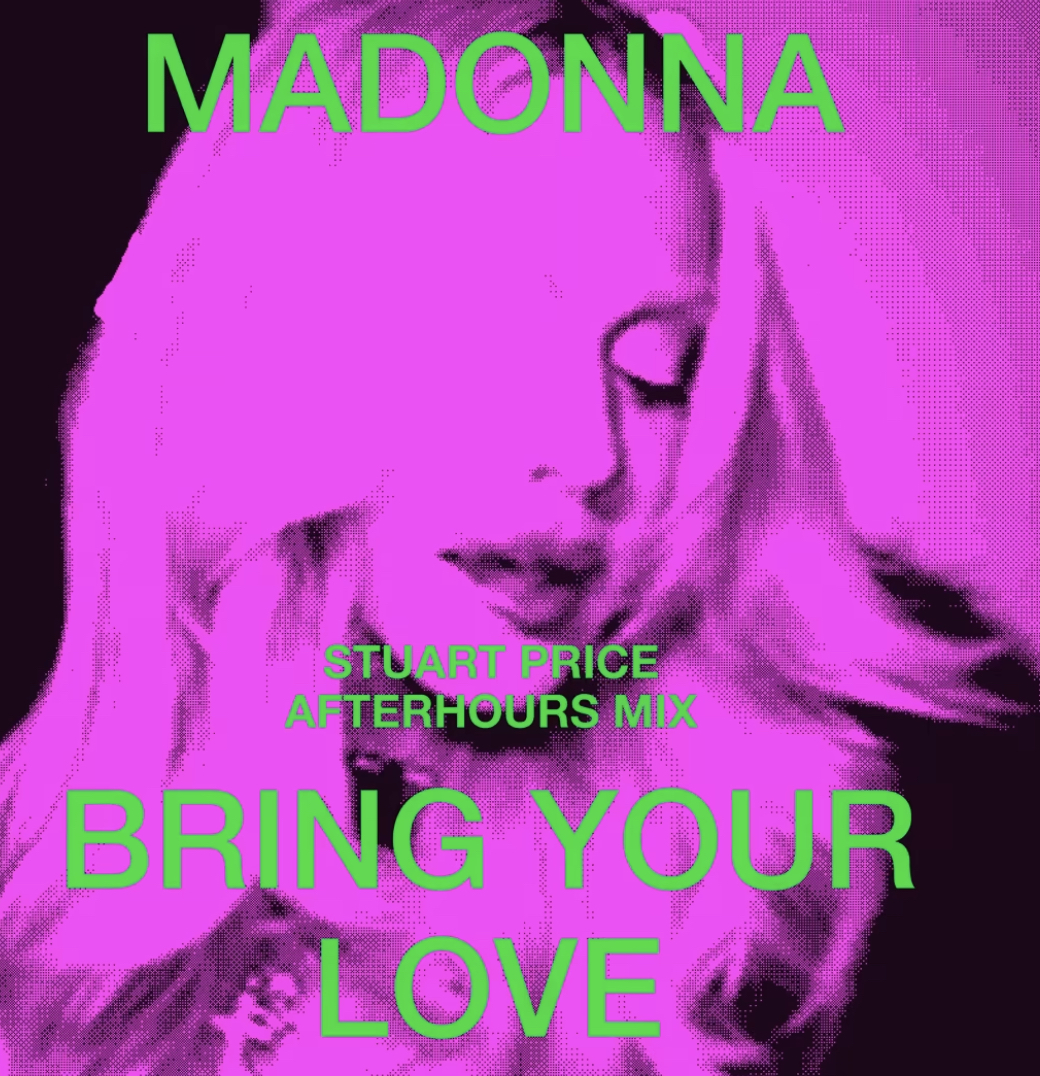
So maybe that’s why Madonna chose none other than Stuart Price to follow it up with his “Afterhours Mix” of “Bring Your Love.” For Price remains one of Madonna’s most trusted producers and remixers—no easy feat, what with M’s reputation still being that she “uses” people and moves on to the next when a new trend sets in (something that Patrick Leonard and William Orbit recently shaded her for—though they’re hardly the only ones to offer up sour grapes in their post-“working with Madonna” era).
Indeed, one could argue that’s the formula she followed when she approached Price in the first place, back in 2001, the year he was initially hired as her keyboard player for the Drowned World Tour (thanks to Madonna being a fan of Price’s Les Rhythmes Digitales), but then quickly stepped up to show his prowess as a musical director. At the time, Madonna was still riding high from the success of 2000’s Music (the album she was touring for Drowned World), produced by Mirwais Ahmadzaï. A musician she was introduced by director Stéphane Sednaoui (best known for directing Madonna’s 1993 “Fever” video) via his single, “Disco Science” (which also appeared in Guy Ritchie’s Snatch). With the success of that album, it seemed only right that Madonna should continue to collaborate with Ahmadzaï for 2003’s American Life. An album that became among her least favorably reviewed after Erotica (for, like the latter, American Life was ahead of its time in what it had to say).
So, yes, it would be difficult not to think that part of Madonna’s reasoning for pivoting to Price for 2005’s Confessions on a Dance Floor was to ensure greater chart success after her previous record. One that remains, despite its electronic nature, her most acoustic/“rock”-oriented yet. So it went that Madonna positioned COADF as a “return” to her dance roots (with her debut single, “Everybody,” setting the precedent for Madonna’s title as “Queen of the Dance Floor” apart from being the “Queen of Pop”). With Price at the helm of restoring them.
And here he is again, in 2026, doing the same. This after Madonna’s now similar pattern of working with Ahmadzaï on an album that is now regarded as her lowest-selling one: Madame X. Thus, at least a small part of Madonna, being as aware as she is of sales, streams, chart success, etc., waiting to release another album after a seven-year hiatus stems from wanting to be extremely methodical about ensuring it tops the last record she put out. And there is no safer way to ensure that than creating a “sequel” to Confessions of a Dance Floor with Stuart Price back at the helm. And, once more, creating remixes for the very music he helped to craft. “Bring Your Love” being his first reingratiation into the Confessions universe.
Tackling a song that, in its original form, features Sabrina Carpenter, in Price’s remix version, Madonna’s vocals are allowed to truly shine all the more without giving Carpenter any play. But before Madonna “shows up” to say, “Ask yourself this/What are you doing it for?,” there’s a pulsing beat for the first seventeen seconds—the kind of beat that’s emblematic of Price’s style. He also sees fit to add in a new lyrical layer to the intro, with a voice (presumably his) that announces, “Discretion, confession.” This tapping into Madonna’s Catholic background for sure. But it’s many of the other lyrics that delve into Madonna’s brand of philosophy, which is, as she once rephrased it on I’m Breathless, “An unexamined life is not worth living. So it is that Price brings out Madonna’s existential side all the more on this remix, with repetitions of such phrases as, “I got somethin’ I wanna talk about” and “What are you doing it for?”
Many will still argue (and not incorrectly) that Madonna is still doing it for numbers and glory. Hence, her trying to nip that speculation in the bud with the lyrics, “Don’t try to distract me with numbers/I did it all for love.” Indeed, that her “grand” confession of the song. That, contrary to popular belief, she’s been in the game this long as a result of her passion for her art (as frequently intermixed with commerce as it is). And that, were it not for such passion, there’s no way she could have stayed around this long anyway. Calling the act of doing so “the most controversial thing I’ve ever done.” For it’s true that the public still expects female pop stars to “fade out” when the “time is right.” With Madonna obliterating that wall and opening up new doorways to pop stars that have come after her, enabling people like Taylor Swift, Ariana Grande and, yes, Sabrina Carpenter to keep putting out records for as long as they want.
Which is why Price is sure to conclude the remix with Madonna’s “immune to your consultations” sentiment, “Bring your love/‘Cause you cannot shake me/Bring your love/‘Cause you’ll never break me/ Bring your love/‘Cause you cannot take me down.” Evidently, nor can anyone take down Price and Madonna’s impeccable “energy” whenever they come together for musical collaborations. Which leads one to believe this will hardly be his only remix offering from Confessions II. Besides, he remixed six of the songs for Confessions of a Dance Floor (“Hung Up,” “Get Together,” “Sorry,” “I Love New York,” “Let It Will Be” and “Jump”), so it would stand to reason that history might repeat itself with this album as well. And rightfully so.


