


After causing a frenzy (particularly with fans wanting to clock all the self-references) with Confessions II: The Film, Madonna wasted little time in offering up a standalone version of one of the videos contained therein: “Bring Your Love.” And, when taking into account that it’s a single that not only features Sabrina Carpenter (who carries the kind of clout Madonna once sought in Britney Spears), but has also been charting well globally, it makes sense that Madonna would choose this as the first “on its own” video to highlight from the Confessions II: The Film collection (as opposed to, say, “I Feel So Free,” which was technically the album’s “lead” single).
And so, to somewhat differentiate it from the version one sees in “the film” iteration, there are plenty of nuances to take note of in terms of comparing and contrasting the standalone video. Which starts in a manner very different to the one in Confessions II (henceforth to be referred to as the Confessions II: The Film version). For a start, it doesn’t lead with the minor car crash Madonna gets in before strutting unfazed into the warehouse rave, which is already filled with people. In the standalone version, the first shot is of a totally deserted warehouse that Madonna saunters into while twirling around and tossing her hair extensions about.
Then, to give a bit more context for those who might not have bothered watching Confessions II: The Film, TORSO brings the “fembot paparazzi” into some of the first scenes of the standalone video, since, in respect to this video, they were introduced long ago in Confessions II: The Film, right around the five-second mark as they begin to infiltrate the space that Madonna is “inhabiting” (a.k.a. sitting in a chair like she’s still in the “Open Your Heart” video). In the standalone version, the fembot paparazzi show up around the twenty-second mark, just before a shot to a slew of muscular men worthy of the “Express Yourself” video. And, apparently, there are two “factions” of them on either side of the “dance floor.” As such, they opt to run at each other like they’re going into battle. But when they actually “make contact,” there is no “hate” displayed, but rather, a merging of bodies that creates a dance floor of love and harmony. In other words, TORSO evokes how Madonna views the dance floor as a space of community and transcendence.
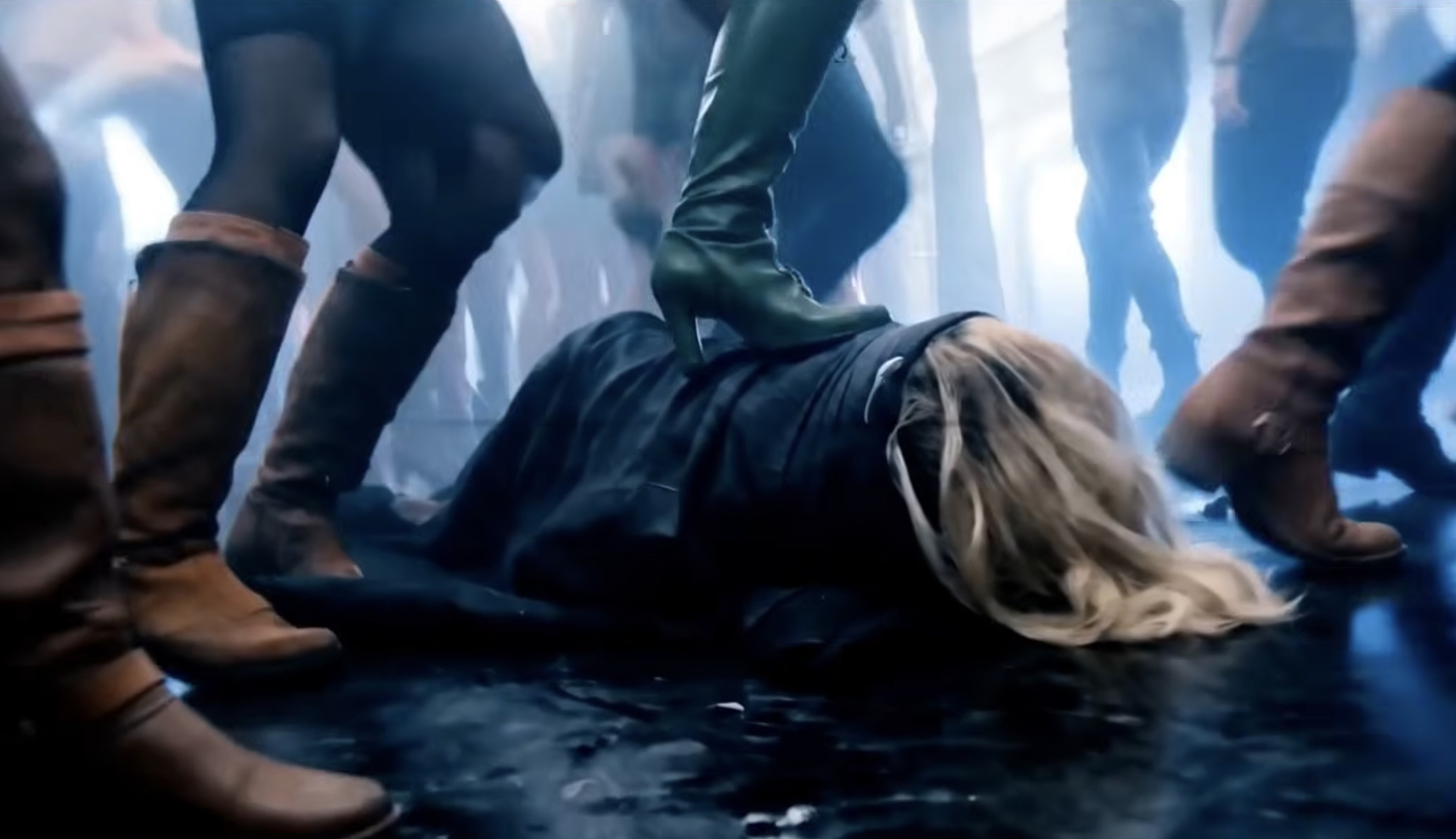
One that she’s at the center of, albeit now wrapped up in a blanket so that someone can “step on” her with their heeled boot as a means to “roll her out” (this feeling, in its way, like a nod to the fact that all of this part of her album rollout). To be sure, it’s very much giving “body bag.” Perhaps an allusion to the line, “I know where the bodies are buried” or even to the fact that this album and its visuals will have fans “deceased.” Mind you, this is not a scene that appears anywhere in the Confessions II: The Film version. She then stands up with the most effortless of ease to “join” with the crowd, albeit still “walking through them” as she urges, “Don’t comment on my ideas/I don’t want your judgment or your expectations.” Carpenter, meanwhile, has already started to enter the fray at the fifty-seven-second mark via a projection onto someone’s chest, before soon after “actually” appearing when Madonna calls, “Sabrina.”
In the Confessions II: The Film version, Carpenter materializes far more immediately (dressed and styled in a manner designed to have people asking if Madonna is her “older sister”). Indeed, she does so not long after Julia Garner makes her own little cameo (in contrast, Garner doesn’t emerge until the latter part of the standalone video, doing her “head whip-back” movement around the three-minute-twenty-three-second mark) as yet another homage to the fact that she was cast to play Madonna in a biopic that remains in limbo. As for Madonna ascending toward the ceiling like she’s some kind of superhero (a dance floor “Super Girl,” if you will), these scenes remain pretty much aligned in both presentations of the video, with the moment when Madonna is suspended in midair echoing her denouement for the “Living for Love” performance at the 2015 Grammys.
A musical callback to “Lucky Star” is wielded in the Confessions II: The Film version (around the four-minute-fifty-four-second mark), whereas “Hung Up” is the musical callback (via a ticking clock that mimics the one at the beginning of said song) in the standalone video, coming in around the two-minute-thirty-second mark. And alternating between these two songs for each “varietal” of the video hardly feels like a coincidence considering Madonna performed a mash-up-type version of “Lucky Star” and “Hung Up” for the finale of 2006’s Confessions Tour.
Ultimately, it’s the restructuring and differing placements of certain scenes that makes the standalone video “its own thing.” And while some might wonder why Madonna would bother with a standalone version of the video at all, it’s apparent that she’s catering to two separate demographics: those who don’t have the attention span for a “film” that’s over ten minutes (*cough cough* Carpenter fans) and those who enjoy tracking the differences between one version and another (*cough cough* die-hard Madonna fans who have never seen so much Taylor Swift-level “Easter-egging” from the Queen of Pop).
And so, it would seem that doing it this way offers something for everyone. However, if this truly were a standalone video without the previous knowledge/framework of Confessions II: The Film, it would be a bit “what the fuck”/“meh” compared to Madonna’s previous boundary-pushing videos (including, but not limited to, “Justify My Love,’ “Fever,” “Bedtime Story” and the original version of “American Life”).
Nonetheless, maybe it is boundary-pushing to conclude with an entreaty (not seen in the Confessions II: The Film version) like, “Come to the club of love” (presented as a poster on the door Madonna walks out of so that she can ostensibly go back into the laser forest of “Good for the Soul”). For “love” is, as the world has repeatedly demonstrated, a very small and, evidently, exclusive club. Proving James Baldwin’s (a key figure in Madonna’s pantheon of heroes) assertion, “The world is held together, really it is held together, by the love and the passion of a very few people.” With “Bring Your Love,” in both its visual forms, Madonna and Sabrina would like to count themselves among those people.


