


If “The Cure” could best be described in relation to Olivia Rodrigo’s first single from You Seem Pretty Sad for a Girl So in Love, “Drop Dead,” it would be as the polar opposite. Or, more to the point, as “part two,” of sorts, to the single. One that acknowledges what happens after “happily ever after”—and that is the fallout that arises once the pheromones of the initial “so in love” period wear off. Because, once they do, a girl (or boy) can start to realize that love isn’t the quite the panacea that one might have hoped for (particularly if they were going off the many movies and songs that assure it is).
And, considering the album’s title, it’s no wonder that Rodrigo would describe “The Cure” in particular as the “thesis statement” of the record. For it speaks to why, exactly, a girl in love might be so sad. This ultimately being because after the high of the “falling in love portion” of her story, there’s the low that comes with realizing 1) it doesn’t solve everything or make feelings of emptiness go away and 2) that the intensity of the love doesn’t sustain itself in the same way after the beginning. Hence, the moody sonic landscape of “The Cure” from the outset, which mimics the guitar sound of both Smashing Pumpkins’ “Disarm” and Foo Fighters’ “Everlong.” What’s more, the video itself, directed by Cat Solen (who has such music video credits as Bright Eyes’ “At the Bottom of Everything” and CSS’ “Let’s Make Love and Listen to Death from Above”) and Jamie Gerin, is very reminiscent of something The Smashing Pumpkins would do. For it’s plenty in line with, say, their “Tonight, Tonight” video aesthetic. Starting from the moment the title card appears as a hospital tray with a “patient towel” that gets stitched in red, and by an injection needle no less—not a knitting one—with the cursive-y words, “the cure” (no connection to the band, though Rodrigo is obviously a fan, and even went so far as to “coincidentally” release the song on World Goth Day). To the point of the knitting visuals, YouTube found the video special enough to equip the usual look of its player with a ball of yarn and two needles (not injection ones) in lieu of the usual basic “dot” that shows up when one hovers over the area toward the bottom of the video.
After the title card, Solen and Gerin then cut to the “paper dollhouse”-looking hallway of a 1950s-styled hospital. Hence, the look of the nurses as well—all decked out in a Nurse Ratched kind of way (complete with the way they coif their hair). This includes “Nurse Rodrigo” herself, who has the important role of seeking out a cure for the hearts that enter her care. So it is that she has her own special laboratory that she retreats to so that she might conduct her experiments. Tinkering in such a manner that recalls Lana Del Rey’s 2017 album trailer for Lust for Life. Which wouldn’t be totally off the mark considering that Rodrigo has outright stated that Del Rey was an influence on You Seem Pretty Sad for a Girl So in Love (complete with a lengthy title to rival Did You Know That There’s a Tunnel Under Ocean Blvd). For, as she told Variety, “This album is going to be very different from my first two projects. I felt like I needed to leave the rockish sound. So I went for something dreamier, almost cinematic. Lana Del Rey was a big inspiration for me on this record.”
Even so, “The Cure” definitely maintains that “rockish” sound she claimed she wanted to get away from (and the one that, incidentally, Charli XCX vaguely wants to run toward). And why shouldn’t it, considering such angst-ridden lyrics as, “All the pretty girls in the foreground of my mind/I thought I’d done enough, but they keep moving the line.” This referring to Rodrigo’s “age-old” problem (despite being a mere twenty-three) of comparing herself to others, particularly other women. For, as she once said herself on 2021’s “jealousy, jealousy,” “Co-comparison is killin’ me slowly/I think I think too much ‘bout kids who don’t know me.”
And when she confesses, “I thought I found the antidote this time” on “The Cure,” Rodrigo intends that she thought, in finding a so-called real and all-consuming love, she also found the antidote to all the negative self-talk and general self-loathing she (and so many teenage and twenty-something women) suffers from. In her Nurse Rodrigo form, she contends with that by taking out yet another “test heart” (a knitted one, naturally—adding to the kind of “Tim Burton feel” this video also has) and injecting it with her latest concoction designed to be an antidote, but instead only turning the heart into a cold, black-and-white tone that signifies nothing good. The same then happens with yet another test heart as the following defeated lyrics soundtrack the scene: “My head is full of poison/And my heart is full of doubt/I got toxins in my bloodstream/You tried hard to suck them out [a line that also feels sexually suggestive]/And it feels like medication/And it’s good for me, I’m sure/But it don’t matter how your love feels anymore/It’ll never be the cure.”
This gut-punching (and yes, heart-wrenching) revelation—further underscored by a refrigerator full of black-and-white “test hearts” that simply couldn’t be “cured”—forces Rodrigo to reconcile with the unwanted idea that the only “cure” might actually lie within herself, as opposed to another person. But that thought is perhaps too heavy to deal with just yet as Nurse Rodrigo leaves her experiment room and walks through the halls of the hospital again with a clipboard, peering into each room and watching some of the other nurses go about their “diagnosis and cure” attempts. This while she tallies numbers on the clipboard in “five-barred gate” style.
Then comes a very Alanis Morissette-esque lyrical moment in the form of: “Used to play a game in my head when I’d date a guy/Tally up the girls that he fucked till I start to cry” (a subtle Alanis homage that’s no surprise when taking into account the “You Oughta Know” nature of “good 4 u” and the “Ironic” stylings of the “get him back!” video). To be sure, it’s rather evocative of Morissette demanding, “It was a slap in the face/How quickly I was replaced/And are you thinkin’ of me when you fuck her?” Both verses are sung in such a way as to suggest a kind of fragility, a form of being on the brink of, well, emotionally unraveling.
Rodrigo takes that figurative statement and makes it literal after dropping her clipboard (her nerves are rather shot, after all) and noticing that the very same kind of red strings of the hearts in her lab are slowly but surely coming out of her fingertips as she admits, “But I’m unraveled/I’m unraveled” (continuing to repeat that six more times) before Solen and Gerin then cut to a scene of Rodrigo playing her guitar in her nurse’s uniform—since, as “Drop Dead” also proved, just because Rodrigo is “dressed cute” (complete with also being in her “knee sock era”), she still wants to remind people that she is, first and foremost, a guitar girl.
And as the red strings keep coming out of her in droves from all parts of her body now, Rodrigo is also given a stylized X-ray (in a manner befitting a Michel Gondry film). But nothing can seem to offer a “cure,” thus her rightful set of questions, “Why can’t you come stitch me up?/Why can’t it ever be enough?”
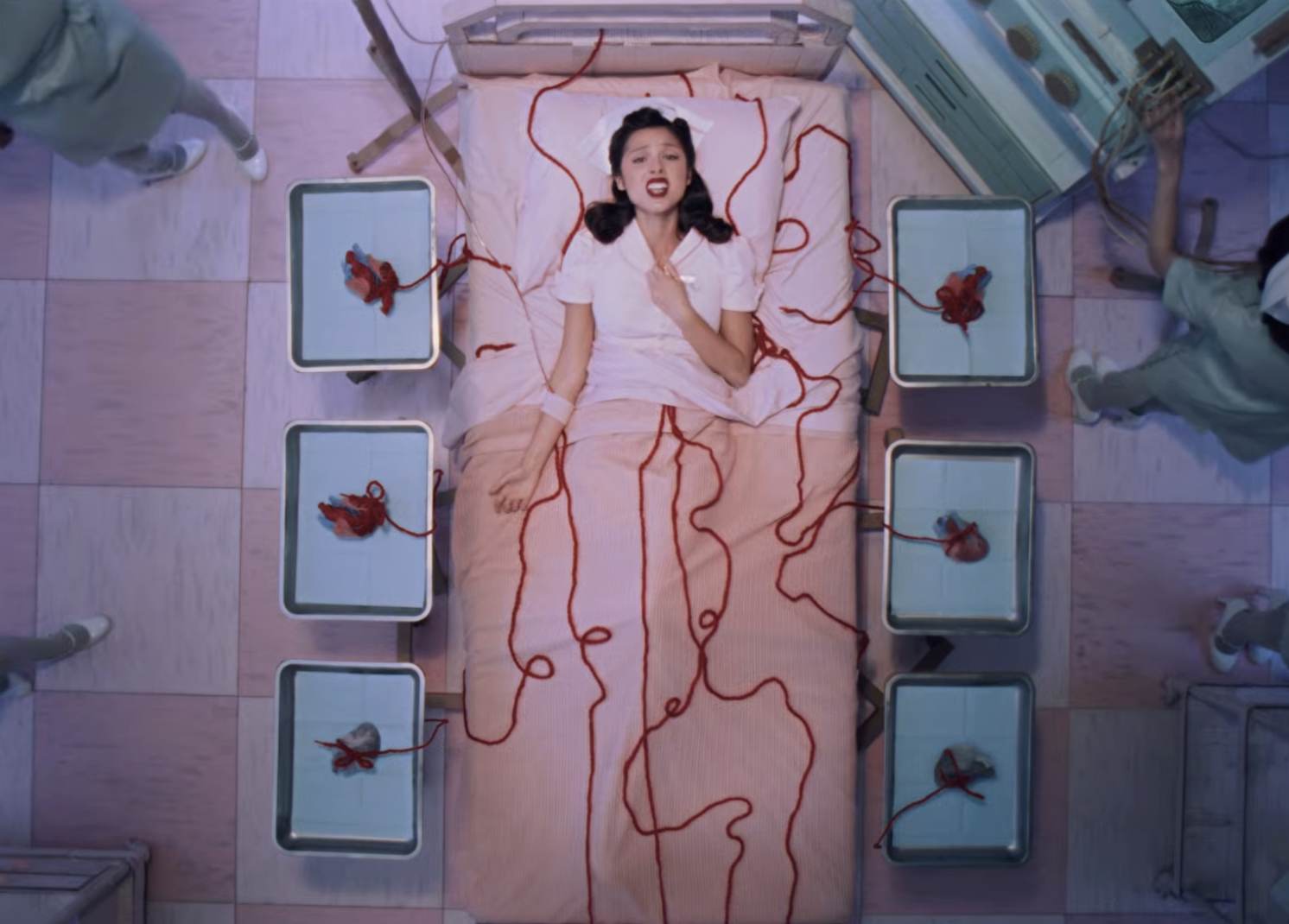
Ones she doesn’t get answers to as she’s wheeled on a gurney into what can perhaps be called an “emergency room,” with one of the other nurses grabbing a black-and-white “test heart” from the fridge and tying it with a red string in the hope of reviving it, which it does seem to by turning back to red. The camera then zooms out to show that all of the hearts from the refrigerator are surrounding her, connected to her in some way in a bid to be “enough” to heal her. Alas, as Rodrigo herself declares at the end of the song, “It’ll never be the cure/It’ll never be.”
At around the four-minute-thirty-two-second mark, Rodrigo then provides the ultimate “Gondry-like” twist by revealing that a pair of hands are dismantling the fake-looking building outside the window. With Nurse Rodrigo herself suddenly looking like nothing more than a doll in a dollhouse. Which, as it turns out, is exactly what she is—albeit a “doll hospital.” “The real Olivia” then peeks through the window, her giant eyes gazing around the room before she places the structure on the ground and unflinchingly crushes it while the Dan Nigro-produced string arrangement adds yet another bittersweet tinge to it all—this representation of a total loss of innocence in matters of, that’s right, the heart.
Rodrigo then stands briefly at the center of the room, filled with other cardboard boxes (as if to indicate she’s moving out…maybe of her ex-boyfriend’s apartment)—which is what the “doll hospital” is also made out of—before walking away without looking back. Yet another symbol of her resignation to the fact that, tragically, there really will never be a cure. At least not until she can look within herself to find it.


[…] that sadness majorly sinks in on the first track to kick off the “You Seem Pretty Sad” side, “The Cure.” The second single from the album, and one that, despite the title, sounds less like The Cure […]