


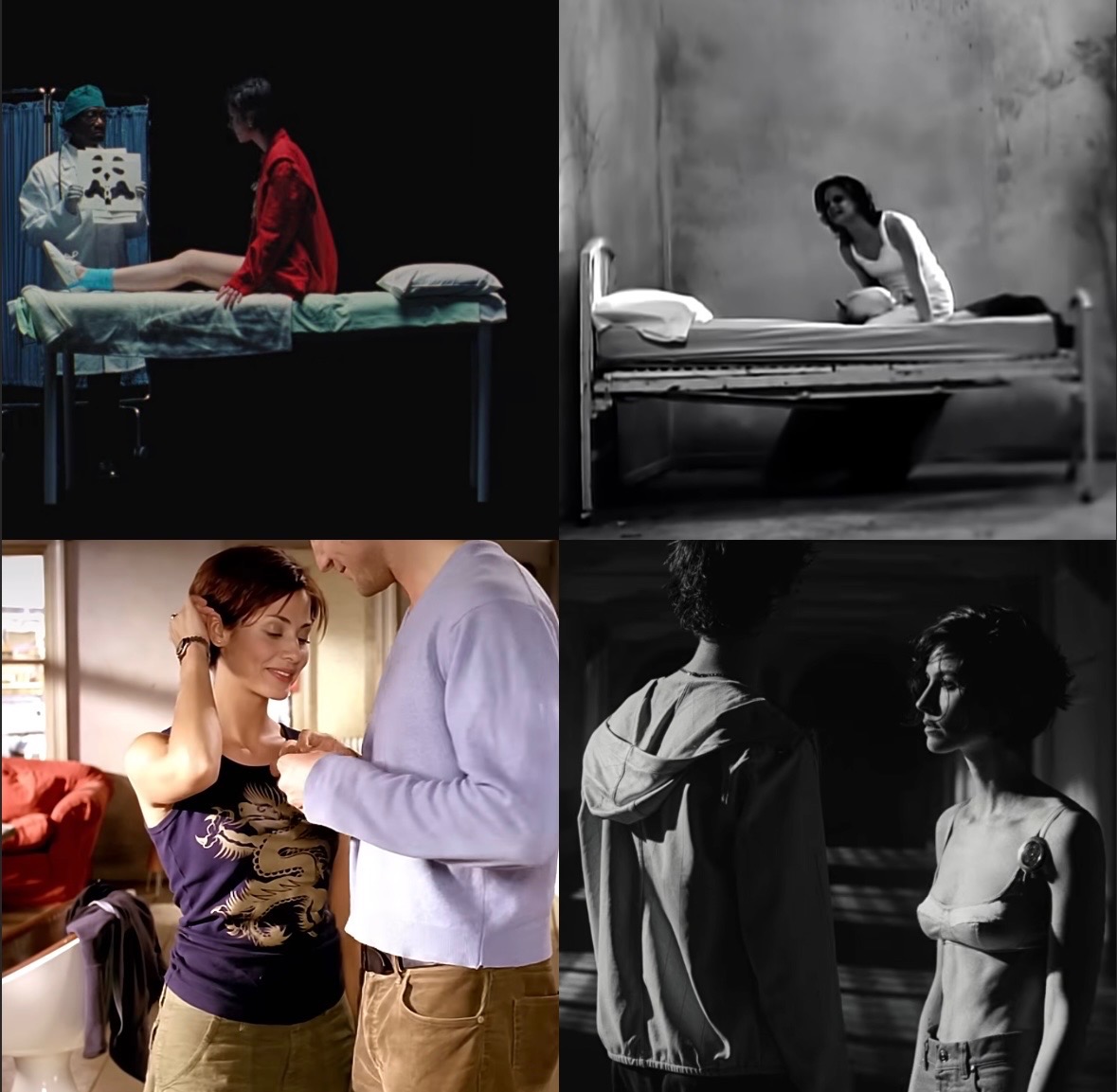
As Gracie Abrams pulls back the curtain on her Daughter From Hell era, the first single she’s chosen to set the overall tone is “Hit the Wall.” But perhaps what sets the tone even more than the single itself is its accompanying video, directed by Renell Medrano (who also recently directed the video for Lorde’s “Hammer”—and yes, there’s a certain Lorde influence over the lyrics as well). Taking place in what amounts to a mental institution (albeit a “stylized,” “surreal” one), the connection to Melissa Etheridge’s iconic 1993 video for “Come to My Window” can immediately be made.
Etheridge’s video, directed by Samuel Bayer, not only features Juliette Lewis as its “mental patient” (with a not dissimilar haircut to the one Abrams has in “Hit the Wall”), but also, in its own way, offers moments of surrealism to the “mentally ill” trope. Of course, it’s not just any kind of “madness” that both Abrams and Etheridge (through Lewis) are portraying, but rather, the kind of madness that stems from being lovelorn. In Abrams’ case, the lyrical delineation of her self-destructive behavior is what she ties into frequently “ruining” romantic relationships, no matter who the person is (perhaps even Paul Mescal). Which is why she described it on Elvis Duran and the Morning Show as more of a “big picture” snapshot of things that tend to go wrong for her in matters of love.
And one of those things is the fact that, as she puts it, “I’m a crack in the pavement, I’m a slip knot.” In essence, it’s her version of saying what Lorde did in 2017: “I understand, I’m a liability.” Other such lyrics about Lorde’s incapacity to have healthy relationships on “Liability” include, “He don’t wanna know me/Says he made the big mistake of dancing in my storm/Says it was poison.” Abrams is of the same mind when she sings during her chorus, “I barely deserve it if you do stay/I wish you would anyway” and “I’m not a problem you can solve/Weighing the cost, impossible.” Even so, Abrams weighs plenty of costs throughout this song, with its video that opens on her lying on what appears to be a very industrial-looking bed in a very industrial-looking space. Just as Bayer opens the “Come to My Window” video on Juliette Lewis in her mental hospital bed, ominously speaking some of the lyrics to Etheridge’s song.
After about twenty seconds of seeing Abrams “languish,” Medrano then cuts to her struggling to come up with a song to play as she sits at the piano, eventually staring at her hands like they’re foreign objects before another scene cut to her sitting on the same stool with no piano in front of her (a metaphor, of course, for being artistically blocked). This scene, in its way, reminds one of the “music room” that Polly (Elisabeth Moss) so desperately wants to gain access to in Girl, Interrupted. To be sure, there’s plenty of overtones of that movie and its motifs as well. Complete with Abrams’ short haircut that has its parallels to Winona Ryder as Susanna Kaysen. Though her hairstyle is much closer to the one Natalie Imbruglia has in the “Torn” video.
Indeed, that 1997 visual also seems like an unwitting influence here. Particularly when there’s a shift to a black and white scene of Abrams (in just her bra and some jeans, of course) approaching a man with his back to the camera (though he does have a certain Mescal quality). This followed by intense close-ups of Abrams’ earnest facial expressions. So yes, that description alone automatically evokes the iconic Imbruglia video. Itself a nod to how the idealized fantasy of things (specifically, relationships) are so often dismantled (in the “Torn” video’s case, that becomes quite literal) by cold, hard reality.
In the next brief black and white scene of Abrams trying to get closer to this faceless man, she attempts nuzzling his shoulder only for him to disappear (this, too, echoing the type of camera cuts that occur in “Torn”). Medrano subsequently goes back to the image of a blue door suspended in a black abyss. That blue door being a subtle nod to Joni Mitchell (in that her most beloved album is called Blue). Even though some might associate the look of the door to the white one Billie Eilish is falling out of (while submerged in water) on the cover of her Hit Me Hard and Soft album cover. But no, Abrams is definitely alluding to Mitchell, as she also does directly when she sings, “‘A Case of You’ playing in the hallway/Hallucinations that I downplay/I’m numb ‘til I’m aching for the sharp pain/Watch my blade ricochet” (or watch Taylor’s “tears ricochet” instead, if that’s your preference).
The opening door seems to lead to different potential outcomes for Abrams’ “escape” from a dead end. Though not every outcome is necessarily appealing. Like when she enters into one reality where three doctors are observing her as she sits on a hospital bed, one of them showing her a Rorschach test that’s well-timed to the line, “A room full of doctors and an inkblot” (which is the kind of lyric that sounds like it could be from Lana Del Rey’s oeuvre [e.g., “Later then hospitals, stand still on my feet/Comfortably numb, but with lithium came poetry”]).
In another version of reality, Abrams goes through the door to find herself in still another hospital-looking setting, standing in a hallway where she sees two twins looking back at her creepily—tossing in a reference to The Shining for shits and giggles (then again, who knows about madness and “hitting walls” better than Jack Torrance?). When she reenters through the door again, she seems to encounter a flashback of herself standing on the roof of a car in the dead of night. A “flashback” that serves to underscore the lyrics, “Flashbacks of my life/What a waste, oh, what a shame.” Medrano cuts to a burning “bush” (or, more accurately, a small, bare-branched tree) in the middle of nowhere after this moment, followed by a montage of all the versions of Abrams we’ve seen thus far. An editing device that keenly sums up Abrams belting out, “At night/Face to face with every girl/That I tried to play.”
And yet, whatever role she was playing, each of those versions of herself found out, “I live in a pattern of breakdowns/You’ll bend to my silence, it’s so loud/And then you’ll lose me to the crowd.” This lending itself to the kind of vicious cycle that prompts her to keep hitting a proverbial wall in matters of love, emotions and her own personal health and well-being.
So it is that the video ends with Abrams back in her glass-encased bed (again, of the mental hospital variety) as she concludes with a feeble, “Hit the wall, I just/I just/Now.” A final scene that, in its way, also mimics the last shot in “Come to My Window,” which shows Lewis lying back in her hospital bed (an undone bandage around her wrist suggesting something sinister) looking defeated and spent after hitting the walls of her “cell” more literally. In both women’s scenario, loving “too hard” appears to be a key part of their problems. Or maybe the more accurate assessment is that other people don’t love hard enough.


