


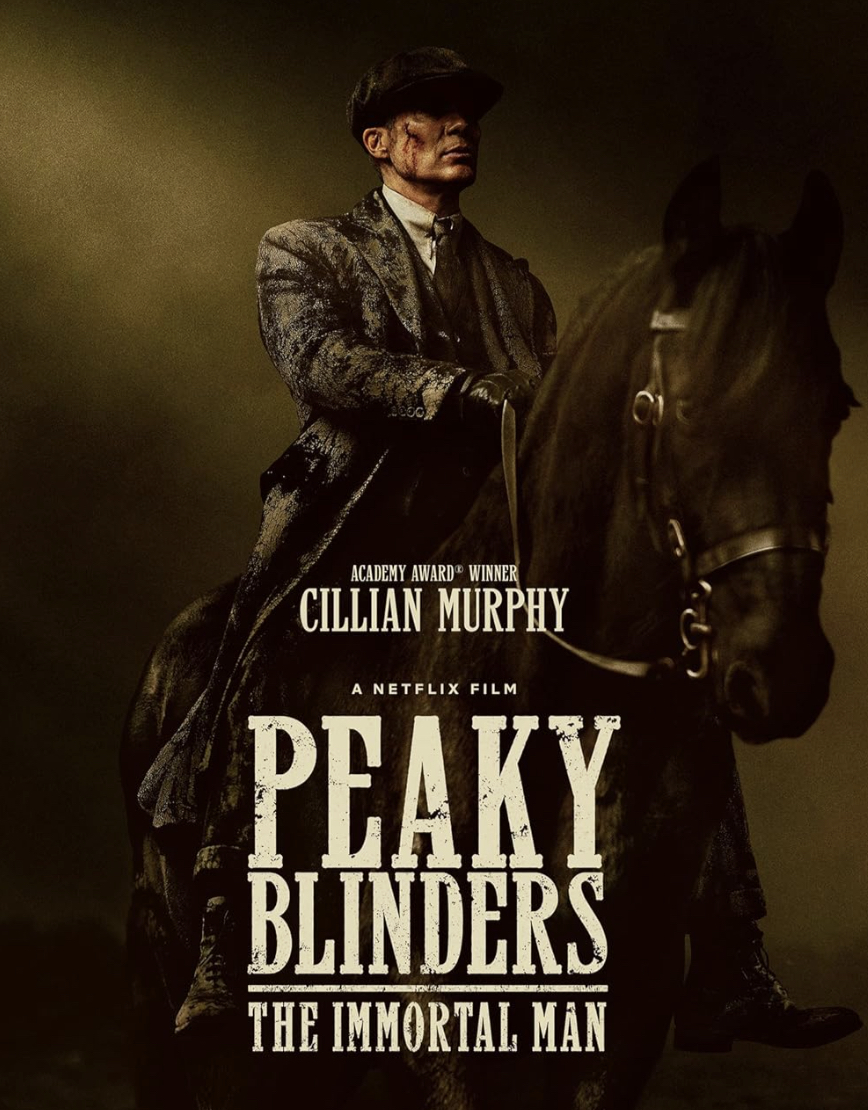
In many ways, perhaps Tommy Shelby’s (Cillian Murphy) “grand finale” ought to have been something that everyone saw coming. After all, his eventual (and, as some would say, inevitable) fate is something that he’s been begging for via his not-so-subconscious death wish for the entirety of Peaky Blinders. This is part of why, when the sixth season (or series, as the Brits call it) saw Shelby allegedly being diagnosed with tuberculoma, he took the news with something more akin to somber resignation than genuine sadness. Indeed, it was apparent throughout Peaky Blinders that Tommy had already seen himself as dead for years (therefore noting of his diagnosis, “How long have [I] been dead for, eh? At least now I’ll have a certificate”). That is to say, whoever he was had effectively “died” while fighting in World War I. The same went for his older brother, Arthur (Paul Anderson), who had much greater difficulties suppressing his emotions about it than Tommy.
The kind of difficulties that would lead to his opium addiction. An ironic turn of events for Arthur in that he was the only one, between him, Tommy and Polly (Helen McCrory), that voted against the first motion that would lead to Peaky Blinders’ wheeling and dealing in the trade. And, of course, it’s Arthur who does most of the opium-slinging, which is what proves too tempting for him to resist as he willfully ignores the adage, “Never get high on your own supply.” So it is that by season six, Arthur is almost fully lost to the drug. Though Tommy also dabbled with it (this being what facilitates his visions of Grace [Annabelle Wallis] in the fifth season), it goes without saying that he’s known for having far greater self-control. Or at least the ability to suppress any and all signs of weakness. With Linda (Kate Phillips) gone, however, Arthur can pretend no more that he has any reason to “hold it together” or feign some level of virtuousness.
So it is that, throughout season six, which saw the most amount of time between filming a season (three years), what with the pandemic making it difficult to go into production, Arthur goes further and further down the rabbit hole. While Tommy, too, engages in new precedents of dangerous and self-destructive behavior, mostly involving getting into bed (one time, even literally) with fascists. What’s more, a key reason that Tommy became even more morally rudderless was due to Polly’s death, which her son, Michael (Finn Cole), blames Tommy for. As most everyone blames Tommy for the death of those close to him. For, as his sister, Ada (Sophie Rundle), tells him in the fifth episode of season five (“The Shock”), “Anyone you touch, which means anyone I touch, which means anyone any of us touch…”
In other words, anybody that gets close to a Shelby is doomed. Served a metaphorical black hand, to reference the plot of season four, which begins with Luca Changretta (Adrien Brody, who has no business playing an Italian) serving the key members of the Shelby family a black hand. The mafia equivalent of a death warrant. But Changretta takes his time with Tommy, at one point coming face to face with him so that he can say, “I want you to be alive after your entire family is dead. That is what will hurt you the most.”
And it is what hurts him the most, as one sees by the time Peaky Blinders: The Immortal Man takes place. Namely, in 1940, as Britain remains the last country in Western Europe that hasn’t succumbed to fascism. Prior to this, season six had ended in 1934, with fascism’s rise in Germany bleeding into other areas. Though it took Germany occupying multiple countries for it to really “rise.” Yet with a number of powerful Nazi sympathizers in Great Britain, including Oswald Mosley (Sam Claflin), Tommy’s nemesis throughout seasons five and six, it was truly a wonder that the country didn’t willingly get on board with what Hitler was doing. But no, because of people like the women seen in the Birmingham Small Arms (BSA) factory at the beginning of Peaky Blinders: The Immortal Man, Britain continued to resist. And yes, the bombing of the factory was a real event that occurred on November 19, 1940, as reiterated by the film’s epilogue: “Four hundred tons of high explosives were dropped on the city of Birmingham by the German Luftwaffe. Fifty-three munitions workers were killed at the BSA factory in Small Heath after deciding not to go to shelters, even after the sirens sounded. This film honors their memory.” Even if it makes it look like the women were totally taken by surprise rather than hearing any warning siren as they sing “Happy Birthday” to a worker named Agnes (Ruby Ashbourne Serkis), only to be blown to bits mid-song.
Right there like a vulture the day after to take advantage of the weapons strewn about is none other than Tommy’s Gypsy son, Duke (Barry Keoghan, who definitely doesn’t look like an older version of Conrad Khan, the actor that played Duke in season six). In the wake of Tommy abandoning his kingdom—something he did after Arthur died in 1938 rather than, as the season six finale would suggest, after he realized he could live like a true dead man the way Alfie Solomons (Tom Hardy) did—Duke has taken over. And, per Ada’s account, is “running the Peaky Blinders like it’s 1919 all over again,” adding, “Worse than you and Arthur ever were.” To which Tommy replies, “Then that is very bleak.” And there it is: the assessment that best describes Peaky Blinders: The Immortal Man. Which isn’t a strike against it, so much as a disclaimer—a warning to those who can’t deal with too much reality in a world that is so chock full of it already (even despite all the AI slop). Especially since, like the men and women of that time, the men and women of now are starting to grasp what it is to live constantly under the threat of war. Granted, it hasn’t officially been declared WWIII, but that’s more as a means to sidestep a collective panic. A matter of “the lie of omission” that the current governments are wielding to their advantage.
Amidst the backdrop of WWII’s increasing escalation (even though WWI was supposed to be “the war to end all wars”), Tommy is essentially in hiding. Roaming the halls of his latest palatial abode when he’s not roaming the grounds outside, where he swears he can see ghosts of family members long gone (particularly his daughter, Ruby). Family members that, more often than not, he feels responsible for killing, whether directly or indirectly. Maybe that’s why he keeps a small graveyard out there, complete with Arthur’s headstone, which allows him to talk to his brother from beyond the grave.
However, it’s the twin sister of Zelda (the woman Tommy “laid with under a hazel tree” long enough to bear a son), Kaulo Chiriklo (Rebecca Ferguson), who ends up talking to Arthur legitimately. As a Palmer gypsy, per Johnny Dogs’ (Packy Lee) intel, she has a keen ability to commune with the dead. That’s why her first encounter with Tommy involves opening all the windows in his house to let the spirits out. It also involves taking up the mantle where Ada failed and convincing him to return to Small Heath and tend to his son, who has gone down a dark path from which there may be no return. This time involving collaboration with an unseemly gentleman named John Beckett (Tim Roth, kind of acting in a Christoph Waltz part here).
It is Beckett who aims to inject the UK economy with seventy million pounds in counterfeit money (created by those imprisoned in concentration camps)—known in real life as Operation Bernhard. And he’s going to use Duke and his various “thuggish” connections to “disseminate” that cash and cause the kind of economic chaos that will allow the Germans to swoop in via an entirely different method. What’s more, as Duke tells him, “The world don’t give a fuck about me and I don’t give a fuck about the world.” This being his assurance to Beckett that he has no issue with committing treason, further adding, “You got lucky finding me.”
Alas, Beckett is not so lucky in that Tommy is going to find him, now that he’s taken a newly vested interest in the fate of his son, ergo the country itself. Which, in this WWII scenario, also means the entire world. Something that Tommy “Takes What He Wants and Fuck Who It Hurts” Shelby hasn’t cared about since he voluntarily signed up to join the WWI effort. But now, here he is, hoping that, amidst all the bleakness, both at a personal and global level, “From this bad will come some good.” Redemption sought and, based on the final outcome, achieved.
And while Tommy had said of himself after learning of his tuberculoma diagnosis in season six, “Not a devil. Just an ordinary mortal man,” the truth is, he is the immortal man. Not just because his legend will live on “forever” (particularly in Birmingham), but because, well, he’s written an autobiography. His pivot toward writing being yet another inevitability. After all, one doesn’t read all that poetry without eventually “feeling the call” to write themselves. And sometimes, as it is said, the pen is mightier than the sword. Or the Tommy gun.


