


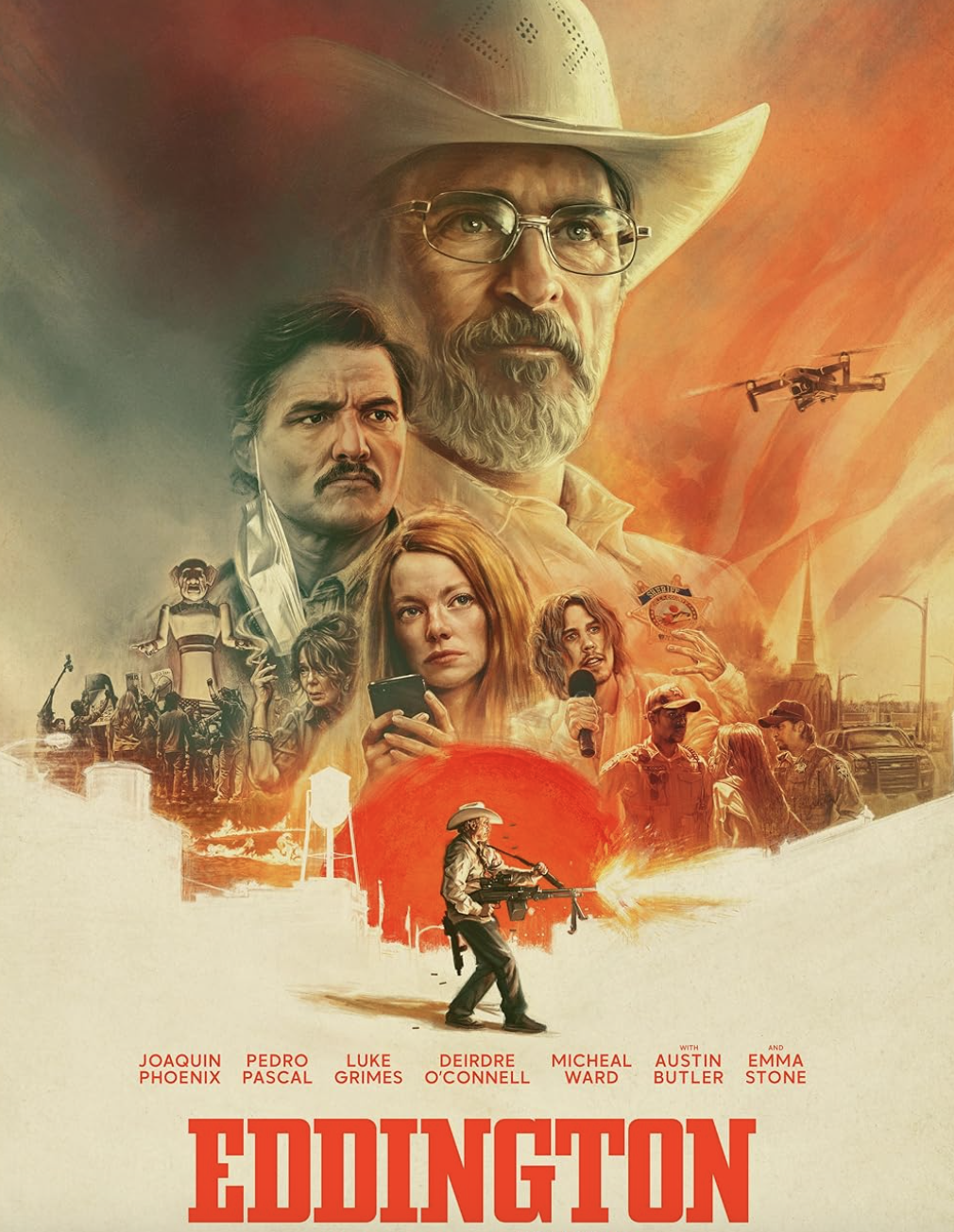
Like every Ari Aster movie to date (which now totals four), Eddington can be classified as “a hard watch.” Though this might, inarguably, be the hardest of all. Even harder than the much-dissected Beau Is Afraid. Not just because, as usual for an Aster film, there’s “a lot going on,” but because it’s a very unflattering mirror to behold for most Americans. A mirror that isn’t “funhouse-y,” so much as a true-to-life depiction. While some will appreciate it, there are still more who most likely won’t. And one wants to believe that, in some sense, this was Aster’s intention all along. That the movie is designed to be as divisive, as polarizing as Covid itself, as the “political flashpoint” it became (or, to put it in Aster’s words, “What I wanted this movie to feel like was the internet” a.k.a. a total cluster fuck of diverging opinions and general misinformation—mission accomplished).
For it wasn’t just the novel virus that took hold of 2020 and the two years that followed, it was all-out political warfare, too. This because, as is typical of the United States, something that should have been straightforward—wearing a mask to help “stop the spread”—became politicized. A matter of right-wing versus left-wing. Self-described “freedom lovers” versus the “too woke.”
That Aster began to write the script in the thick of 2020, when the rabbit hole of the internet was at one of its peaks of insanity (thanks to everyone having the “free time” to participate in it), is apparent in how the film comes across. More like a time capsule than “pure fiction.” Even if one that seems “on acid” because most people have worked very hard to block out what happened during those years. The madness of it all. Pretty much the same way that people did after the 1918-1920 flu pandemic, when they all went straight into party mode in time to create the Roaring Twenties (a term coined by none other than F. Scott Fitzgerald).
In the 2020s, there hasn’t been much partying or any sense of joy to recover from the early years of the decade. And this is the most palpable way in which the new world has bifurcated from the old. Indeed, Aster himself remarked on Deep Dive with Sean Evans, “[2020] feels, to me, like the moment at which the final, like, link to whatever the old world was, was severed.”
This is why it remains a historical moment that many still (rightly) fixate on. For a number of reasons far beyond the fact that it marked the complete “cut” between the twentieth century and the twenty-first. And for some people, those reasons include conspiracy theorizing about where the virus was “really” from. Who “really” unleashed it, and for what purpose (hint hint: power and control). A notion that speaks to Aster’s belief that conspiracy theorizing is baked into American culture. And it started long ago, reaching a full crystallization with the assassination of JFK. The Oliver Stone-directed movie of the same name being a heavy influence on Eddington. This along with Nashville, Unforgiven, Fat City and My Darling Clementine.
Some of these influences, paired with the New Mexico setting (where Aster himself grew up and lived during the pandemic) and the portrayal of the “protagonist,” Joe Cross (Joaquin Phoenix, Aster’s ostensible muse), as a cowboy hat-wearing, “kind-hearted” town sheriff, is what has secured Eddington with the label of a “neo-Western.” It also helps that he has a good old-fashioned nemesis in the form of the town’s mayor, Ted Garcia (Pedro Pascal).
And like many men with a nemesis, that person represents their polar opposite. Accordingly, in contrast to Joe’s soft-spoken, sentimental, unpolished persona, Ted is poised, coiffed and a “man of the future.” As indicated by the reelection campaign platform he’s running on: a tech-oriented one that heavily relies on the promotion of opening a new data center on the outskirts of town. Good for the “future,” good for job opportunities (even though most should be aware by now that technological advancements ultimately always seek to get rid of human jobs).
But Sheriff Cross and those like him—those “trapped in the past”—are not convinced. Nor are they convinced that mask-wearing should be “mandatory.” Especially since Eddington isn’t “a part of all that.” “All that” being what’s going on in “the rest of the world.” A statement that itself gives an indication of how so many small, conservative towns view their place in relationship to “everywhere else.” To be sure, it is this form of hyper-individualistic thinking that has gotten America to the point it’s at today.
As for those who would accuse Aster of trying to make Joe a far too “sympathetic” (via being totally pathetic) character by the end of the movie, it’s worth bearing in mind something he said during an interview with MovieWeb: “What’s important here in how I was approaching all of these characters is…these are all people who care about the world. And they all can feel that something is very, very wrong. But they’re all living in different realities, they’re all fortressed off from each other and they all have very different ideas about what those things are that are wrong. What the sources are… They can’t connect, they can’t reach each other.” Never was that especially American phenomenon more pronounced (and more irrevocable) than at the dawn of the 2020s. Which also saw a total flip-flop/mix-and-match approach to the erstwhile “hard-line” distinctions between conservative and liberal. As Aster also mentioned to MovieWeb, “In a lot of ways…conservatives [have] kind of adopted the language of 1960s, like, liberal activism. It’s gotten so fuckin’ distorted.” These distortions, of course, only became more amplified in 2020 and, now, in 2025. Wherein, somehow, the conservative party has become more associated with “free speech values” than the liberal one.
And yet, perhaps the ultimate “point” of Eddington is to remind that, while everyone is squabbling over ideology, the big power—the “puppeteers pupperteering the puppeteers,” to paraphrase Aster—keeps insidiously making changes that go unnoticed or that people are too distracted to keep up with until it’s too late. Never mind which “side” of the political spectrum ends up on top. The only entity that ever truly wins is the corporate overlord.
Although Eddington is hardly the first movie to throw its (cowboy) hat in on capturing the cultural horrors stoked by the pandemic, it is perhaps the most standout offering to date. Granted, a more, shall we say, accessible movie (and one that truly gives a big “fuck you” to power) that captured the essence of that time period is Dumb Money. Eddington, conversely, aims to capture a certain unique breed of American ugliness in a more “here it is!” way, rather than one that will serve as “educational” or providing a “moral of the story.” Certainly not a moral that emphasizes, as it would in any traditional Western, that good triumphs over evil (because we now live in a time when those definitions have been totally warped and “subjectified”).
In this regard, there are many who might not be so easily “taken in” by an assessment of Eddington as “brilliant” or “a masterwork.” Instead seeing it more as, “Okay, what was the point of this? Tell me something I don’t know” (a sentiment that can also be lobbed at Jesse Armstrong’s Mountainhead, though to a far greater extent). By the same token, the lack of critical thinking—or any kind of thinking at all—in America means that it needs all the help it can get in understanding how it got to where it is in order to perhaps backpedal a bit and, at some point, “God” willing, correct its course. Then again, that might be the sort of optimistic thinking only the twentieth century had the luxury of engaging with.


[…] about a modern-day witch hunt, a community turning on each other when the going gets rough (à la Eddington). Justine is an effortless scapegoat, viewed as someone “dangerous” who must have been teaching […]