


In the five long years since the release of HAIM’s last album, Women in Music Pt. III, it feels more like ten have gone by. This “vibe” further compounded by the fact that the trio of sisters put the record out during the height of the pandemic (in June of 2020). An “era” in human history that itself helped to increase the sense of time accelerating at a faster rate than ever before. This due to the constant barrage of viral memes, news headlines and “micro trends” (e.g., “hot rodent boyfriend”).
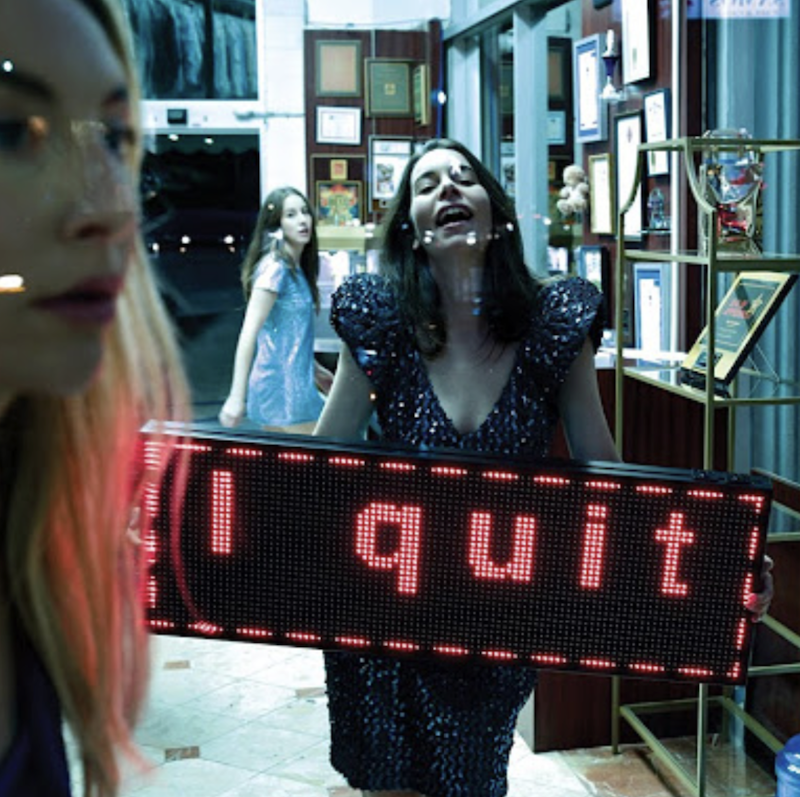
So it’s no wonder that the Haim sisters are so clearly seeking, in their own way, a return to a simpler time in history. Or at least a simpler time in pop culture history. Hence, their entire single cover art “campaign” for I Quit being centered on “old school” paparazzi shots from the 90s and 00s (though only one of the images, for “All Over Me,” was inspired by a 90s “snap”). Or the fact that the album title itself was taken from an uber-niche line of dialogue from 1996’s That Thing You Do! (a movie that is, arguably, “uber-niche” in and of itself). Indeed, while making the rounds for interviews and various “press opportunities,” HAIM has repeated the same story over and over again about the moment when Jimmy (Johnathon Schaech) mockingly sings, “I quit” into the microphone while in the recording studio with his band, The Wonders.
And then there is a song like “Take Me Back,” drenched in the kind of yearning that only nostalgia for another (better) time can elicit. What’s more, as the sisters have also remarked at various point throughout their “press tour,” all of them being single again at the same time made it feel like they were teenagers again. Teenagers just trying to sneak into concerts and after-parties, as they told Kesha in a Spotify interview called “Countdown to I Quit.” In fact, it was Kesha, they say, who taught them that 1) they should sneak into concerts and 2) how to do so effectively. It was perhaps during those early days of rebellion that they first experienced the rush of freedom so jubilantly conveyed on I Quit’s first track, “Gone.”
Commencing with a “strummy” acoustic guitar sound, HAIM builds up to showcasing the sample contained within the track. In fact, they chose to sample from one of the best, George Michael, by interweaving “Freedom! ‘90” (repeating the word “freedom” in that intonation, of course) starting around the forty-six-second mark. A fitting selection for the overarching theme of I Quit, which, as Este described, speaks to how the sisters, “look at [quitting] as a new beginning and betting on yourself. We quit things that don’t serve us anymore.” And what definitely doesn’t serve them anymore is self-doubt, with each sister confirming that I Quit is the apex of how they’ve always wanted to sound. Like Sabrina Carpenter telling Rolling Stone that Short n’ Sweet was what she had been working years toward sounding like, Haim also echoed the sentiment with, “We’ve always wanted to sound this way, but, it’s like, how do you get there?”
Evidently, how you “get there” is through years of disappointing relationships. That motif being quite palpable on “Gone” as Danielle sings, “Now I’m gone/Quick as a gunshot/Born to run [very Bruce Springsteen]/Can’t be held up/Now I’m free, finally/You packed my shit/But it’s nothing I needed/You can fool some people some of the time/And I was one of those fools/But you can’t fool everyone all the time/‘Cause it catches up with you.” In short, she has no fucks left to give or fucks left to invest in a toxic man/relationship. The band then delivers one of the most badass musical breakdowns since the glory days of 1970s rock before Danielle delivers the epic bridge, “You can hate me for what I am/You can shame me for what I’ve done/You can’t make me disappear/You never saw me for what I was/You can’t fake it/And I won’t make you.” The moody, brooding energy of it all—counterpointed by the joy of the “Freedom! ‘90” sample—is concluded with, “I won’t make you (freedom)/I won’t change you (what I want, freedom)/‘Til I’m gone/‘Til I’m gone/Until I’m free.” This meaning, perhaps, that a person doesn’t really see the need to make a change about (and within) themselves until someone leaves them.
The hard edge of “Gone” is immediately contrasted by “All Over Me” (with an intro that momentarily sounds like Fallout Boy’s “Sugar, We’re Going Down”), which finds Danielle using her “upbeat voice” as she paints the picture, “Your place or my place, it doesn’t matter to me/Your lips, my tongue, they’re intertwined/You want us locked in, I’ll give you my sympathy/But that’s one thing I won’t define.” Thus, while it might initially sound as though she’s in the kind of love so often conveyed by 90s and 00s-era rom-coms, the reality is that she wants her cake and to eat it, too. In other words, she wants this dude to be available to her sexually whenever she feels like it, while also enjoying the company of other men when she feels like that as well. Hence, the chorus, “So take off your clothes/Unlock your door/‘Cause when I come over/You’re gonna get some/I know it’s not/Quite what you want/Being on call for me, waiting up for me/But when I want you/I want you all over me, I want you all over me.”
So it is that HAIM blends a “sweet” sentiment with a “fine print” one. This further confirmed by Danielle insisting, “You know I’ve always had a wild heart/And that won’t ever change/So when you see me out with someone else/I will not be ashamed” and “Walk away from me/Don’t talk that way to me/Just trust me, uh/We’ll meet in secrecy/After the party/And when you’re face to face with me/On your knees or underneath.” Talk about being an empowered woman who can “have sex like a man.” That phrase from the pilot episode of Sex and the City that changed the game. And yes, HAIM mentioned that the elevator pitch for the album is “like Sex and the City—but set in Los Angeles.”
Which is precisely what the lead single called, what else, “Relationships,” aims to convey. Continuing with the “upbeat voice” Danielle parades on “All Over Me,” she opts to commence the track with her “Sheryl Crow/Liz Phair rock voice” by saying, “Wasting my time driving through the Eastside/Doing my thing ‘cause I can’t decide if we’re through/Well, are we?/And if we are, what we gonna do?” HAIM then lays out a classic “can’t live with ‘em, can’t live without ‘em” picture as they convey the ups and downs of relationships (though mainly the downs) via the chorus, “Baby, how can I explain/When an innocent mistake/Turns into seventeen days?/Fuckin’ relationships/Don’t they end up all the same?/When there’s no one left to blame?/I think I’m in love, but I can’t stand fuckin’ relationships.”
As for the specificity of “seventeen days,” the HAIM love for Prince—a beast on the guitar—is no secret, which is why it’s a clear nod to his 1984 track, “17 Days.” An important intertext considering some of the key lyrics for that are all about a doleful lover, with Prince bemoaning, “Called you yesterday/You didn’t answer your phone/The main drag is knowing that/You probably weren’t alone/So here I sit in my lonely room/Lookin’ four my sunshine/But all I’ve got is two cigarettes/And this broken heart of mine… You’ve been gone 17 days/17 long nights.” Prince being a proponent of expressing the amount of time his love has been absent from his life, as he also does on “Nothing Compares 2 U” by noting, “It’s been seven hours and thirteen days” (Sinead would later change it to “It’s seven hours and fifteen days”).
The tone—both vocally and thematically—shifts once more on “Down to Be Wrong,” their third single, and the one that has arguably the most “fuck you/this” energy. For what they’re down to be wrong about is all the faith they put in a person who wasn’t worth it/not who they thought they were (as is so often the case once the rose-colored glasses worn during the early phase of a relationship start to fall off). Ergo, Danielle belting out (once more in a decidedly Liz Phair tone), “Oh, I bet you wish it could be easy/To change my mind/Oh, I bet you wish it could be easy/But it’s not this time,” building on the conviction in her voice when she continues, “Boy, I crushed my whole heart/Tryin’ to fit my soul into your arms/And I crushed up these pills/And I still couldn’t take ‘em/I still couldn’t take ‘em.”
Another pill, so to speak, that HAIM finds difficult to take is the passing of time. A passage that has led us here, to this political horror show. So it is that, as mentioned, “Take Me Back” is the song that most achingly conveys a sense of nostalgia. Not just for a simpler time, but even for a time before you got fucked up by a bad relationship. And yes, once again, HAIM offers up an earworm of a bridge in the form of, “Take me back to driving/Smoking with the windows down/Trying to waste the day away [or, as Lana said, “Miss doing nothing the most of all”]/I never get to do that now/Take me back to Kling Street/Looking for a place to park/In an empty parking lot/Just so you could feel me up.” The reference to a street in San Fernando Valley, paired with the mention of cars and parking, just goes to show that what Danielle said to Kesha during that Spotify interview is true: “I feel like L.A. is such a central part to who we are and how we grew up.”
And yet, like Addison Rae, HAIM is choosing to betray that home by moving to New York. Rightfully billed as “shocking” by i-D, Danielle told the magazine that not only is their move to said city because Este’s fiancé lives there, but because, “I feel like there’s a new energy there. As you know, I’m single, and LA is the worst place for dating, truly. I can be really isolated, and I just feel like in New York, it’s so easy, everyone is kind of hitting you up. It’s better for my personality, because I can definitely be a hermit.” Which is, in truth, why LA is actually the best place for hermits. Facilitating the kind of recharging isolation that New York can’t provide. Regardless, HAIM seems to be speaking to Los Angeles on “Love You Right” when Danielle muses, “And I know that I can’t survive/Without shedding a little pride/But to start, could you recognize/It’s hard to love you right?”
With its mid-tempo acoustic guitar and piano, the backing track accentuates the angelic sound of Danielle’s voice as she, again, seems to be subconsciously talking to Los Angeles with the verse, “Tryna get out, tryna get even/Trying to get up off my knees/You piss on the wall, it’s nothing at all/But, baby, you know that I’ll still forgive you/Had to get out, but you want a reason.” The “reason,” in the case of abandoning L.A., being that she needs more reliable dick. And yes, there’s some truth to the stereotype about Californians in general being flaky, but not if they know there’s the chance for some “punani Dasani” (to quote Cardi B). The pronounced mid-tempo of “Love You Right” might mislead the naïve listener into thinking it’s “happy,” but the melancholy of the song is embedded in the nature of the lyrics, which conclude, “I guess I’ll never find the strength to love you right/I will never love you right.” This, once more, feeling like a pointed dig at LA. As though it’s somehow LA’s fault (read: the men it houses) that the Haim sisters have ostensibly “fallen out of love” with it.
That “out of love” aura persisting on “The Farm,” which has been called out for its overtly Sheryl Crow sound, while also reminding listeners why HAIM was tapped to work with Taylor Swift on the country-twangin’ “no body, no crime.” Even so, sonically speaking, it’s “Moonlight Mile” by The Rolling Stones that “The Farm” really channels—further proving HAIM’s decided late 60s/early 70s predilections when it comes to their musicianship. Hence, Stevie Nicks confirming that the Haim sisters could have easily been in Fleetwood Mac.
Things shift toward a more Bob Dylan-y bent around the two-minute-forty-three-second mark, with the harmonica coming in strong. Which only makes sense for a “home on the range” song like this. Except that Danielle has yet to find her home in this little narrative. One that details the dark period after a breakup. For Danielle, that breakup was with Ariel Rechtshaid, HAIM’s long-time producer and Danielle’s boyfriend of nearly ten years. Their “schism” in 2022 had a categorical effect on I Quit, both lyrically and sonically. To the latter point, if Danielle and Rechtshaid hadn’t broken up, he probably would have produced their fourth album instead of Rostam and Danielle herself. As for her involvement in producing, it seems to be no coincidence that once she got involved on that front, HAIM started to sound, per their own account, more “like themselves” (or the idea of themselves they had been trying to get across all this time).
But before that silver lining, there was the pain of the breakup, as evidenced in the verse of “The Farm” that goes, “‘We wanna see you smilin’”/Said my mother on the hill/But the distance keeps widenin’/Between what I let myself say and what I feel/And my sister said, ‘It’s alright/You can stay with me/If you need a place to calm down/‘Til you get back on your feet.’” As it would turn out, Danielle living with Alana would unlock all kinds of previously untapped creative “juices” (presumably while other types of juices also flowed). What’s more, the lamenting chorus finds Danielle resigned to the fate of her relationship, which she had previously tried to avoid. But now, she reasons with her soon-to-be ex, “So we can give up tryin’/And you can keep the farm/Just buy me out/Buy me out.”
To take the listener back to a “less depressed” state than the one evoked by “The Farm,” “Lucky Stars” (perhaps called as such because everyone knows full well that Madonna has ownership over the title “Lucky Star”) picks up the rhythm and resolve. In fact, this song, fittingly at the midpoint of the album, is when the tonal shift becomes more palpable, with HAIM radiating the sort of exuberance that only comes once the breakup blues have subsided and a “new love” enters the picture at full force. Which is why train imagery is so effective for the first verse (in addition to coming directly after the train image at the end of “The Farm”): “I was on my own and finally/Trying to heal myself with all the/Roaring trains of change and doubt that/Pulled in the station/Your inner light beamed blue and green/Something ‘bout it made you seem like/You could fill the seat next to me/Without complication.”
In the second verse, Danielle delineates the initial encounter further (while using what has become HAIM’s now signature “down to” phrase) by singing, “You werе down to change your plans/You found me in a foreign land/Pickеd me up when I was down/Yeah, honey, I was stranded/The thing I like about you most/You always make me feel at home/You fill the empty space I hold/And it’s nothing like I imagined.” In other words, it feels fucking great. This is the part of the relationship that everyone can’t get enough of: the “your love is my drug” phase (to quote song title of HAIM’s apparent bestie, Kesha).
And so, it’s easy for a girl to think that, for once, maybe “fate”/“luck” was on her side when this new boo came into her life, with Danielle wondering in the chorus, “Tracing back lucky stars/In my mind/Was it fate or coincidence/That brought you into my life?” Probably coincidence, but it’s so much nicer to pretend otherwise. Just as it’s easier to pretend that any one person can possibly be another’s salvation. So much so that they’re prompted to declare, “I will follow/The brightness of the glow/I will follow/Your star shine [this is where it starts to lyrically mimic Madonna’s ‘Lucky Star’] ‘til we’re home.”
The sweetness of “Lucky Stars” bleeds into “Million Years,” another up-tempo, 90s-sounding track that can be characterized as very “past life attuned”—a further indication still of HAIM’s “LA-ness.” And, talking of that “LA-ness,” the sisters can’t resist referencing the town anew when mentioning how they, “Cut down Ventura Boulevard/Tryin’ to get nowhere.” The driving imagery persists with, “Gettin’ lost/I hit the coastline and the water/Into the ocean, honey.” This, in its way, mirroring the sense of freedom begat from driving to an erstwhile forbidden “endpoint” that’s conveyed by Charli XCX when she says, “I crashed my car into the bridge, I watched, I let it burn” on “I Love It.” To be sure, all the driving nods on I Quit are a key reason for why Alana insisted that people listen to it blasting from their car stereos (this suggested in a video for Perfect Magazine). Because, though the Haim sisters might live in NY now, their general vibe is still, “We should all be Angelenos.”
As for the sisters’ overall frustration—or perhaps fear is the better word—with the very concept of relationships, it crops up again here via the lyrics, “And I know love finds a way to take a toll on you.” Even so, that hasn’t stopped many a “conscientious” woman from falling into the trap, down the rabbit hole, etc. Because, for many, despite all the pain of being in a relationship, it’s still worth the frequent agony—for the sake of being able to say, “Yeah, that’s my person, and they’d be ‘my person’ in any lifetime.” This sentiment manifest in the lyrics, “But we stopped time once in a photograph/And I keep it in my pocket/I know I’ll find you there/Even if it takes a million years.” It smacks of Chelsea telling Rick on The White Lotus, “You’re not gonna get rid of me that easy. If you kill me, I’ll follow you into the next life, and the next. You’ll never get rid of me.” Ah, the creepiness that true love can so often radiate.
So creepy, in fact, that it’s enough to make a girl want to run for the hills and rock back and forth in solitude for a few hours (or years). That’s the energy of “Everybody’s Trying to Figure Me Out,” with Danielle taking back her power (again, presumably after a bad breakup) long enough to find a new mantra—a new “Jesus Prayer.” And it goes, “You think you’re gonna die, but you’re not gonna die.” Before coming to that conclusion, however, Danielle also arrives at the revelation that she’s free to do, well, whatever the fuck she wants—regardless of how other “perceive” it. Ergo the rebuffing verse, “I don’t want your charity/Spend a night in the cold if it keeps me free/Everybody’s got a bed they’re sleeping in/And I know that I’ve made mine.”
The hard edge of “Everybody’s Trying to Figure Me Out” is quickly canceled out by the feel-good sound of “Try to Feel My Pain.” Though the only one who feels good in this post-breakup scenario is Danielle, who clearly seems to be addressing her ex when she says, “Even though I know it broke your heart/Baby, can you see where we went wrong?” It has the same motif as Danielle suggesting on “The Farm,” “So we could keep on tryin’/Or we could sell the farm/Just buy me out/Buy me out.”
Whether Danielle’s ex wanted to “buy her out” or not, that’s obviously what’s happened by the time “Try to Feel My Pain” rolls around. And that’s precisely what she’s trying to do—feel her pain so that she can then release it and move on. Yet there is an indication that she doesn’t quite know “the right way” to feel that pain, recounting, “I try to feel my pain, try/But I don’t know which way/How does it feel to be on your own [this being an overt Bob Dylan reference]/And be anyone you want?/Like when a camera takes a picture of you/From across the room/And sees you in a different light.” This verse could technically be directed at both herself and her ex, as she tries to comfort him about their breakup by reminding him of all the new possibilities it will open up. After all, when someone says, “I quit,” it signals both an ending and a beginning (or, as Semisonic put it, “Every new beginning comes from some other beginning’s end”).
As the shortest track on the album, “Try to Feel My Pain” can be classified as a “little ditty” more than anything else. The same goes for “Spinning,” which also clocks in at under three minutes. It also happens to be the only song with a distinctly Carly Rae Jepsen feel, thanks to the production (again co-produced by Danielle and Rotsam), levity of the lyrics and unusually high pitch of Danielle’s voice. Addressing that “funny feeling” love can cause (almost like being dizzy), a girl has to wonder, at times (that is, when her neurotic behavior really flares up), “Remind me, why do you love me?” Garbage once asked the same question. But perhaps what I Quit gets across above all else—apart from quitting that which no longer serves you—is that love is never logical (-Olivia Rodrigo). And because of its illogicality, it’s bound to drive even the “sanest” person insane.
So much so that they just start to “Cry.” A.k.a. the title of track thirteen on the record. However, in spite of being a song about crying, it’s another joyous-sounding number—mostly thanks to the Este-heavy vocals. Vocals that detail how, in the aftermath of a breakup, one second you can feel perfectly fine and, the next, you’re breaking down in public. This summed up in the verses, “Seven hours and I feel no pain/Oh, it’s not terrifying, it’s not anything/And I feel that I am holding strong/Then I’m telling a story and I have to say your name/And I’m overcome/And I just cry, cry/And I don’t know why I just cry, cry/When I realize/Seven stages of grief/And I don’t know which I’m on/I’m past the anger, past the rage/But the hurt ain’t gone.” For many, it never really is. But we just tell ourselves that it’s gone because to say otherwise after a certain point would be deemed “weird” and “obsessive.”
Things get a bit more country again with “Blood on the Street,” a song of the “he done me wrong” genre. Maybe that’s why all three sisters end up getting on the mic throughout the song, for who amongst them doesn’t have a tale to tell about some guy who turned out to be a sleazoid (a classic Valley Girl word)? But it’s Alana’s vocals that stand out the most because they’re the most rarely heard between the three of them. It’s she who goads, “The smell on your breath, what a stench/I wonder why I put up with that stress/You order a drink, took a spill on the rink/You cut your upper lip, well, boy, what did you think would happen?”
However, it’s Danielle who really shuts it down with the verse just before the two-minute-nine-second mark, when things get especially sweltering and bluesy on the guitar. Prior to that moment, Danielle chides, “Man, I get the sense/That you think this is still on the table/But when I don’t pick up my phone/It’s not because I am unable/You saw what you wanted and not what was there/Now you turn around and say I was unfair/Well, I wasn’t.” There’s no doubt that many a woman would say “amen” to that (including Sabrina Carpenter).
And many will also say “amen” to HAIM pulling out the big guns for the grand finale, “Now It’s Time.” Indeed, this is the song that, out of all fifteen, feels like the most “stadium-ready.” A battle cry filled with blasé rage as Danielle has the revelation, “I’m not asking anymore for an apology/I can’t wait anymore for you to set me free/Yeah, it isn’t yours to give, it has to come from me/Yeah, it’s mine, yeah, it’s mine.” This type of “personal change must come from the inside” thinking being precisely what fueled the songwriting process behind MARINA’s Princess of Power. As a matter of fact, it looks as though all the “pop girls” (and “rock girls”) are coming to some similar conclusions this summer. Which is that happiness, especially for hetero women, does not come from others via a romantic relationship, but rather, an “okayness” with oneself. Once that energy radiates from the inside out, the energy that it, in turn, attracts is meant to change entirely. Or so one is told…often by Californians.
With its robust tracklist, which is as varied in sound as it is robust, I Quit covers the gamut of emotions during the various stages of relationships: before, after and during. And it seems that what matters most is who you have in your life to support you in the before and after portions of a relationship. That, in truth, is possibly the only way to either 1) survive a (fucking) relationship or 2) make it last. Well, that, and a lot of parties. For, as HAIM also told Kesha during their interview, “Parties change lives.” Charli XCX would, of course, agree. As she also would that it’s a HAIM summer, and we’re just living in it.


