


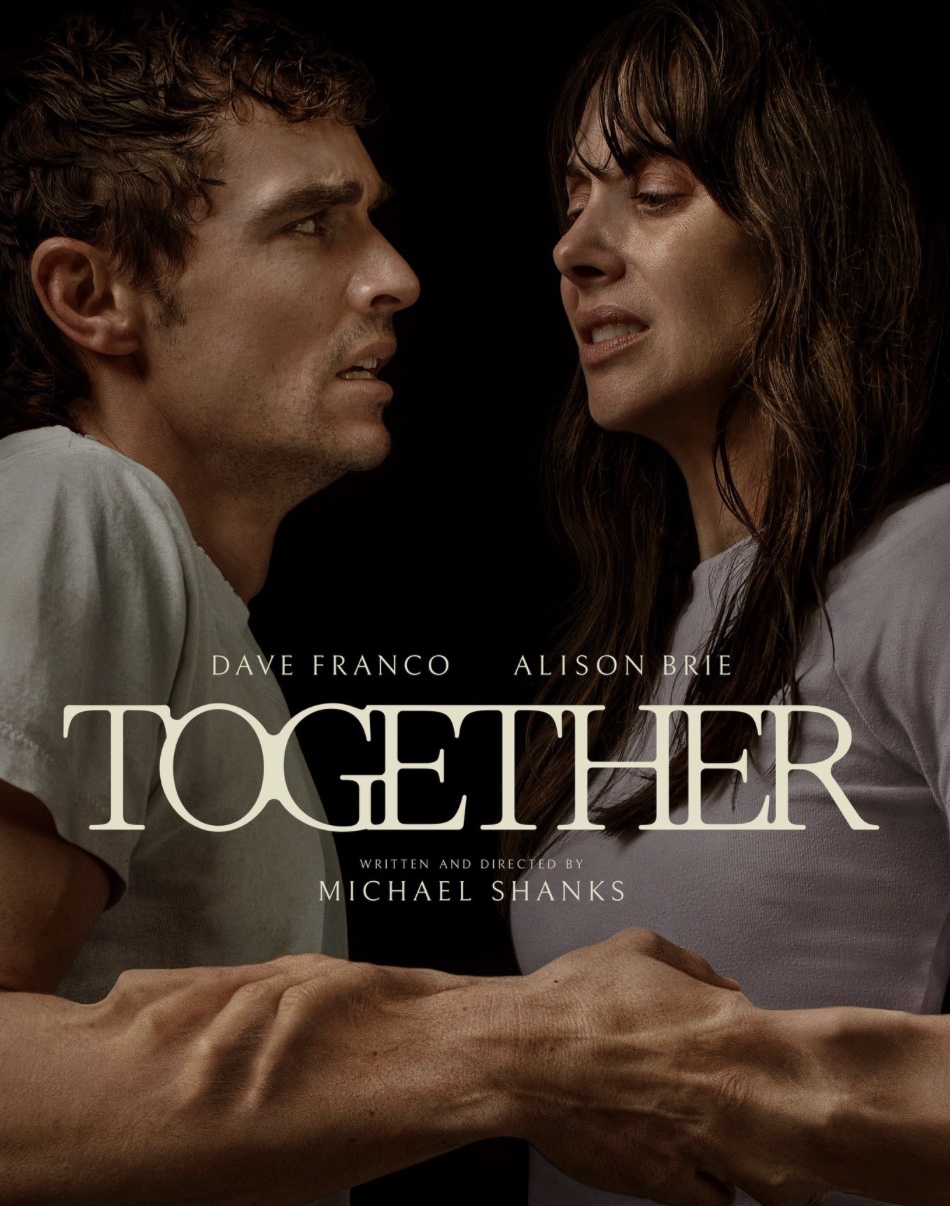
While Alison Brie and Dave Franco are no strangers to working, er, together (see: The Rental), Together marks the first time they’ve gone all in on carrying a movie as co-stars. Using their prowess as established actors, the duo elevates Michael Shanks’ debut film to heights it likely wouldn’t have reached if it had been made on an even more “independent” level (read: casting unknown actors). As for Shanks, an Australian who has tellingly cited David Lynch and Ari Aster as influences on his work, the joy of getting a film made has been somewhat tainted by the plagiarism lawsuit that made headlines well before the release of Together.
The lawsuit in question was filed by filmmaker Patrick Henry Phelan, whose movie, Better Half (which has thus far only been screened at the Brooklyn Film Festival), he argues, was the overt “meat” of the eventual script for Together. In many ways, it echoes the plagiarism accusation made by Simon Stephenson against Alexander Payne’s The Holdovers, for, in both cases, each screenwriter making the accusation argues that those who made the offending film had access to the original storyline while making their own version of it. Brie, Franco and their lawyer, Nicolas Jampol, have vehemently denied the claim, not just because Phelan presented the script to their agent in 2020, while Shanks registered his with the WGA in 2019, but because, as Jampol puts it, “[Phelan] does not own this concept. Neither do [Brie and Franco]. It is an unprotectable idea, one that predates all of our clients and has been explored in many films, television shows and other fictional works.”
That said, Brie and Franco, through their characters, Millie and Tim, take the concept and turn it into not just a body horror film, but an allegory for the toxic codependency that tends to inevitably arise when any couple has been together for a long time. However, although these two have ostensibly been together for years, they’re not yet married. This painfully awkward detail becoming apparent when, at their going away party in New York, Millie proposes by getting down on one knee in front of their guests and pantomiming like she’s opening a ring box (making the whole thing even more uncomfortable) while asking him to spend the rest of his life with her. Caught off guard, Tim says nothing for an amount of time that officially makes it weird. And as though he doesn’t want that. Then, as if trying to save face, he replies in the affirmative. But the damage is already done. And it’s obvious that both are feeling skittish about their move together to “the country” (one assumes this means Upstate New York, where many an NYC couple “retires” once they’re in their thirties).
For Tim, this was intensified during the moment at the party when Millie’s brother essentially makes fun of him for being whipped, therefore letting his music career fall by the wayside, telling him, “When I die, I don’t want someone else’s life flashing before my eyes.” In bed together that night, Millie, still miffed over how the proposal went, floats the idea that maybe they should break up, musing, “If we don’t split now, it will be harder later.” A pointed choice of words, considering what happens to them once they move to the country. Indeed, through a certain lens, Together almost feels like a cautionary tale about ever leaving the city. But, of course, its obvious message is that couples “unavoidably” tend to lose themselves in each other, with one person in the permutation often being the more beta of the two, therefore more willing to be, in essence, “absorbed.”
That phenomenon is taken to very literal levels in Together, and it’s obvious that, yes, Tim is the “weaker” of the pair, willing to go wherever and do whatever Millie wants—not least of which is because she’s the breadwinner. Something her friend, Cath (Mia Morrissey), points out when they’re having a video call (while Millie’s on a break at the school where she works) about how things have been going since Millie and Tim moved away. Millie says she’s fine because she’s “the boring one,” thus has no problem with the slow, quiet country life (having taken a job as an elementary school teacher there). Cath replies, “You think you’re boring because, what, you have an actual fucking job?” Tim, instead, is still pursuing his “rock star dreams,” which Cath assures is far more boring for a thirty-something white guy to still think is going to happen.
Millie brushes her off, insisting that Tim is a good guy, remembering how, on their first date, she had no idea he was a music buff (ergo, snob) and told him that the Spice Girls were her favorite band. On the next date, he then brought her Spice on vinyl. Cath is unimpressed, asking the Janet Jackson question of what has he done for you lately? It’s at that moment that Tim creepily appears on the playground outside her window. This after Millie had dropped him off at the train station to go into NYC for music rehearsals. But, by now, the water that Tim drank from a mysterious cave that the two fell into a few days prior has caused his literal (and very supernatural) magnetic pull toward her to be unstoppable.
Giving in to that pull herself, Millie lets his passion escalate to having sex in the boys’ bathroom, not aware that her ephemeral pleasure is about to become very painful when Tim tries to pull out and can’t. His penis has fused to the inside of her vaginal wall, this realization arriving at a very inconvenient time, as her co-worker, Jamie (Damon Herriman), walks in after a little boy calls him in to, basically, confirm that he saw two pairs of feet behind the stall. Fucking narc.
Jamie’s part in these bizarre goings-on is, of course, fairly obvious from the start. Which is why one hopes there will be a bigger reveal about him than there is in act three. As for act one, there appears to be a valuable reason for first wielding two dogs to show what happens if a “pair” falls into that eerie cave together. Because, symbolically speaking, it is said that dogs look like their owners. But there’s also the saying about how couples, over time, also start to look like one another. Together takes that trope to the next level with its final outcome. Inevitable, but still fascinating to watch, particularly as it’s soundtracked to Spice Girls’ “2 Become 1” (another predictable but not unwelcome scenario). In the final scene, the viewer gets to see what the fused version of Millie and Tim look like and, not surprisingly, it’s Millie’s facial features that dominate.
Although a “solid effort” overall, there are many noticeable plot holes in Together, ranging from small to big. For instance, why wasn’t the dangerous opening in the ground covered up after the dogs fell into it at the beginning and were presumably pulled out before being taken back home? How did Millie and Tim not see the missing couple somewhere in the cave when they got stuck in there? How would no one in the town notice that Jamie suddenly looked like a hybrid of himself and his partner? How did the church sink into the cave, and how long ago (for that level of sinking implies it’s been causing this to happen to various couples for decades)? What was the deal with this “2 Become 1” cult anyway?
It seems that, by leaving so much unanswered, it’s less about “allowing things to be open for interpretation” and more about an inability to broach these issues without running into some harried writing work. Thus, Together is overly reliant on the body horror element as it pertains to the overarching theme and message of the movie: do we love each other or are we just used to each other? For many couples, it’s the latter—and they can’t acknowledge that that’s the real reason it’s so difficult to…split. For there is perhaps nothing more paralyzing than being comfortable.


[…] You’ll Never Hear “2 Become 1” The Same Way Again: Together […]