


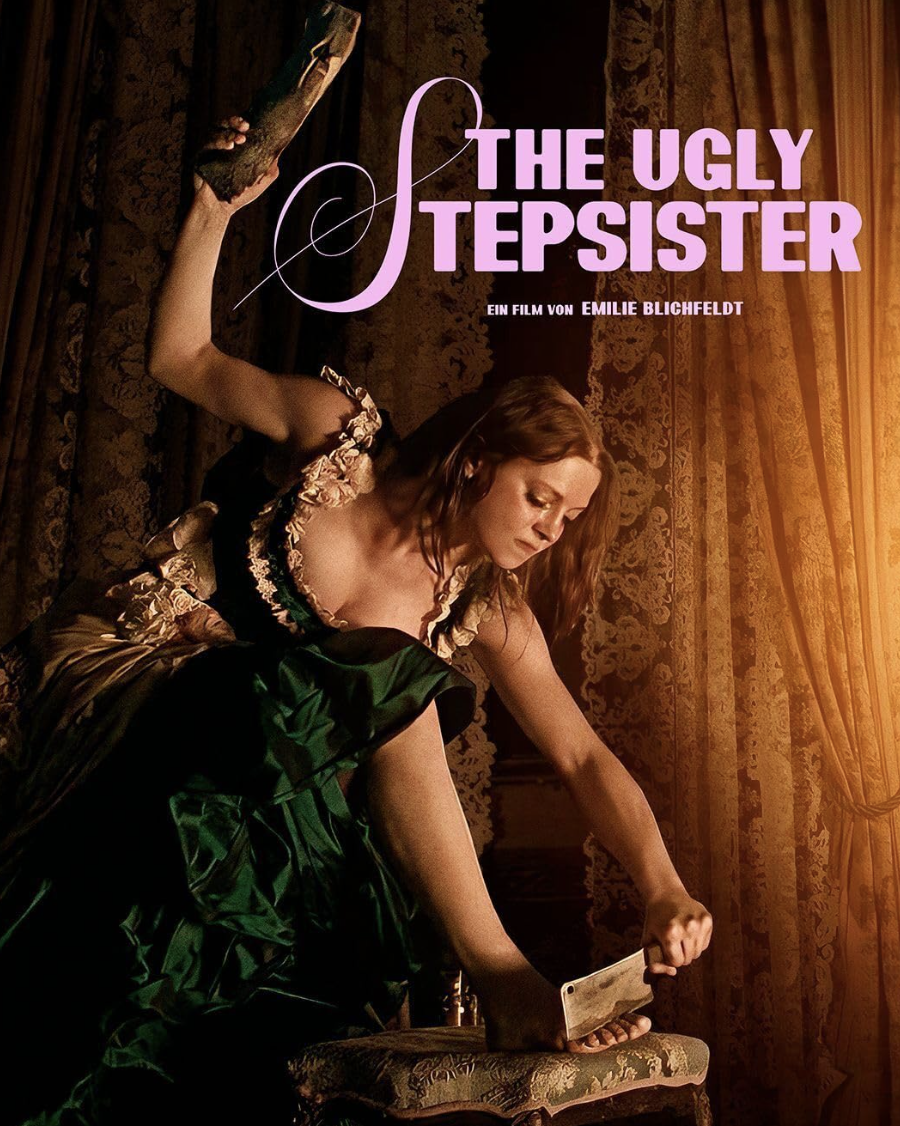
Following five short films made between 2013 and 2020, Norwegian director Emilie Blichfeldt settled in quite nicely to her feature-length debut, The Ugly Stepsister. As the title suggests, it’s about none other than Cinderella’s ugly stepsister. And while there are the usual two stepsisters at play, it is the eldest one in particular, Elvira (Lea Myren, incidentally, a model in real life), who is made to feel the pressures brought on by her so-called ugliness. This because her mother, Rebekka (Ane Dahl Torp), has married a supposedly moneyed older widower named Otto (Ralph Carlsson) that ends up dropping dead on their wedding night, only for Elvira to be the one to learn of his destitution through an insult from Agnes a.k.a. Cinderella (Thea Sofie Loch Næss) about how her father never would have married into such a déclassé family if they didn’t need the money. After this reveal, each side realizes they’ve been bamboozled by the other, continuing to prove the valid theory that rich people never actually seem to have any liquid assets.
With this newfound revelation, the heat is turned up on Elvira to marry the prince (or any rich man, really) so that their mother’s financial woes can be solved, once and for all. As for Elvira’s younger sister, Alma (Flo Fagerli), she’s exempt from the entire undignified affair of trying to “land a man” because, mercifully for her, she hasn’t yet gotten her period, therefore isn’t considered of “marriageable age.” This means that the business of saving them from abject poverty falls squarely on Elvira’s shoulders. And yes, it all has a very Bridgerton sort of feel (think: the Featherington family), minus the total lack of romance and plus the glaring spotlight on the horrifying things that women did to themselves in a bid to look beautiful so that they might “secure their future” a.k.a. a man.
But, of course, in addition to the Bridgerton parallel, there is most definitely some Sofia Coppola influence here—namely, 2006’s Marie Antoinette, complete with the more modern music (albeit instrumental, 80s-sounding offerings and not outright pop hits from the Decade of Excess). Yet, barring the aesthetic and contemporary vibe of the movie, it is the work of Julia Ducournau and David Cronenberg that most inspired Blichfeldt in her telling of the story, realizing that the body horror route, despite being a genre she was largely unversed in before, er, boning up on it, was the best one for telling Elvira’s story.
And of course, as is the ongoing film trend of the past decade, which reached a certain apex with Arthur Fleck (Joaquin Phoenix) in Joker, The Ugly Stepsister reframes the narrative to showcase how and why a supposedly “wicked” or “evil” person might end up that way. Or rather, be presented that way. In Elvira’s case, the eventual lore surrounding her supposed “evilness” stems from being an “ugly” girl (though ultimately, it’s her hairstyle that could make all the difference to her appearance) in a world that prizes and praises only beauty. Itself a subjective concept that capitalism has rendered objective for the purposes of making anyone who can’t live up to “the beauty standard” feel shitty enough to buy some products that can maybe help them somewhat look “desirable.”
That’s exactly the fate that befalls Elvira, with the help of her mother, who sees her daughter as nothing more than a simultaneous burden (for her ugliness) and meal ticket (for her youth). She can work with the raw material though, even if she’s about to buy Elvira’s “new look” entirely on what amounts to credit, promising Dr. Esthétique (Adam Lundgren)—whose “office” bears the ominous sign, “Beauty is pain”—that she’ll be able to pay him back once Elvira’s revamped appearance wins the prince over at the ball.
This revamped appearance consists not only of removing her braces (yes, orthodontics existed in the 1800s), but also reshaping her nose with the same two tools (a hammer and a pick) used to give a crude lobotomy. Indeed, there is a certain statement being made that one essentially does need to be lobotomized to go along with these types of “beautification” processes. To become so consumed with and obsessed by them (see also: the Kardashian-Jenner brood). And yet, even the least vain of women can’t help but fall prey to the trap sooner or later, with Blichfeldt herself remarking, “This beauty horror twist on Cinderella is inspired by… my own struggles with body image.” Further adding that, in showing the lengths that Elvira is willing to go—the ways in which she turns her body into a battleground for the sake of “looking hot”—is meant to make people, especially women, have more empathy for a character who, up until now, has been presented rather two-dimensionally. Even in one of the more nuanced adaptations of Cinderella, Ever After (with Drew Barrymore as Danielle de Barbarac a.k.a. Cinderella). Though screenwriter Susannah Grant did pave the way for the notion of at least one non-evil stepsister (Jacqueline, played by Melanie Lynskey).
As for Elvira, she’s the character that does her best to be nice to Agnes at first. That is, until Agnes starts acting like a total bitch the minute her father dies and insisting that Elvira and her family are trash. She might not be wrong (especially when it comes to Rebekka), but still, one doesn’t need to say such things aloud. And so, where once Elvira might have admired Agnes for her natural beauty—a beauty she doesn’t even need to try at cultivating—she now resents it immensely. Which is why she seizes on the opportunity to prove that Agnes is nothing more than a “dirty slut” after catching her getting banged by the stable boy, Isak (Malte Gårdinger), in the barn (where else?). Though, to be fair, it seems like he’s “only” railing her from behind, so maybe Agnes technically is a virgin, vaginally speaking.
No matter to Elvira, who spreads word of what she’s seen to Rebekka. In response, Rebekka embodies the evil stepmother trope to a tee by stripping Agnes of all her erstwhile rights and dignities and turning her into a servant. This, in turn, means that Cinderella can’t keep going to the finishing school where all the girls in town have been sent to fine-tune their various “skills” (mainly in the art of dance). Because, as a non-virgin, she’s now out of the running at the ball entirely. Or so Elvira would like to believe.
In the meantime, Alma has been watching (from a measured distance) all of this drama unfold, including her sister continuing to mangle and destroy herself, as she seems to silently pray that she’ll never get her period. Alas, when it does come one night after Elvira has gone practically blind thanks to a barbaric application of fake eyelashes at Dr. Esthétique’s “office” (i.e., torture chamber), Alma looks as though she might fall into a puddle on the floor over her combination of fear and depression. In other words, she’s got her own problems to worry about, which is perhaps why she doesn’t bother to help lead Elvira to the kitchen. Elvira who is quite in need of a midnight snack after swallowing a tapeworm egg—this being just one of her latest additions to a “get hot in time for the ball” regimen.
And yet, even someone as conventionally beautiful as Cinderella must also force herself to change in some way before the ball, to give something up: Isak. Knowing that the smarter, “better” choice is marrying the prince rather than broke ass Isak. Unfortunately for her, Cinderella’s road to the ball, ergo marrying the prince, isn’t any easier than Elvira’s (well, never mind, it kind of is—or at least much freer of physical pain). She’s stymied at every turn, with Elvira even stooping so low as to destroy her gown. Luckily for “Cindy,” though, her “fairy godmother” arrives in the form of her biological mother, who works her pumpkin-into-a-carriage magic, along with sending some enchanted silkworms (better than a goddamn tapeworm) to repair her elegant blue gown. All of this done as she hovers above the corpse of Otto, who has been left to rot in the deep recesses of the house since Rebekka doesn’t have the means to pay for a proper burial (yet another macabre flourish Blichfeldt adds in for good measure).
Thus, it is proven once again that while Elvira must struggle every day to look even baseline “beautiful” the way Cinderella does—and the way Elvira sees herself in all the saccharine fantasies of her and the prince (in scenes that recall the style and saturation of Anna Biller’s The Love Witch)—Cinderella barely ever has to lift a finger. In fact, “magical resources” just make themselves available to her if need be. As for those unrealistic fantasies of Elvira’s, yet another cautionary tale element of The Ugly Stepsister is harboring impossible romantic ideals as much as impossible beauty ones. And, in keeping with that theme, Prince Julian (Isac Calmroth), is very much a douchebag who most certainly doesn’t live up to the vision in Elvira’s daydreams. Even so, despite being fully aware that Julian is a pig and a prat, she keeps working toward her goal of being the “hottest bitch at the ball” for him.
By the end, of course, she’s physically (not to mention emotionally) worse off than when she started. And after putting all that work, time and effort into herself, to boot. This result playing up the additional message that when beauty becomes an obsession, it’s as though a “once you pop, you can’t stop” philosophy arises, with the person seeking to become a “better version of themselves” endlessly tinkering with their face and body until they become 1) unrecognizable and 2) uglier than before. Or, as Blichfeldt told The A.V. Club, “I found the scene where she cuts off her toes in the Grimms’ version, and really identified with that moment, the willingness to do almost anything to try to fit within the beauty ideal. Then when I found… the tapeworm thing, I saw that, up until that moment, she’s been the victim of other people telling her, ‘You’re not looking right,’ ‘Do this, do that,’ or doing it to her. She’s a victim. But when she takes that tapeworm egg, that’s the first action she does herself. For me, that’s an image of her starting to self-objectify, so she’s internalizing the objectification and integrating it with her own belief system and identity. Then it eats her up literally and metaphorically from the inside.”
So it is that it takes quite overtly hitting rock bottom for Elvira to fathom how far she’s fallen. When she does, Elvira at least as her trusty younger sister by her side to help put her back together again (at least somewhat). And with the word “Slutt,” the appropriately cheeky (in English anyway) word for “End” in Norwegian, the film comes to a close as Elvira and Alma make their escape from the abode. Riding on horseback not into the sunset, per se, but at least away from their mother’s negative influence. An influence that only reiterates the idea that women should kill themselves (sometimes literally) to adhere to impossible beauty standards. And, in this sense, The Ugly Stepsister posits that breaking the cycle of self-hatred starts, at least partially, with steering away from the indoctrination of one’s own matriarch.
It might seem like it has a misogynist tinge in this regard, but, then again, sometimes women can be the biggest misogynists of all. Particularly when they wield a competitive nature not for any grand purpose, but for the purpose of finagling a man’s affections (ephemeral though they may be).


[…] No Good Can Come of Changing Yourself to Please a Man (Or Woman): The Ugly Stepsister […]