


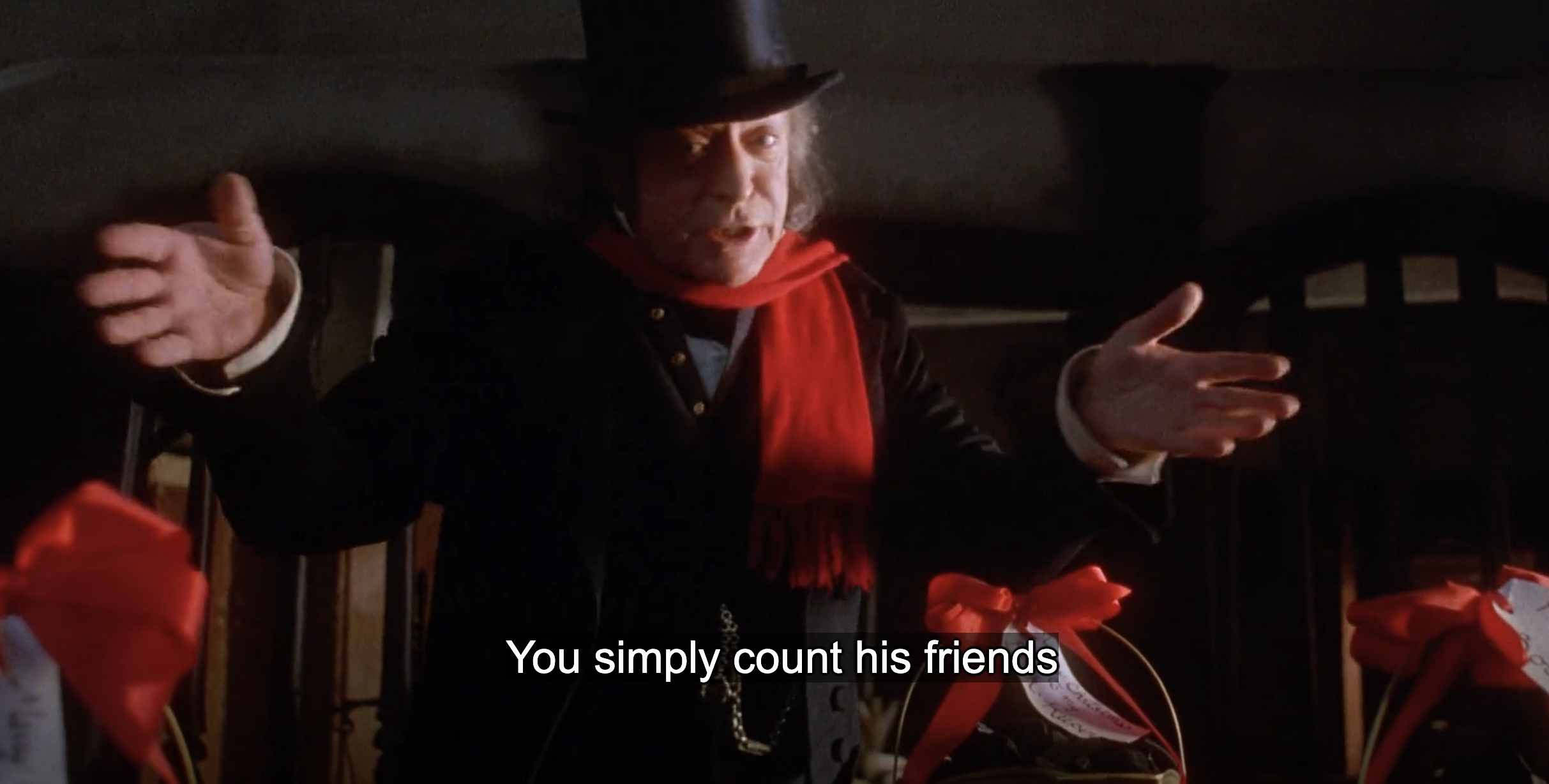
In the category of, “Well, guess I’m fucked then,” there’s a particular lyric from 1992’s The Muppet Christmas Carol that will leave introverts, shy people and misanthropes (for the three are not necessarily the same thing—even if often lumped together) feeling spotlighted in a way designed to make one feel hot with embarrassment and shame. That lyric is, of course, “And if you need to know the measure of a man, you simply count his friends” (never mind that plenty of people with a lot of friends have the sort that reveal their “measure” in a very unfavorable manner [see: Jeffrey Epstein]).
For the introvert/misanthrope, this little aphorism is “cutting,” to say the least. Even more so because, in the end, it is Ebenezer Scrooge (Michael Caine) himself who delivers it. A traitor to his own misanthropic kind, really. Though not to introverts, as that’s not really what Scrooge can be categorized as. In point of fact, if one looks up the definition of “misanthrope,” it reads, “A person who dislikes humankind and avoids human society,” followed by an example sentence wielding “misanthrope” that says, “Scrooge wasn’t the mean-spirited misanthrope most of us believe him to be” (a phrase ostensibly pulled from a 1992 Los Angeles Times article about depression amongst the elderly population).

So there you have it: Scrooge being used as a “textbook” case of what it means to be a misanthrope. And yet, A Christmas Carol presents him, more than anything else, as a textbook case of the capitalist run amok. Making all the money in the world, so to speak, and still being miserable, and taking that misery out on the “little people” who actually enable the capitalist to make so much money. As for Scrooge being both uber-capitalist and misanthrope, it can be said that rich people are, in many ways, highly misanthropic. Allowed to become that way because of their ability to avoid “the great unwashed” thanks to the sidestepping possibilities that gobs of money can buy (the image of Leona Helmsley comes to mind). And this is part of why Scrooge “magically” transforming literally overnight feels so unbelievable. Because if you don’t take away a rich person’s money, you can’t really “erase” their misanthropic behaviors—not fully. Besides that, it’s an insult to the non-rich misanthropes to be lectured by Scrooge about how the measure of a man can be counted by his number of friends.
In any event, it’s during the big final number—titled “Thankful Heart”—of the Brian Henson-directed movie that Scrooge expresses the full extent of his epiphany/philosophical one-eighty. Having seen the light, so to speak, by seeing three spirits (well, five…if one counts Jacob and Robert Marley, played by Statler and Waldorf, respectively) visit him the night before, Scrooge suddenly realizes that being “as solitary as an oyster” (to borrow a phrase from Gonzo-as-Charles Dickens) isn’t how a person ought to live their life. Even if the core of his very nature previously suggested that a man like him could never change. Especially so instantaneously (hence, billing it as a “Christmas miracle”).
But this is where the message behind A Christmas Carol gets twisted in terms of some being only too ready to classify Scrooge as a garden-variety misanthrope when his entire being is something else: a cold, hard capitalist. Indeed, in many regards, the about-face that Scrooge makes is a reflection of the proletariat’s wishful thinking that a rich man would be generous with his cash rather than stingy (*cough cough* Jeff Bezos). That he might, at the bare minimum, share his wealth if he sees fit to keep benefitting from the rigged game that is capitalism. Considering that Dickens wrote A Christmas Carol in 1843, as the effects of the Industrial Revolution were still being freshly felt, it’s not surprising that Scrooge should be portrayed as such a merciless capitalist a.k.a. “a squeezing, wrenching, grasping, scraping, clutching, covetous, old sinner! Hard and sharp as flint…”
In this sense, too, Scrooge being categorized as introverted or misanthropic is an insult to both types in that a capitalist of his level is an entirely different animal altogether (emphasis on the word “animal” in this case). To be sure, it’s more believable that a capitalist could alter their entire nature so drastically (to the point where Scrooge is singing socialist rhetoric like, “With an open smile and open doors/I will bid you welcome/What is mine is yours/With a glass raised to toast your health/And a promise to share the wealth”) than it is to believe an introvert or misanthrope could. For these are the ilk least likely to make such an instantaneous switch to their entire mode of being—after all, introversion and even misanthropy are personality types that tend to be innate, a matter of “brain wiring.” Ergo, difficult to, for all intents and purposes, obliterate. Which is why this lyric in “Thankful Heart” feels like a bit of unwarranted “attack.” To boot, it was already known racist/eugenicist Charles Darwin who said something similar with, “A man’s friendships are one of the best measures of his worth.” So that should tell one something about the kind of person who believes in such a “needlepoint platitude.”
As Scrooge repeats the “Darwin-ism,” it’s also telling that he’s laying out baskets filled with gifts for each of his employees (more specifically, his seeming army of bookkeepers). Further proof that Christmas is, as Mariah Carey well knows, intrinsically linked to capitalism. Reinforcing the Western notion that love, at its “realest,” must always be expressed through a purchased item. Because if you can’t give a monetary-based, tangible token of your friendship, well, then what kind of friend are you, really? (A low-budget, ergo low-priority kind, that’s what.) Considering that Scrooge is the ultimate capitalist, it makes plenty of sense that he would immediately take to this bastardized form of expressing “camaraderie.” A fundamentally impersonal expression on his part that aligns with his “formerly” misanthropic approach to life. After all, it’s not as though he had many examples during his developmental years in terms of learning about love. Least of all love shown through non-material means. And one could argue that Scrooge being sent to boarding school by his parents was one such form of “love” displayed through the material. After all, schools like that don’t come cheap.
For Scrooge to learn to “love” and “spread joy” this late in life, however, is meant to be the positive affirmation of both A Christmas Carol and The Muppet Christmas Carol. An assurance that it’s never too late to mutate your entire being to suit the comfort levels of others who have been off-put by your “true colors.”


