


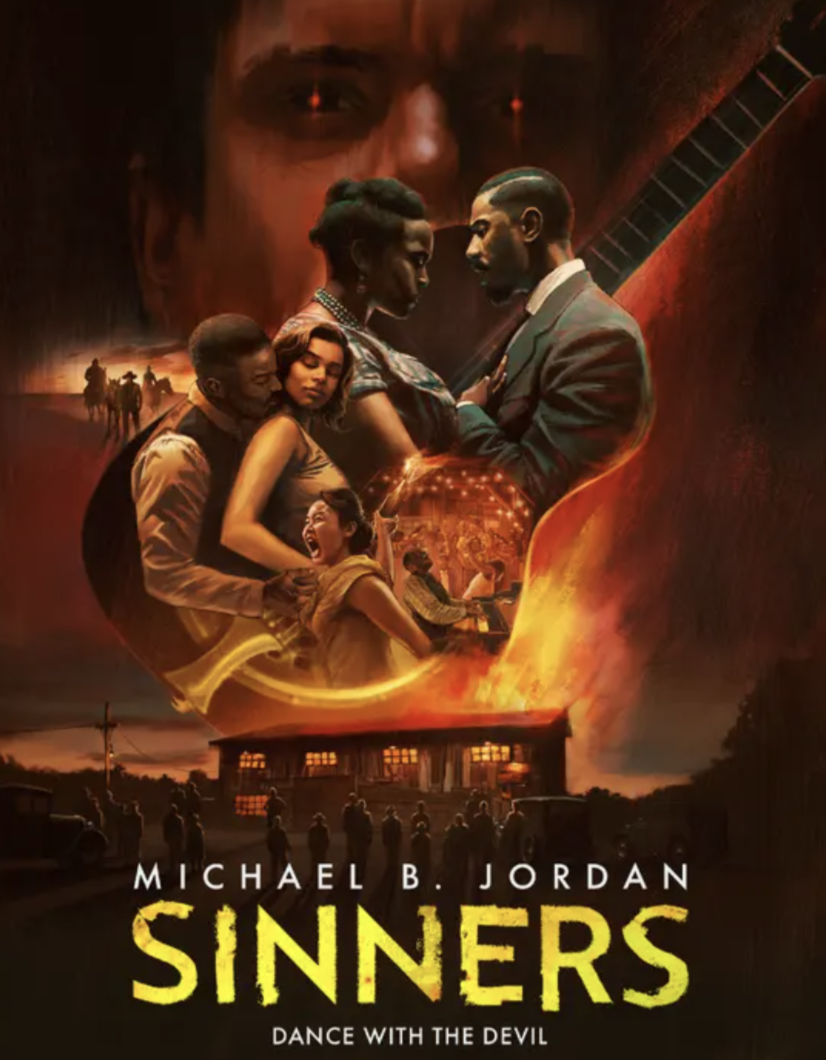
Despite the universal praise for Ryan Coogler’s latest film, Sinners, there is something of a pall hanging over it as a result of the comparisons that many critics are drawing to Robert Rodriguez and Quentin Tarantino’s 1996 cult classic, From Dusk Till Dawn. And yes, to be sure, there are some noticeable similarities that make it “only natural” for cinephiles and casual movie viewers alike to point out. The primary ones will be named hereafter in order to get them out of the way/refer to them later: 1) like Sinners, From Dusk Till Dawn centers on two nefarious/criminal brothers, Seth (George Clooney) and Richie Gecko (Tarantino)—and the latter is much more of a bad seed than the former; 2) there’s a genre shift at the midpoint of the film that finds the Gecko brothers trapped inside a biker/trucker bar where they must fend off vampires until the sun rises; 3) only one of the brothers—the one prone toward being more evil—gets turned into a vampire.
So yes, certainly, those are some very big narrative and character correspondences to Sinners, which tells the tale of two brothers named Elijah a.k.a. “Smoke” and Elias a.k.a. “Stack” (both played by Coogler’s muse, Michael B. Jordan). Brothers who, like the Geckos, head down South from a more northern part of the country (specifically, Chicago). Unlike the Gecko brothers, however, they’re not on the run from the law, but rather, the criminal element they’ve stolen from while working as two of Al Capone’s many foot soldiers. And it is with the money (and illegal liquor—thanks to the story taking place during the tail end of the Prohibition era) they’ve pilfered that the duo returns to their native Mississippi (namely, the Mississippi Delta). Not just to get as far as they can from Illinois, but to purchase a sawmill (or what they’re told is a sawmill) from a white man named Hogwood (David Maldonado). This done with the plan to turn it into a juke joint. A plan so ironclad, they get to work the very same day so that the joint (called, aptly, Club Juke) can open that very same night.
To make it come together so quickly, Smoke and Stack enlist the help of local suppliers Grace (Li Jun Li) and Bo Chow (Yao) to provide the food and drinks, a reluctant Delta Slim (Delroy Lindo) to play the piano, their cousin, Sammie “Preacherboy” Moore (Miles Caton), on guitar and a woman—married, she’ll have you know—named Pearline (Jayme Lawson) to sing and dance (though her skills in this department aren’t the only things that attract Sammie to her). With the entertainment and food/beverages covered, there still needs to be someone who will actually cook the ingredients, which is where Smoke’s ex, Annie (Wunmi Mosaku), comes in. Even though it takes a bit of convincing on Smoke’s part, especially seeing as how he left her high and dry for Chicago seven years ago in the aftermath of their infant’s death. Stack, too, has his own “little sweetheart”—Mary (Hailee Steinfeld, who has her own Black roots)—that he abandoned when the duo absconded all those years ago. Except that his sweetheart is more “controversial” because she’s a white woman…or at least she passes for being completely white, though her mother was the product of a mixed-race marriage. In any case, white-passing or not, she has no issue publicly “fraternizing” with a Black man by telling Stack off and reminding him of all those words of devotion he said to her “while his face was in her cooch.”
Smoke fares better on gaining forgiveness more quickly, making up for lost time by getting Annie “low and wet” (you know, the opposite of high and dry), ingratiating himself to her (yes, that involves lifting her dress up) after an argument about her obsession with hoodoo and the occult. An “obsession,” she maintains, that has kept him and his brother safe from harm all these years. It’s here that Smoke takes the opportunity to dig the knife in by retorting that if her “magic” worked on them, why couldn’t it work on protecting their child. To this, Annie admits she doesn’t know. But she does know that, despite everything, she’s missed him and still loves him. So it is that one of the film’s many “saucy” scenes ensues. In fact, it can be said that what really differentiates Sinners from From Dusk Till Dawn is how much sexier it is (barring the illustrious scene of Salma Hayek as Santanico Pandemonium, doing her seductive dance at The Titty Twister).
That, and well, the trenchant racial commentary (further emphasized by setting the story in 1932). Indeed, Coogler takes a more Jordan Peele approach to the narrative than a Tarantino/Rodriguez one, with the core of the message stating that, in the United States, a Black person is better off trying to succeed/generally carry on as a vampire than trying to make it through while actually alive. And that white people can only shed their racism and preconceived notions about Black people by also becoming vampires and delighting in the concept of a “community” based on this common denominator.
As for Jordan’s nuanced performance of Smoke and Stack, let’s just say that, much the same way as Lindsay Lohan in The Parent Trap or Nicolas Cage in Adaptation, he pulls double duty playing twins with plenty of award-worthy efficacy. This tour de force acting, paired with Coogler’s (and cinematographer Autumn Durald’s) highly specific eye/storytelling methods (which reach an apex during what will now go down as one of the most memorable scenes in cinematic history—the scene where the past, present and future coalesce in a single instant spurred by Sammie’s highly affecting [so affecting that it can conjure evil spirits] guitar-playing), are what make Sinners a project all its own. In truth, apart from the two very noticeable similarities to From Dusk Till Dawn mentioned above, Sinners really only becomes its most Tarantino-esque when Smoke goes on a “roaring rampage of revenge” against the Klan, saving Hogwood for last as his pièce de résistance kill.
And so, like trying to reduce Dev Hynes to “Kendrick Lamar for queer black folk,” there is something insulting about critics trying to diminish or dilute what has been achieved with Sinners by incessantly bringing up the From Dusk Till Dawn “parallel.”


