


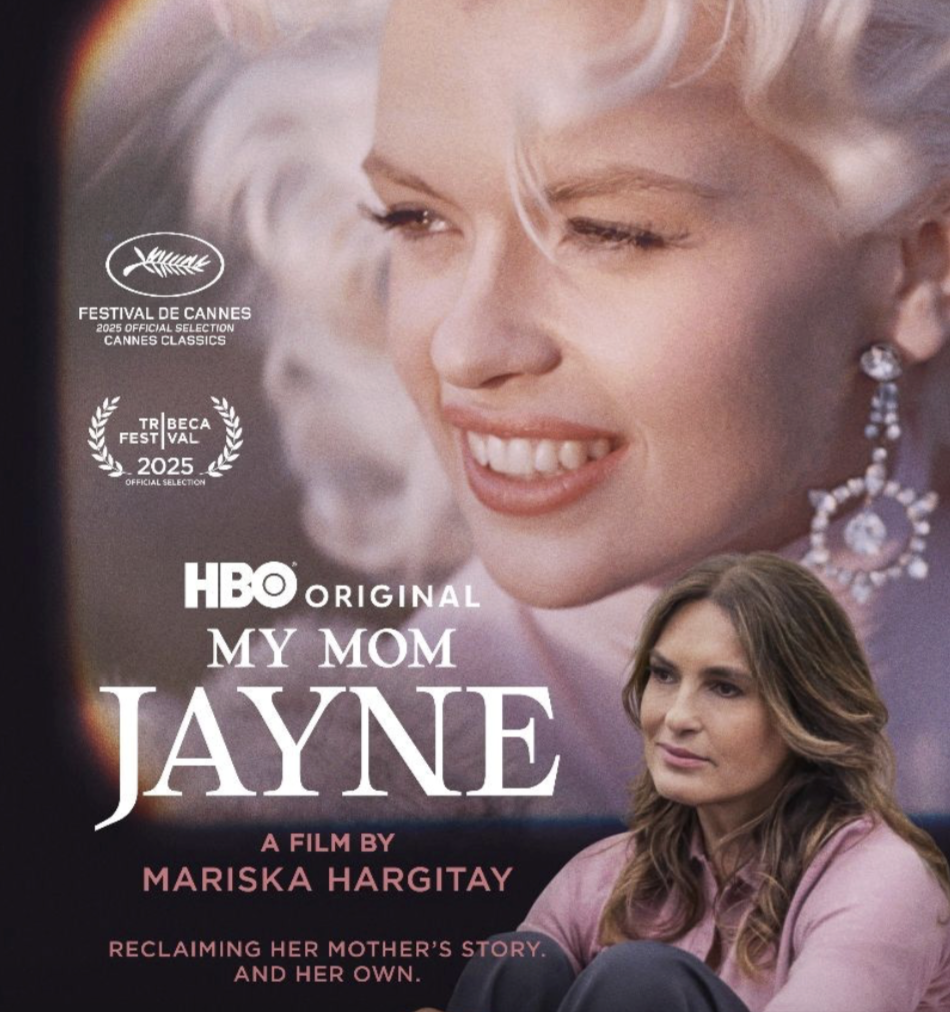
By opening a door to the past that Mariska Hargitay had long kept closed for the sake of her own emotional self-preservation, the result became My Mom Jayne. A tender, bittersweet rumination on the ways in which her mother, Jayne Mansfield, was ultimately a victim of her childhood. In other words, her behavior with men was a direct result of losing her father when she was just three years old. And, in the end, her behavior when it came to men is what led to her death. The same can of course be said of Norma Jeane Baker a.k.a. Marilyn Monroe. And yes, Norma Jeane’s real name bears a bumpkin-esque similarity to Jayne’s own original name, Vera Jayne Palmer.
To cultivate the glamor she was seeking, Jayne dropped the Vera and took on her first husband Paul’s last name by the time she decided to move to California circa 1954. Although Paul came with her and “their” daughter (though it was often said Jayne Marie Mansfield was the daughter of someone else, with some speculating that the pregnancy was a result of date rape), it wasn’t long before he realized that Jayne was actually serious about turning this into a career, prompting him to head back to Texas, where the two were previously living. Thus, Paul Mansfield is the James Dougherty of Mansfield’s life—the first husband who was never meant to “stick,” but, rather, serve as more of a jumping off point. And, like Marilyn, Jayne got married as a teenager (seventeen to Marilyn’s sixteen), with both women in search of the father they’d lost before they were fully coherent. In Marilyn’s case, her father, John Newton Baker, was out of the picture from the get-go. With Jayne, however, her father, Herbert William Palmer, would have undeniably stuck around, for he had proven himself to be a steady provider, practicing as a lawyer in New Jersey up until the point when he had a heart attack in 1936. In what would retroactively be an extremely eerie and ironic turn of events, Herbert died while driving, with Jayne in the back seat to bear witness. Cut to thirty-one years later, and Jayne’s own children would be in the back seat of the car when she, too, died (though at least her children were asleep when it happened). “Poetic,” some might call it. Others, downright sadistically cruel of the universe.
Told, at first, primarily through interviews with the siblings she grew up with, Zoltan Hargitay, Jayne Marie Mansfield and Mickey Hargitay Jr., Mariska paints the picture of a woman whose taste in men—apart from bodybuilder-turned-actor/Mr. Universe, Mickey Hargitay—was part of what led her down an inevitable path of destruction. The same, too, can be said of Marilyn, whose ceaseless quest for a man a.k.a. father figure to love her unconditionally invariably left her more bereft than when she started out in the relationship. And yes, both actresses had affairs with John and Robert Kennedy (oh these brothers with their incestuously competitive nature). Chalk it up to another way in which Mansfield was the most thorough Marilyn imitator of the day (though Anita Ekberg was a strong contender as well). Indeed, in the documentary it’s mentioned that Mansfield had “great admiration” for Marilyn, and was as horrified as any other fan upon learning of her death in that early August of 1962.
However, there were times when Mansfield’s admiration ostensibly turned into an ugly form of envy, most notably when it came to Marilyn’s “open secret” affair with the president. Determined to have her own affair with Kennedy and prove her commensurate worth as a blonde bombshell and Playboy centerfold (even if Marilyn’s centerfold wasn’t voluntary like Jayne’s), when Jayne did seal the deal, it was reported that Marilyn’s reaction was, expectedly, not favorable. As for what Marilyn would have been jealous of Jayne for, it was most likely her ability to have children, and so bountifully, too. By the time Marilyn died, Jayne “only” had three, but by the time of Jayne’s tragic death in 1967, she would have two more, Mariska in 1964 and Tony Cimber (through her marriage to Matt Cimber) in 1965.
In this regard, Mansfield, through Monroe’s eyes, measured up more “viably” to the sex symbol role. For what is a sex symbol if not just a “hot” woman, but a woman can do the very thing that sex is “supposed to” lead to: getting pregnant. Not only that, but a woman who relishes her body and her sexual exploits with gusto. Marilyn was less inclined to feel this way than Mansfield, who was patently more comfortable in her own skin than Monroe (this made evident by the various publicity appearances—complete with their pre-engineered wardrobe malfunctions—that Mansfield engaged in). What’s more, throughout her life, Marilyn struggled emotionally with her fertility issues, enduring some of her deepest depressions over an ostensible inability to carry a child to full term while married to Arthur Miller, during which she miscarried three times. This being the result of her endometriosis, which also made sex mostly unenjoyable for her. And yet, that didn’t stop her from continuing to try to lean into her sex symbol status at full-tilt, for it was also during her marriage to Miller that Marilyn had an affair with Yves Montand, her co-star in Let’s Make Love. At the same time, like Mansfield having an affair with Nelson Sardelli while married to Mickey Hargitay, Marilyn’s affair was an act of defiance. A means to get the attention of the husband who had wounded her. In Arthur’s case, the wound was getting a little too cozy with photographer Inge Morath while on the set of The Misfits in 1960 (and soon after marrying her in ‘62). A disastrous production in every way—though the final product is one of Monroe’s best performances.
Which brings one to a key difference between Monroe and Mansfield: the latter wasn’t notorious for holding up productions and generally bringing a whole lot of drama to the set. Maybe that’s why Mansfield ultimately had more film credits under her (garter) belt by the end of her life. That, and she didn’t have a crippling drug dependency (quite possibly, in another blow to Marilyn’s inability to become a mother, because Mansfield had so many children to anchor her, therefore prevent her from such temptations—though Mansfield certainly wasn’t prevented from sexual ones).
There are other noticeable differences between the two bombshells brought to the fore in the documentary. For instance, the strategically wielded clip of Mansfield while appearing on the Groucho Marx-hosted You Bet Your Life. During it, Mansfield shrugs off the idea that she’s leaning into the dumb blonde persona despite being an intelligent woman by explaining, “It’s like this: the public pays money at the box office to see me a certain way and, uh—” Marx interjects, “And they get their money’s worth too.” Mansfield laughs along with the audience before finishing, “So I think it’s just all part of the role I’m playing as an actress.” This attitude was not one that Monroe adopted so readily, making waves in Hollywood in 1955 when she “dared” to start her own production company, MMP (Marilyn Monroe Productions), in response to the typecasting she had been tormented by at 20th Century Fox, with Daryl Zanuck as the ringleader of consistently writing her off as a one-note actress with nothing to offer but a pretty face and a traffic-stopping figure.
By 1956, Monroe had gotten her wish to play a more nuanced part: Chérie in Bus Stop. Marking another parallel between her and Mansfield when, a year later, she, too, would star in a more serious film with the word “bus” in it, The Wayward Bus. And yes, both women did their time starring in the musical Western and musical comedy genres.
In My Mom Jayne, there comes a second mention of Monroe after the one where Mansfield’s former press secretary (and the author of the illustrious book, The Tragic Secret Life of Jayne Mansfield), Raymond Strait, states the obvious about Jayne culling her “act” from Marilyn. That second mention being, specifically, how her death in 1962, per Jayne Marie, seemed to suddenly make Jayne realize that, despite her prior claims of being “just fine” with her relegation to ditzy blonde bombshell parts, “That whole blonde persona was a box.” And once you got boxed in long enough, it was unlikely you’d ever get out. And so, like Marilyn, Jayne decided “she wanted to reverse that image.” And, also like Marilyn, she didn’t have much success in doing so. Not if she wanted to keep paying the bills. Which is how 1963’s Promises! Promises! came to be, establishing her as the first mainstream actress of the “talkie” era to do a nude scene. Here, too, it’s worth noting that Monroe would have been the first were it not for 1) her being fired from the George Cukor-directed Something’s Got to Give and 2) her premature death. The scene of Marilyn in question from that film was of her skinny dipping in a pool. Alas, Mansfield was able to outshine her in this regard alone.
When Mariska asks Raymond where he thinks Jayne’s “role”/“persona” came from (complete with the baby voice that Mariska was made so uncomfortable by), he replies, “That’s what the studios wanted. And so she sorta copied Marilyn Monroe.” “Sorta” is certainly an understatement. For if Marilyn was a “slight” caricature of Jean Harlow, Mansfield was a caricature of Monroe to the nth degree. Her rendition of Marilyn almost a mocking parody. And yet, Mansfield was, in her way, taken more seriously than Marilyn by sheer virtue of her tireless work ethic. Having no trouble appearing at event after event without calling in with a fever or citing exhaustion, etc. Perhaps this was an underlying part of the reason behind Mansfield’s nickname, the “Working Man’s Monroe.” For Mansfield was an undeniably hard worker herself. Monroe, instead, was a notorious “loller,” lolling about for days on end before she could bring herself to become “Marilyn” long enough to film some scenes.
As for another one of their marked life similarities, there’s the fact that both women died at a young age (Jayne at thirty-four, Marilyn at thirty-six), before time could “defile” their looks—the thing that society at large had drilled into their psyches as the only attribute that made them “worthwhile” human beings. Though it might sound cruel, in some sense, there was a cosmic kindness to their too-soon deaths. “Allowed” to live forever young as their vanity would have wanted. And while My Mom Jayne is all about Mariska Hargitay coming to terms with where she came from, and the overdue acceptance of her mother for who she was—in all its complexity—one is left wondering if Marilyn, had she been able to have children of her own, would have ever been given the same eventual grace.


