


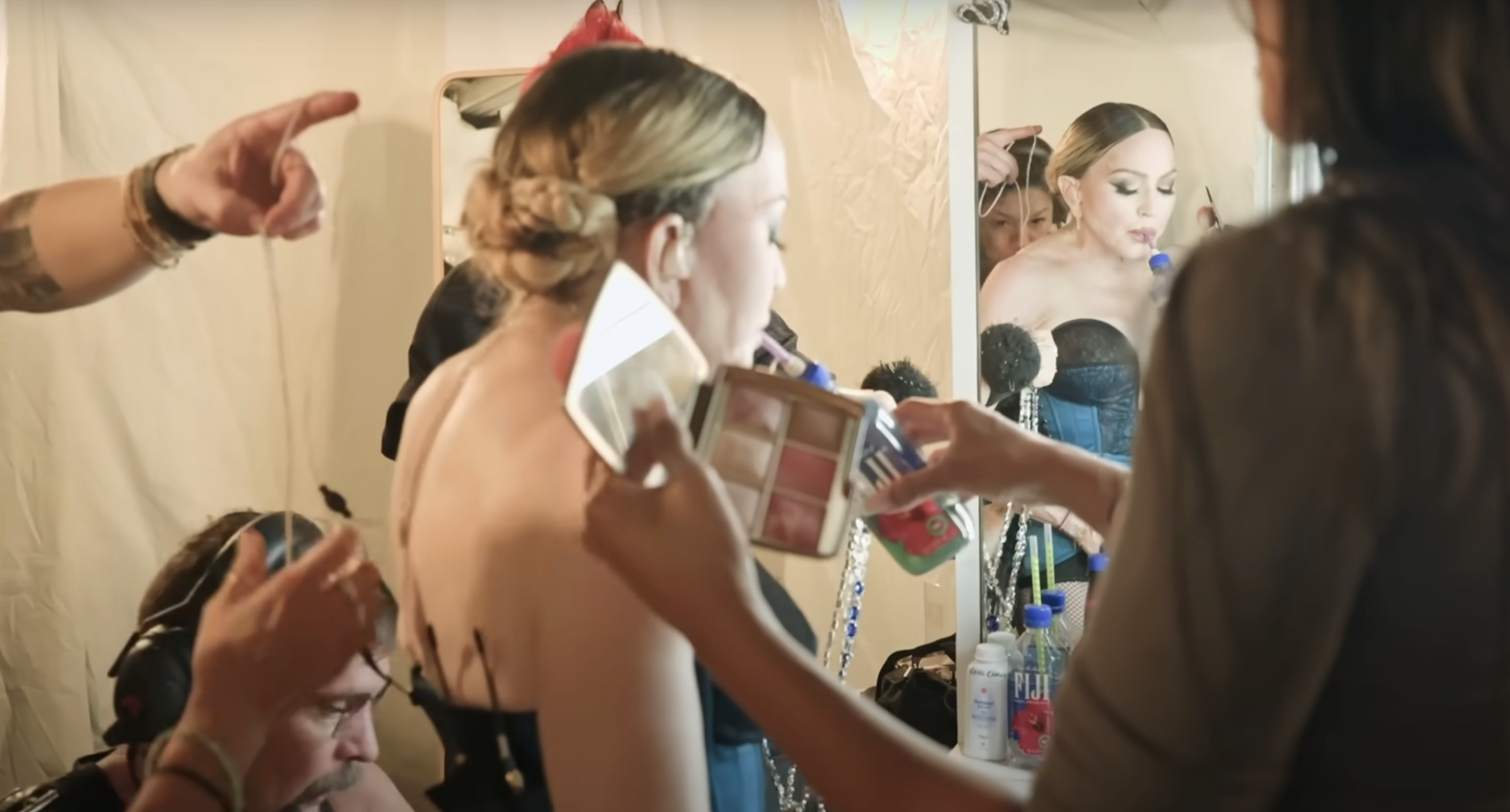
While certain rivalry-loving ilk have been quick to point out that Lady Gaga just surpassed Madonna’s record last year at the Copacabana for attracting the largest audience to a concert (at 1.6 million attendees, now surpassed by Gaga’s 2.5 million at the same beachside venue), it doesn’t change that The Celebration Tour was a feat of epic proportions. Not just in general, but specifically when “retrofitted” to accommodate the show at the Copacabana. To give a glimpse into that daunting technical task, on April 29th (a week before the one-year anniversary of The Celebration Tour in Brazil) Madonna released the complete form of some previously teased footage constituting a behind-the-scenes look at what went into getting the production ready for Rio.
Of course, longtime Madonna fans can’t help but think of her previous documentaries (or “rockumentaries,” as the genre sometimes likes to be called), 1991’s Truth or Dare and 2005’s I’m Going to Tell You a Secret, when seeing something like this. But, unfortunately, the edited footage only clocks in at eleven minutes and forty-two seconds, leaving viewers wanting to see a full-length feature detailing a more complete look at Madonna’s many stops along the way leading up to this final date of the tour.
Co-directed by Raoni Carneiro, Pedro Secchin and Jonas Åkerlund (a Madonna go-to), the mini-doc opens with a series of news clips discussing her imminent Copacabana performance, as well as its “aftermath”: attracting over a million concertgoers to the beach in what was then a record-breaking feat (because yeah, yeah, yeah Lady G got 2.5 million and topped it). Interspersed moments from the live performance enhance the idea of understanding “why” so many people would gather to see this event. Apart from Madonna being among the last of the true icons, from a time long before “virality” was the key to fame, the reason is that there is still no one on this Earth who can put on a show like her. Not even—gasp!—Lady Gaga. Who has her own brand of a “weird theater kid” going on, but at a much less accessible level. Indeed, that has always been the “trick” of Madonna: making “freakshowdom” (once upon a time, a euphemism for being queer or generally “other”) “palatable” to the masses. And as a Midwestern girl, Madonna knows something about the type of “everyman” ilk that lives in said part of the country (much like a pop music spawn of hers, Chappell Roan). Knows how to convey a uniting message of love and “music makes the people come together”-ness that is slightly less, let’s say, esoteric.
Of course, that doesn’t at all mean that Madonna is without her fair share of polarizing references when it comes to what she’ll incorporate into her work. For The Celebration Tour, it goes without saying that no “layperson” would be entirely on board with her “strange” monologues. The ones given with a version of herself standing next to her and portrayed by one of her dancers. And, speaking of those dancers, Madonna continues to prove that she holds the highest esteem for this art by featuring them in the first segment of the behind-the-scenes look, with a title card reading “The Performers” leading into her emcee, Bob the Drag Queen, talking about how they’ve all been working on the show since October of 2022.
This far-back starting point tracks with Madonna’s level of perfectionism when it comes to putting on a live performance of this magnitude. Such a perfectionist, in fact, that she now famously ran herself into the ground in the summer of 2023, incurring a life-threatening bacterial infection that forced her to postpone the tour. Nonetheless, despite knocking on Death’s door at a certain point, Madonna refused to enter, all in keeping with what Norman Mailer once billed as her “cast-iron balls.” Or rather, her being “a pint-size Italian American with a heart she hopes is built out of the cast-iron balls of the paisans in generations before her.”
Clearly, it still is, considering she was able to carry off The Celebration Tour at this scale, and to be the first person to tackle the technical aspects of it at this particular venue (with Copacabana expected to host more shows like this every May until at least 2028, all ultimately in a bid to draw in an economic “boost” to Rio). As portions of a voiceover to a video clip she made for MTV in 1991 (in honor of its tenth anniversary) plays over the performers—Madonna included—rehearsing, it’s also apparent that M wants to highlight two points: 1) she’s more self-referential than ever (and has every right to be) and 2) her cheeky sense of humor is just as present as always.
Elsewhere, Madonna mentions her children being in the show with her (for, while everyone keeps talking about Beyoncé including Blue Ivy and Rumi on the Cowboy Carter Tour, Madonna has been the pioneer of featuring her children in her performances, starting with Lourdes Leon playing the flower girl at the 2003 VMAs rendition of “Like a Virgin/Hollywood”). And then there are the callbacks to Truth or Dare with various intercut “musings” about Madonna (“can be very demanding”) and the tour from those who work with her.
Damien Jalet, one of the choreographers of the show (who also worked with Madonna on the Madame X Tour) also gives a big nod to Truth or Dare by quoting Salim “Slam” Gauwloos when he says, “I’m panicking right now. Belgian stress.” Stress that Madonna’s son, David Banda, brushes off as he says, “It’s just what we do.” As it’s just what Stuart Price does to tinker with the sound of Madonna’s songs for live shows. Having started off as her musical director on 2001’s Drowned World Tour (and later producing one of her biggest albums of the 00s, Confessions on a Dance Floor), this is hardly Price’s first rodeo. Which is why, during the “Adapting the Show” part of the mini-doc, he calmly states, “I feel like this would be a really great time to rip it all up and just start again.”
The same goes, in many regards, for the costume design, which also gets its own segment in the featurette. As Madonna’s stylist, Rita Melssen, alludes to her perfectionism as well (“M is very specific,” she notes diplomatically), we see that the key sartorial pièce de résistance for this show is a revamped version of M’s cone bra corset styled in the form of a Brazilian flag. As for describing what it was like to outfit Madonna and her dancers for this particular tour, Melssen commented, “It’s been a really deep dive into her history and just fashion history.” After all, Madonna pretty much invented the concept of fashion and pop stardom going hand in hand.
The final segment, “Rehearsals,” goes into the sound production and choreo aspects of putting the performance together. Namely, for the rehearsal of “Music,” incorporated into the set list exclusively for this show. Complete with an onstage cameo by Pabllo Vittar, who stops by to join Madonna for the rehearsal. As is Madonna’s way, she also asked local Brazilian students to accompany her on instruments for “Music,” giving the show at the Copacabana an even more “bespoke” feel. But perhaps what stands out most about this behind-the-scenes look is the fact that Madonna doesn’t feature herself in it as much as she does everyone else who helped put not only the tour itself together, but its tailored form in Rio. And yet, even back in the days of the Blond Ambition Tour, Madonna was always certain to acknowledge that it takes a village to create something of this magnitude. In short, that no icon is an island.


