


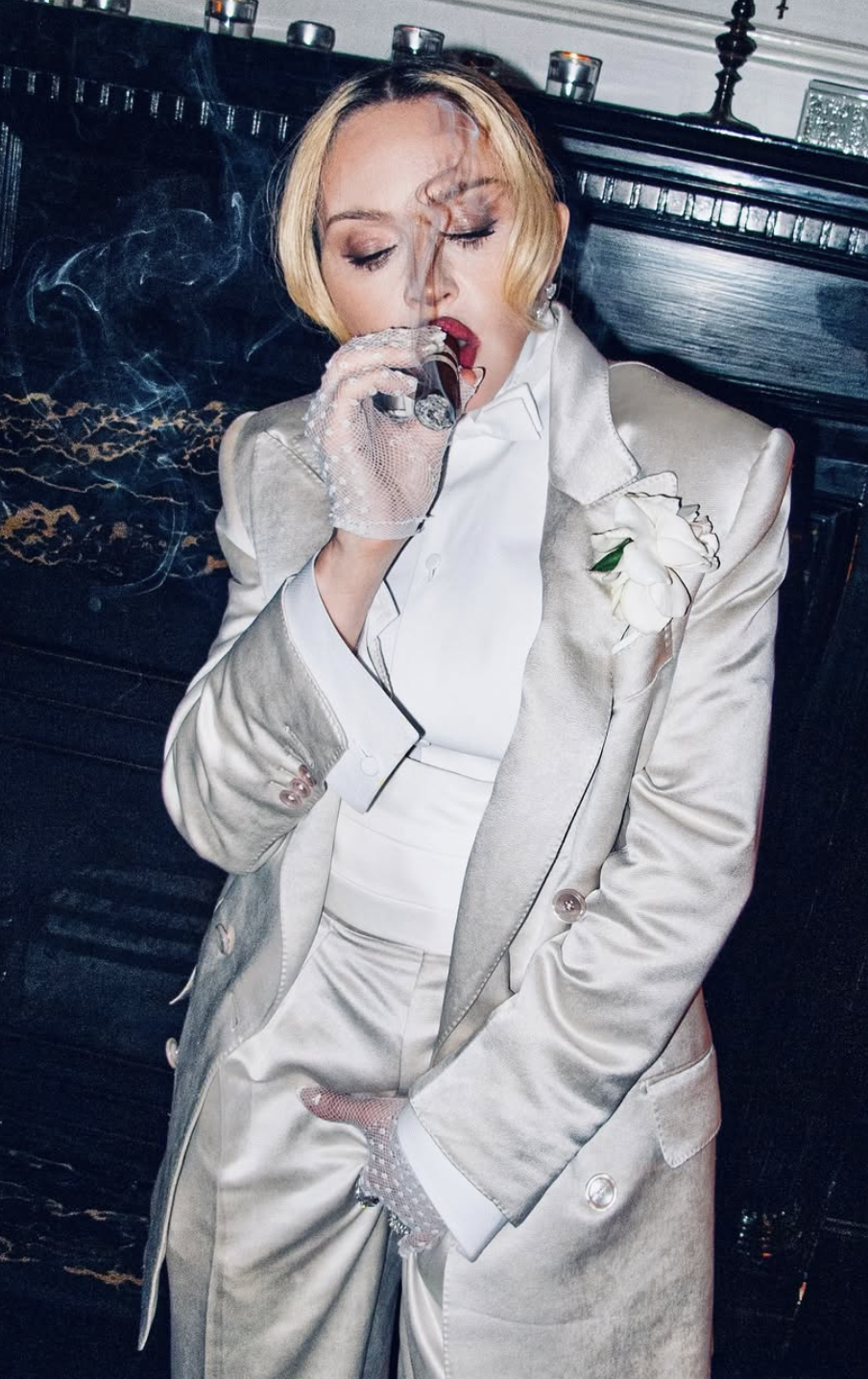
Madonna’s predilection for displaying her androgynous tendencies through her sartorial choices is nothing new. But at this year’s Met Gala, that fondness for what can be described as “Marlene Dietrich-style masculinity” reached another apex. More than being “epicene,” Madonna’s ensemble selection for the annual fête was in keeping with the theme this year: Black dandyism (a.k.a. “Superfine: Tailoring Black Style”). Or, in M’s case, just plain dandyism. And yet, when Madonna wore outfits of this bent in the past, it was branded as “androgyny” with far more eyebrow-raising. And, what’s more, as another classic example of Madonna having “penis envy” for daring not only to act like a man (which is to say, as she pleases), but to dress like one too. Albeit a very stylish one. This adding to the “galling” nature of it all: that Madonna sees herself not just as a man, but as a man of the most powerful and successful order (think: serving CEO realness—much as she did for most of her photoshoots throughout 2000 and 2001).
As for M’s decision to attend this year’s gala after a seven-year absence (last appearing with Jean-Paul Gaultier in 2018 for the “Heavenly Bodies: Fashion & the Catholic Imagination” theme [which actually would have been much timelier this year]), it’s hardly a coincidence. Not only because she’s “dusting herself off” for the public eye in preparation to release a new record, but because co-chair Anna Wintour (in conjunction with Colman Domingo, Lewis Hamilton, A$AP Rocky and Pharrell Williams) picked a sartorial motif that resonated with her. And Madonna rarely participates in anything that doesn’t resonate with her (if/when she does, it tends to go up in smoke à la the Pepsi deal [fire pun intended]). Which is why she seized on the opportunity to return to her “masc” roots for this event, outfitted in a white satin tuxedo from Tom Ford (and designed by creative director Haider Ackermann, who accompanied Madonna on the, er, blue carpet).
Those roots trace, at the bare minimum, back to the days when she first arrived in New York, establishing herself on the dance and art class modeling scene with a “boyish” (read: surfboard body) physique and gamine aesthetic (complete with shorn locks that seemed to mirror her figurative shedding of the skin upon arriving in “the big city”). In the years during which she was taken under the wing of her first manager, Camille Barbone, Madonna also likely got some additional inspiration on how to be “butch.” For Barbone’s sexuality was certainly no secret, least of all to Madonna, who was fully aware that Barbone was in love with her—using that sentiment to her advantage until it no longer served her.
Indeed, while some might try to paint Madonna as a “bitch” for casting Barbone aside at the eleventh hour of something finally happening for her music career (in large thanks due to Barbone keeping Madonna financially afloat), others find it plain to see that Madonna acted in a manner that is commonly associated with “masculine bravado.” And entitlement. In truth, a large reason behind the enduring contempt for Madonna over the decades has been directly related to the “audacity” she’s displayed in acting exactly as any cis white hetero male would. To men of that “persuasion,” it’s been the ultimate affront, while, to women, it’s also been “insulting” because some part of them wishes they had the, well, balls to behave so cavalierly.
Appropriately, although Madonna’s major record label deal came in 1982, with her self-titled debut released in the summer of ‘83, she didn’t become a true pop superstar until her sophomore record, Like A Virgin, was released in ‘84. The reason for this isn’t just that “Like A Virgin” blew up in the wake of Madonna’s then scandalous VMAs performance, but because she had become the femme/sexpot “pop tart” that audiences—both male and female alike—wanted to see. Whereas during the Madonna era, she still had ultra-short hair and hyper-masc energy that was accentuated by her clothing choices (what amounted to tattered rags with no tailoring a.k.a. form-fittingness) and clunky, chain-oriented jewelry that still bore the aura of a street urchin wordlessly telling potential attackers, “Get the fuck away from me.”
Transitioning into the femme era (even if it was ripe with irony) of Like A Virgin, however, Madonna was fulfilling the ideals that both men and women had (and have) of what a female “ought to” be. More specifically, what a female “ought to” look like. Which is why it was hardly a surprise that, all of the sudden, she had “mass appeal.” This in contrast to the “niche audience” of Madonna. Not only because many listeners presumed she was a Black artist, but because, upon actually seeing the white girl behind the songs, they realized she didn’t live up to any traditional beauty standard for women.
And so, Madonna adhered (in her own unique way) to the standard for a couple of years before going back to her androgyne flavor in 1986, once again cutting off her tresses (and dyeing them platinum blonde) in favor of a cleaner, crisper look for the True Blue period. Taking into account some of the “shocking” messages she had to deliver on this album (namely the one on “Papa Don’t Preach”), it was no wonder she felt comfortable embodying a more masculine energy for the occasion. Much to Sean Penn’s probable dismay. And yes, there’s no denying a certain rebellion on M’s part in choosing to go for a short coif just as she became “Mrs. Penn.” Almost as if refusing to aesthetically represent the “little missus” trope in any way, least of all via long hair.
In the years after True Blue (and after her divorce from Penn), the pendulum swung back toward looking femme again (even if always exuding the “chutzpah” of a man). In ’89, the shift started to veer back toward “butch” again with the “Express Yourself” video, wherein Madonna donned a pinstripe suit and grabbed her crotch (a maneuver grafted from Michael Jackson). In the same video, she also presented herself in hyper-femme form (through the lens of Old Hollywood glamor). Exploring both sides of the two gender tropes, Madonna was working her way toward something bigger. Something that started to manifest more clearly in the “Justify My Love” video, which hit airwaves in late 1990. Directed by Jean-Baptiste Mondino and shot in a Paris hotel, Madonna was reestablishing her distinct flavor for gender-bending yet again through the content of this “too hot for MTV” narrative. And with more of a vengeance than ever before.
Or so MTV thought until the Erotica era descended in 1992. It was during this year that, in addition to once again returning to ultra-short platinum blonde hair (almost like a “Ken doll” style) for her Dita persona, Madonna took to exploring the various gender forms and sexualities via her “wildest” (by society’s standards) fantasies for the album’s “companion,” Sex—an infamous coffee table book that would shoot to the top of the New York Times Best Seller list.
It was, thus, no wonder that 1992 was the year that yielded one of her most memorable photoshoots, dressed almost like a drag king in an “executive realness” suit that made her look as butch (read: powerful) as she ever had (with one of said images being used as the cover art for Madonna’s “Deeper and Deeper” single). Distinct from previous “flirtations” with androgyny in that Madonna actually dressed in the sartorial stylings of a man (or rather, the stylings conventionally associated with “being a man”), the overall masc-ness was further accentuated with a coup de grâce accessory: her cigar.
And to resuscitate this look for the 2025 Met Gala (cigar and all) is not without meaning or (of course) self-reference for Madonna. Particularly during a moment when the political landscape is, once again, filled with conservative rhetoric trying to tell people what each gender is “supposed to” be. With the current government quite literally legislating the definitions and, moreover, insisting that there can only be two genders. With no gray, “epicene” area in between. Which is precisely why, even more than a fashion statement, Madonna was, once again, making a political statement with her ensemble. Reminding everyone that, as Baird (Donovan Leitch Jr.) in season three of Sex and the City once said, “Gender is an illusion.” Social class, on the other hand, is not. So it is that Madonna captioned a post featuring her latest iconic masc look with the adage, “Clothes make the man.” But, in Madonna’s case, it has always been the woman who has made the clothes. Regardless of which gender she’s currently inhabiting.


[…] Madonna’s History of “Being Butch” Reemerged at the 2025 Met Gala for Good Reason […]