


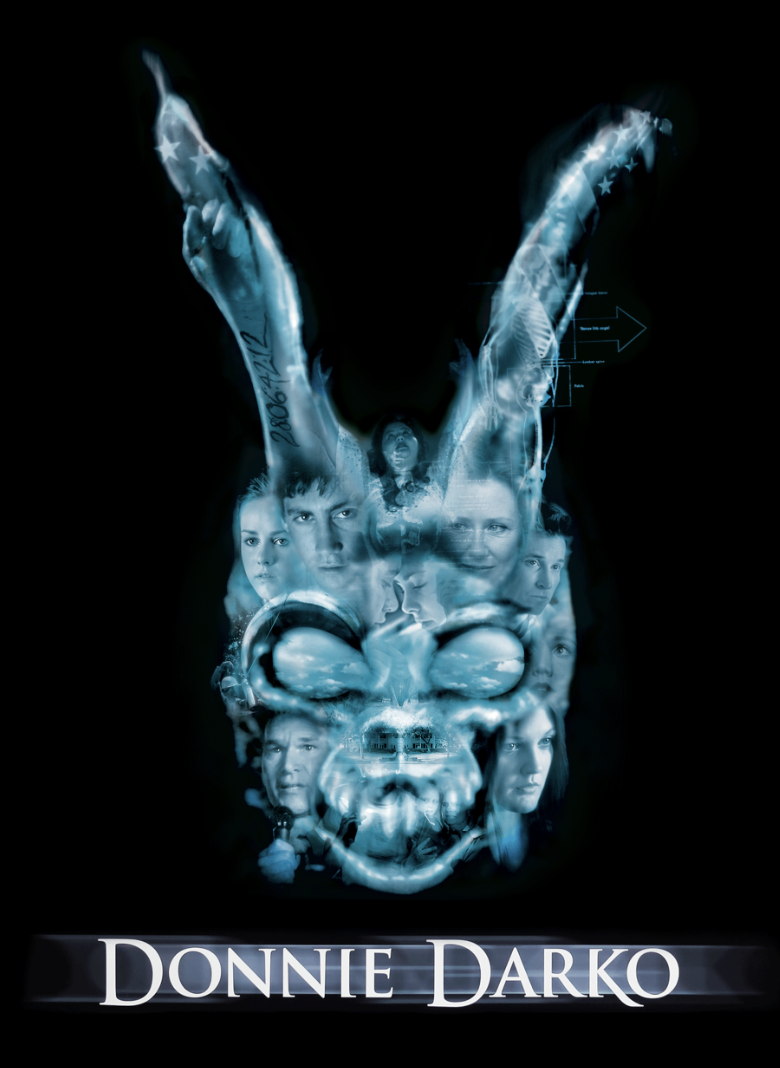
Much in the same way that there’s a long-standing debate about whether or not Die Hard is a Christmas movie (P.S.: it absolutely counts as one), it can be said that Donnie Darko presents a similar kind of “dilemma” for certain viewers. And yes, many would argue that just because a man dresses up in a demented-looking rabbit suit and appears repeatedly throughout the narrative doesn’t make it an Easter movie. Though that is a key argument for what does. However, there’s more to it than just that. There’s what the film represents: the idea of transformation through destruction. More to the point, self-destruction. An almost willful determination to expire because your very existence is a threat to the proverbial System. With both Donnie and Jesus providing “teachings” to others (through words as well as actions) that are far too “outrageous” for the status quo to bear.
Writer-director Richard Kelly emphasizes this point repeatedly in the film, particularly through his use of Graham Greene’s “The Destructors” in one of many integral “teaching scenes” of the movie. This short story is assigned by Donnie Darko’s (Jake Gyllenhaal) English teacher, Karen Pomeroy (Drew Barrymore). And when no one else in the class can seem to understand the message Greene is imparting, Ms. Pomeroy calls upon Donnie to explain. He’s only too happy to oblige, assessing of the gang’s activities, “Destruction is a form of creation. So the fact that they burn the money is ironic. They just want to see what happens when they tear the world apart… They want to change things.”
Donnie’s implication is, thus, that change—real change—can only arise through destroying something (e.g., the old world order). Like even, say, a human life such as Jesus’ (though many will be quick to tell you that Jesus was “supernatural”/no “ordinary” human being—even if he clearly was based on his mortality alone). Destroyed, in essence, by an angry mob. One that didn’t really want to “change things” as much as they wanted to watch the world burn, so to speak.
This being another theme that Donnie Darko speaks to: is there ever really a “reason” behind wanting to destroy, or are all justifications for doing so ultimately just that?: arbitrary (and false) justifications attempting to mitigate that man is nothing more than a savage animal. To underscore how humans are simultaneously complex and utterly base in this way (see also: Jim Cunningham [Patrick Swayze]), Kelly wields another one of Donnie’s teachers, Kitty Farmer (Tiler Peck), for a teaching scene about how, per Cunningham, there’s an “energy spectrum” that dictates how all human emotions/actions either come from a place of love or fear. With, apparently, no in between (side note: Cunningham’s self-help tapes blatantly ripped off Elisabeth Kübler-Ross, who helmed the “love and fear theory” in psychology).
Donnie, unwilling to accept this, rebels against the assignment, telling Mrs. Farmer, “There are other things that need to be taken into account here. Like the whole spectrum of human emotion. You’re just lumping everything into these two categories and, like, denying everything else.” Which is, at its core, how modern Christianity has also turned out. Providing only black-and-white answers to questions and conundrums that are decidedly gray. And yes, Mrs. Farmer definitely embodies the easily outraged and scandalized “good Christian woman” who would sooner deny all reality rather than have anything “unpleasant” seep into her day-to-day existence.
As the movie progresses, and the prophesy of Frank the rabbit starts to draw closer and closer—slated to take place on October 30, 1988 (because Donnie Darko is that rare combination of things: an Easter movie and a Halloween movie)—Donnie begins to more fully come to terms with what he must do. The Christlike thing he must do, as it were. Which is: sacrifice himself for the greater good of humanity (or really just his local community, but still). Offer himself up to Death so that those he loves (and those he doesn’t even know) can go on living. That is, in the “correct” timeline. Not the parallel one that was formed as a result of Donnie evading the death that was originally intended for him. The death that would have come if he had been in his room at the beginning of the movie, when the jet engine crashed through the roof where he usually slept (after all, the 1980s were a period of such airplane-related cataclysms [e.g., Pan Am Flight 103]). Except that, thanks to Donnie sleepwalking to the nearby golf course, he wasn’t in his room when it happened—thereby creating an alternate timeline that is, ultimately, “against nature.” To use an ominous term.
So it is that in this regard, too, Donnie represents a sort of Jesus-esque figure. A symbol for self-sacrifice and goodness (despite being filled with the same foibles that any ordinary person is). For in a timeline where Jesus might have survived—didn’t get nailed to a cross—he then doesn’t create myriad religions purporting to be rooted in love and acceptance. What’s more, like Jesus, Donnie serves as a talisman for inviting in and embracing the broken and misunderstood (including Gretchen [Jena Malone], Cherita [Jolene Purdy] and Grandma Death [Patience Cleveland]). And, technically, he is capable of miracles as well—having visions and “resurrecting.” Albeit, his resurrection comes first rather than second. Starting from the moment when he averts Death’s usually merciless call. Then, of course, there’s the, er, Easter egg of Kelly choosing to place The Last Temptation of Christ on the marquee of the movie theater where Donnie is watching The Evil Dead with Gretchen. This title (and its pairing with the latter) hardly being a coincidence.
In the end, however, it is Donnie who must nail his damn self to the cross, if you will, as a means to correct the timeline. To render himself into the sacrificial lamb. Which perhaps makes him even more beneficent than Jesus because he was willing to do it to his own body…rather than letting others do it for him.


