


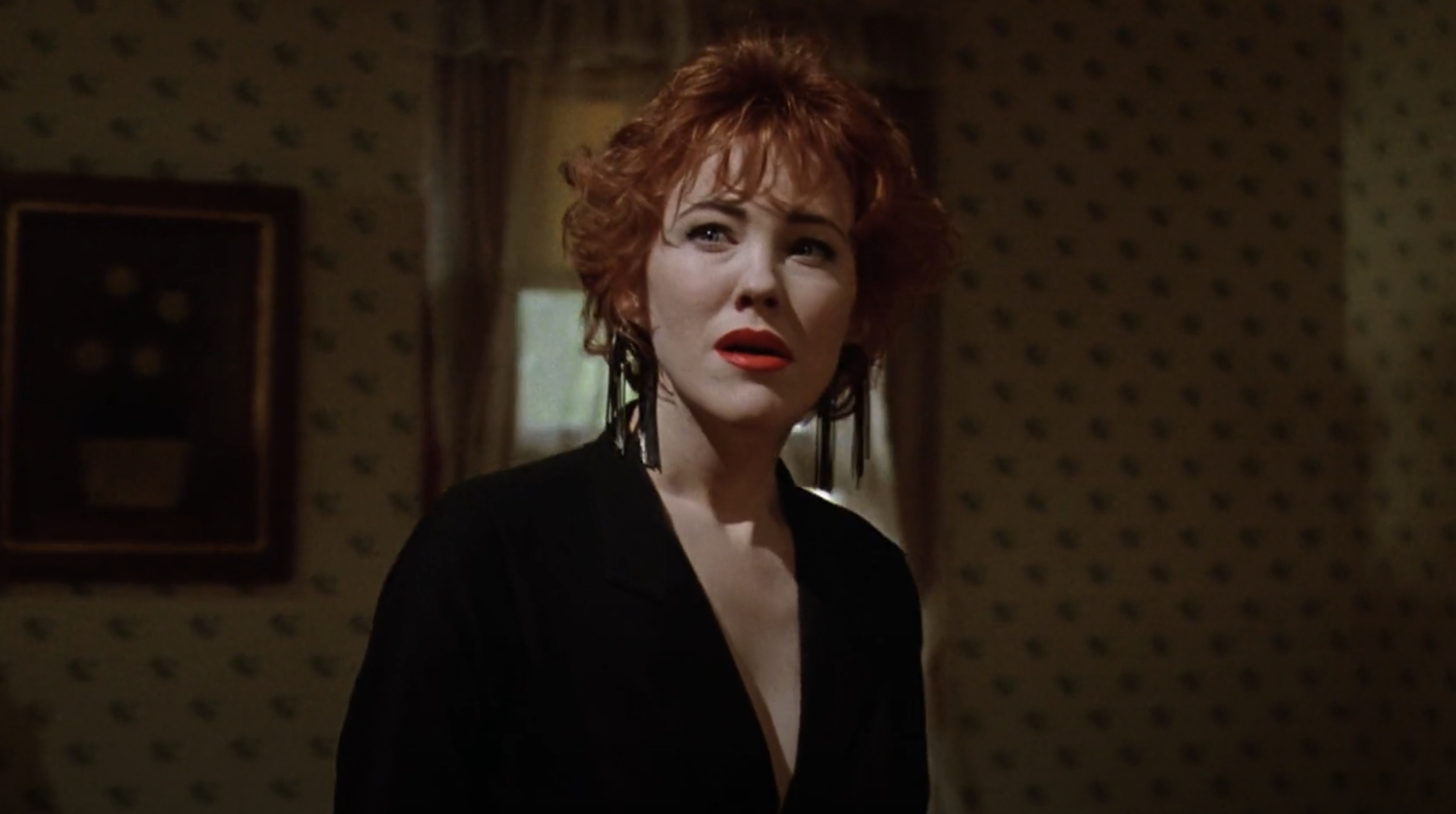
As “spooky season” has long ago been bumped up to September (perhaps the fault of Mariah Carey’s own bumping-up-of-Christmas timeline), and with the coinciding of Gloria Steinem’s death at the beginning of said month, it seems appropriate to bring up Beetlejuice and the ways in which it conveys the failures of second-wave feminism as “represented” by Steinem (whether women wanted her as their representative or not). Delia Deetz (Catherine O’Hara) is nothing if not the “poster child” for the kind of woman that second-wave feminism was supposed to benefit the most. Freeing them from the cage of domestic imprisonment and at last “given” the chance to be seen as Serious People. Yet, as the narrative for one of Tim Burton’s most beloved films (written by Michael McDowell and Warren Skaaren) unfolds, it becomes apparent that Delia remains just as dissatisfied and lost as any of the housewives Betty Friedan was referring to in The Feminine Mystique.
It starts out “subtly” at first, with Delia making no secret of her distaste for leaving New York City in favor of Winter River, Connecticut and moving into a home she deems unlivable. Though the previous owners, Adam (Alec Baldwin) and Barbara (Geena Davis) Maitland, would beg to differ, as they just so happen to still be living in it…even if in a dead capacity. As for Delia, she can’t even think of conceding to her husband Charles’ (the disgraced Jeffrey Jones) command that she and their daughter (well, her stepdaughter), Lydia (Winona Ryder), surrender to living in this “dump” until she at least does a complete remodel with her “city boy” interior designer, Otho Fenlock (Glenn Shadix). This in and of itself telling of the fact that Delia has little in common with the so-called modern woman (despite certainly dressing that way) and more in common with the housewives of yore that second-wave feminism was meant to jettison in favor of allowing women the “opportunity” to become more “multi-faceted”—a.k.a. work for pay while also still likely performing free domestic labor at home when not “on the job” more literally.
Her “shared characteristics” with that housewife of yore being that she needs to tend to the domestic space as if she were a mama bird cultivating branches “just so” in her nest. Even though Lydia couldn’t give less of a shit and rather likes the “grandma-chic” aesthetic (especially where the wallpaper is concerned) of the joint. Charles, too, thinks the house is wonderful as is (otherwise he wouldn’t have bought it), going so far as to tell her as they’re having their things moved in by “professionals,” “Look at that kitchen. You’re finally gonna be able to cook a decent meal.” She turns and looks at him as if he’s a madman. He, in turn, looks at her with an “I’ll double down if necessary” kind of expression.
This mostly wordless exchange is indicative in and of itself of the divergent way that Charles sees Delia and the way that Delia sees herself. That is to say, not clearly. In her mind, she’s convinced she’s a modern woman making modern art sculptures and that her modernness is further verifiable by her love of and appreciation for art. Which, in her mind, extends to her meticulousness about the way the house ought to look after the remodel as she tells a wary Charles (who doesn’t want to spend a mound of cash [even though he certainly has it from all that real estate developer money]), “I will not stop living and breathing art just because you need to relax.”
When Charles tries one last attempt to push back on the remodel plans, Delia seethes, “I’m here with you. I will live with you in this hellhole. But I must express myself. If you don’t let me gut out this house and make it my own, I will go insane and I will take you with me!” For all intents and purposes, this is what housewives of the 50s and 60s did—expressed themselves through decorating and buying things for their house—without the “luxury” of being able to scream-verbalize it to their husbands, who, like Don Draper in Mad Men, didn’t much care what their wives did with the allowance they were given, so long as they did anything but “nag” them about what they wanted to do and just did it (granted, that never seemed to work out very well for Lucy Ricardo).
During the scene of the Deetzes’ first dinner together in the house, Delia further emphasizes the way her desire to be the epitome of the “modern woman” is at war with her continuing ties to the mindset and behavior of a conventional housewife. For, on the one hand, she’s defies Charles’ unwanted remark about her being able to cook a “decent meal” now that they have this kitchen by instead having them order takeout. On the other, she’s acting like the beleaguered housewife who seems to have nothing left to do with her college education except showcase her inherently “cosmopolitan” nature by deriding, “I can’t believe we’re eating Cantonese. Is there no Szechuan up here?”
As the dinner goes on, Delia keeps musing about ways to make Winter River less torturous for her by suggesting to Charles that they turn the house into a summer art retreat/museum type of place for the New York cognoscenti. Not really interested in the idea with regard to what it might mean for their “clout,” Charles replies, “That’s a very good idea. That’ll be, uh, very time-consuming.” In other words, the busier Delia is with her “art,” the less time she’ll have to focus on fiddling and tinkering with the interior of the house and generally disturbing his peace (which he specifically moved to Winter River to get). As if to titillate Charles all the more with the prospect of her being “busied,” Delia even adds, “I could start sculpting again. You know I’m only truly happy when I’m sculpting.”
Though it would appear few others are happy when she is (least of all her art dealer), considering the type of results her sculpting yields. Even so, this notion of opening an “art center” gives Charles hope that it will get her off his back—the longstanding desire of “husbands who are breadwinners” everywhere. And yes, it’s clear that Delia’s “art career” is something that’s merely indulged rather than taken seriously. That it’s somehow meant to sub in for the reality that she’s still considered a “do-nothing” and a “layabout” who only ultimately has a talent for spending her husband’s money.
Thus, when this “excitement” of the Maitlands haunting the house presents itself, rather than being scared of these “specters,” Delia sees another way she can distract herself not just from the humdrumness of country life, but the humdrumness of her life in general. Not to mention the profitability of turning their haunted home into a tourist attraction. Which Charles, too, is surprisingly on board with despite his alleged quest for peace and quiet. Indeed, his proposal to make the place into something akin to a theme park is considered “serious work” that Delia is far more supportive of than he would ever be of anything she did (at least not in terms beyond the monetary support). Her “purpose” in this dynamic is, therefore, very much the same as it would have been in the decade prior to second-wave feminism “gaining traction,” with the 1980s meant to be the decade when the hard work of feminist protesters and revolutionaries had truly paid off and all the benefits had at last “settled in” (though that never meant the legitimate ratification of the Equal Rights Amendment).
But from the looks of Delia’s lifestyle and her frequent conveyance of dissatisfaction and ennui, there clearly remained that proverbial “problem that has no name.” This time around, though, that problem is perhaps even more deeply felt because “women’s lib” was “supposed to” make it go away. And to an extent, it did. Replacing it instead with a new form of discontent and frustration. One that Delia exemplifies in the sense that she is still not regarded with much respect, nor is the work she’s passionate about deemed valuable or worthy. In the end, she is still just a frivolous woman. A decorative piece (who also makes decorative pieces) to Charles’ life and a bane to Lydia as her stepmother.
There is no redemption for Delia’s character either, though perhaps one would like to believe there is with the appearance of a coffee table book displayed on the shelf during one of the final scenes. That book is by none other than “Delia Deetz” herself and is titled Art in America: Images of the Afterlife. In other words, in order to find publishable success, she had to graft from someone else. Namely, the Maitlands. So it is that even any “artistic identity” she might have carved out for herself is still based on someone else’s. Making her the most roving, disconnected spirit of all in that house in Winter River.


