


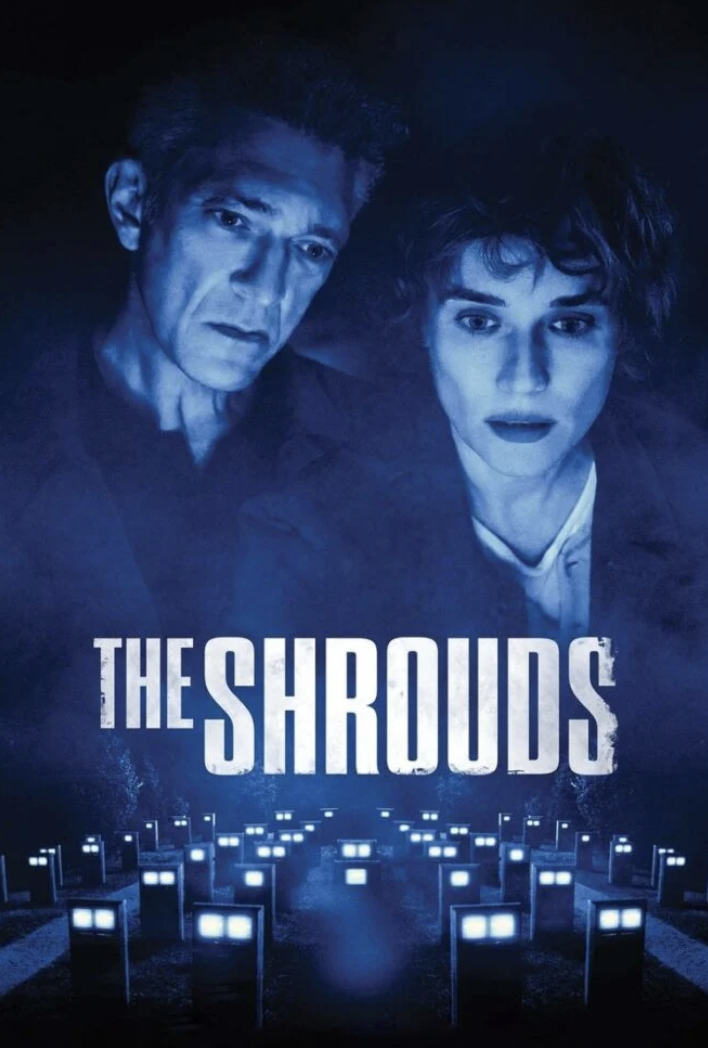
Like Woody Allen, David Cronenberg is among the few auteurs of a certain age given total carte blanche to make whatever kind of movie he wants. And, also like Allen, it’s been that way pretty much since the beginning of his career. Unlike Allen, however, his later work has always been, in one way or another, at least somewhat redeemable (yes, even Crimes of the Future). With The Shrouds, however, that is very much not the case. This in spite of, miraculously, the onslaught of glowing reviews touting such a pile of utter shite.
Granted, The Shrouds doesn’t immediately make that known, easing the viewer into it and then walloping them over the head with the reality of its badness. Commencing with a nightmarish dream scene of Karsh (Vincent Cassel) observing the rotting corpse of his wife, Becca (Diane Kruger), before he screams out of grief, Cronenberg then cuts to the same shot of his wide-open mouth in a dentist’s chair. With this “slick” transition, Cronenberg wants to make the viewer believe, however briefly, that he can deliver them something “insightful.” Or, at the bare minimum, worthwhile. And while it might lure a few down the primrose path with a potent, “thoughtful” enough start, it doesn’t take long for The Shrouds to devolve into full-on nonsensical/non sequitur-ness. Sort of like if one had tasked AI with writing a script based on a prompt that asked for a “sci-fi, tech-related story about grief in the style of David Cronenberg.” That Cronenberg is now on the level of generative AI is indicative of his own degeneration as a filmmaker. Which is something that no one wants to admit to because, well, many people do want to have faith in the notion that it’s possible for an artist’s work to only get better as they get older. But Cronenberg has not added to the column in favor of that theory (and, needless to say, neither has Allen) with The Shrouds.
And yet, the critics seem afraid to say out loud that this film is not only a two-hour extravaganza essentially parodying an art-house film, but of Cronenberg reheating his own nachos. The most prevalent callbacks to his own work being the maimed body of Becca (which Karsh so blatantly fetishizes) and his obsession with the idea that she’s had an affair with the doctor that “tended to” her while she was getting her cancer treatments. In other words, it’s a mash-up of Cronenberg’s “greatest hits” concepts explored in Crash and The Brood, respectively.
Cronenberg has also made no secret that The Shrouds was directly inspired by his own grief over the death of his wife, Carolyn, in 2017. The cause? Cancer, bien sûr. “Deeply personal” or not, however, there’s no denying the ludicrousness of the film’s entire conceit. Which is that Karsh has found a successful business model in selling high-tech graves (hence, the company’s oh-so-original name, GraveTech) that let you watch your loved one decompose in real time. Of course, while there might be a market for that sort of thing among rich, freak-show tech bros, there isn’t much of one outside of that niche. Even Cronenberg himself could admit to Variety, “In this film, I have invented a clientele for the cemetery that probably doesn’t exist… It might be completely unrealistic.” “Might be” is an understatement, and it’s not the only unrealistic element by a long shot. There’s also Maury (Guy Pearce), the ex-husband of Becca’s twin sister, Terry (also Kruger), offering a tacked-on explanation in the form of a monologue that pretends to illuminate the convoluted conspiracy surrounding the desecration and security hack of the graves. For that’s the primary “issue” in The Shrouds: Karsh trying to figure out who’s fucking with his business and why (spoiler: the viewer never really finds out for sure).
It’s an explanation as cliché as it is cracked out, with Maury pinning it on a combination of some Russians he hired to hack the system and the Chinese government subsequently believing that Maury will make an ideal mole for them because of his Russian “collusion.” Part of Maury’s increasing villainy throughout the movie is meant to be attributable to a bad combination of schizophrenia and jealousy, for he knows there’s something going on between Karsh and Terry (this “twinning/double” trope harkening back to Alfred Hitchcock’s Vertigo, and David Lynch’s Twin Peaks). That is, when it’s not going on between Karsh and Soo-Min Szabo (Sandrine Holt), the wife of a dying Hungarian CEO who wants to help fund a new GraveTech location in Budapest.
All of these thrown-into-a-blender elements of the movie serve to make it feel even more half-baked than it already was based on the concept alone (in short, maybe Cronenberg should have reheated his nachos a bit more thoroughly if he was going to bother doing it at all). Leading one to perhaps better understand why Netflix didn’t end up green-lighting the project. While there are times when Cronenberg gets across the extent of grief’s power to render someone effectively mad (a.k.a. “mad with grief”), it isn’t enough to compensate for the overall cockamamie story…and the dialogue within it (almost always expository). Take, for example, the opening scene of Karsh and the dentist, who tells him, “Grief is rotting your teeth.” He then mentions, with creepy flair, that Karsh had a beautiful wife. Karsh somehow takes this as an opportunity to ask, “You still have her dental records here, I guess. X-rays of her mouth on your computer?” Not even batting an eyelash, the dentist asks, “You want jpegs?” The presumed intent is to convey that other people effortlessly understand the macabre turns that Karsh’s grief is taking. For not only does he want to be inside his wife’s grave with her, but he also seems to want to be inside of her, full-stop. Obsessed with every aspect of her body.
This, too, has its own kind of Woody Allen undertone, for the neuroticism of such an obsession is easily associated with men of the Jewish persuasion. And maybe there’s also something to both auteurs being octogenarians (Cronenberg being eighty-two to Allen’s eighty-nine). So checked out of reality that they’re each convinced the one they’re creating onscreen is truer to life than anything else. And, in Cronenberg’s case, he’s also checked out enough to turn most of the movie into one long Tesla ad. Even if using the argument that owning such a car is in character for an “industrialist” like Karsh, it was in poor taste long before Elon became a “shadow president” to parade this brand so profligately.
And yet, the majority of reviewers have inexplicably hailed this film as some kind of triumph, with The Shrouds eliciting such praise as “David Cronenberg Draws on His Wife’s Death for a Brilliantly Cerebral Thriller About the Physicality of Grief.” But no, the only thing cerebral about this movie is how it might give you brain damage.
Which brings one to the usual pompous claim on the part of elder auteurs (not just Allen, but even someone like Francis Ford Coppola)—not to mention their devoted fans—that it’s not their fault if the audience “just doesn’t get it.” A copout defense that so blatantly doesn’t hold water, especially in this instance. For it doesn’t take an “elevated mind” to see that The Shrouds is, beyond a total vanity project, an undercooked movie posing as a “high art” film.


[…] David Cronenberg Reheats His Own Nachos With The Shrouds (And They’re Quite Gnarly) […]