


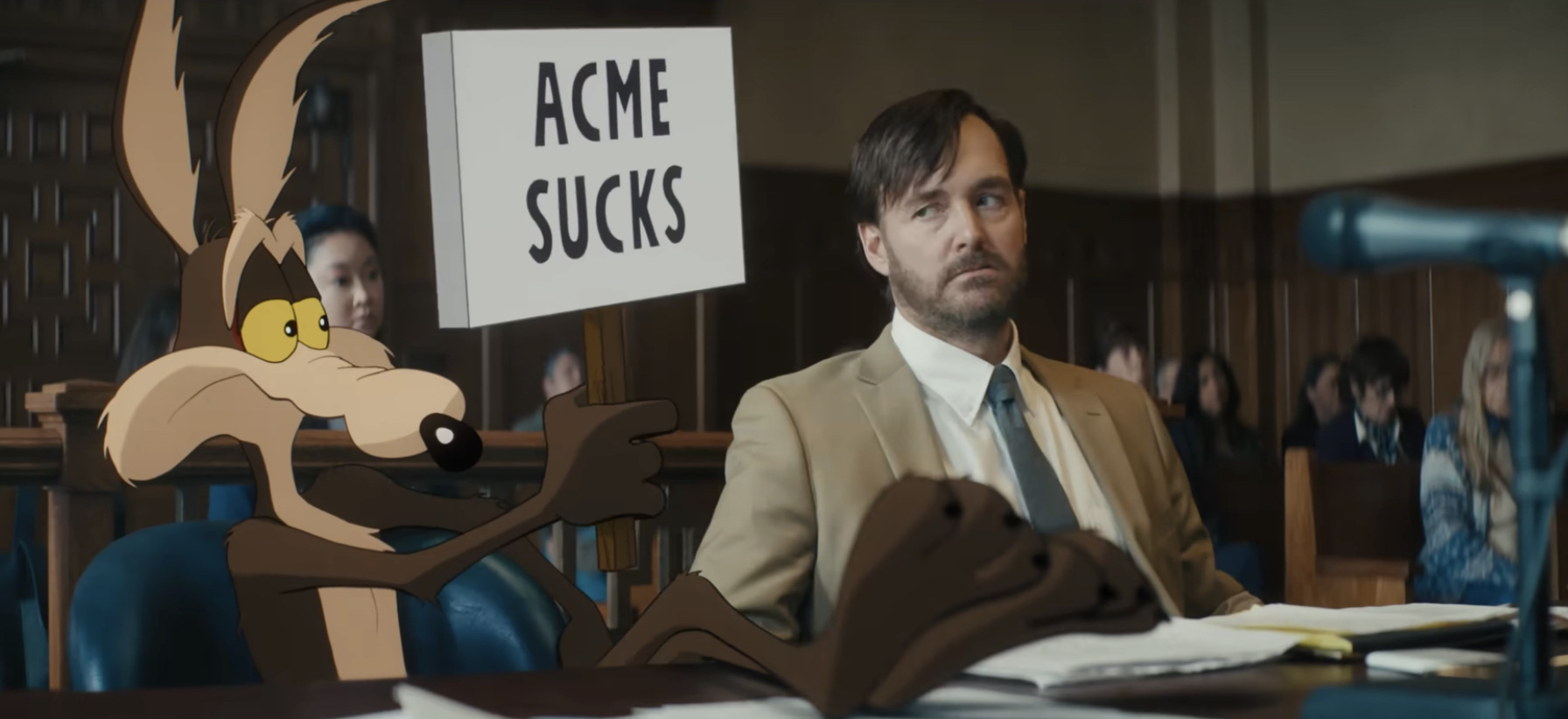
When Ian Frazier’s short story, “Coyote vs. Acme,” was published in The New Yorker in 1990, it’s doubtful that very many people envisioned it as a movie (at least not until 1998, when Scott Rudin Productions first bought the rights for the article, but failed to get Warner Bros.’ approval to make it; after the option expired, James Gunn would go to bat for the project). And yet, now more than ever, it is the story that is relevant to this era.
As if to add another layer to that relevance, the saga behind Coyote vs. Acme actually being released reveals yet another recent instance of how the film industry really views art. That is to say, as a disposable tax write-off. The shade thrown at Warner Bros. for that move seems almost immediate at the beginning of Coyote vs. Acme, with an asterisk to the logo on the title card homed in on to reveal the fine print, “*A wholly owned subsidy of the Acme corporation.” And, as Coyote vs. Acme reveals, there is no greater representation of the soulless corporation than “Acme.”
The film then opens on a “test footage” video of Daffy Duck trying out a product called Super Slime. After a few, let’s say, rough-and-tumbles, it’s obvious that whatever purpose the Super Slime is supposed to serve isn’t working. That, instead, the only effect it has is one that is entirely painful and adverse. Dr. Lorre (Eric Bauza, who does most of the voices for the animated characters), seeing this, tries to send a message in a special can of paint as he tells Tweety, “They’re not going to let us be.” The “They” in question is, of course, Acme, which clearly has a nefarious plan afoot. That much Dr. Lorre is very aware of as he sneak-sends his package off with the unknown message inside of the paint container (which will become a major plot point later). And, just when he thinks he might have gotten by undetected, a cartoon turtle observing Dr. Lorre narcs on him to security.
Chased out of the factory, Dr. Lorre uses a few handy Acme gadgets (including some “dehydrated boulders”) to make his escape, only to be cornered by more Acme security goons and forced to jump into a portable hole, where he’ll be stuck for the next few decades. Indeed, all of this takes place in 1992 (incidentally, two years after Frazier’s short story was published). Director Dave Green and screenwriter Samy Burch (best known for writing an entirely different kind of movie before this: May December) then cut to thirty years later, which would be 2022. And, were it not for Warner Bros. trying to shelve the project permanently, it was slated for a release around that time. Specifically, the summer of 2023. Only by November of ‘23, Warner Bros. announced that it was shelving the movie in favor of a thirty-million-dollar tax credit. Marking the third instance of the studio doing this, along with Scoob! Holiday Haunt and Batgirl. The difference was that Coyote vs. Acme was the first instance of the studio doing it to a film that had actually finished production.
Worse still, none of the crew was told about the decision until the movie was already in the can. Which might have allowed for a bit more upheaval beforehand. In other words, exactly what Warner Bros. didn’t want. But the upheaval came anyway, and in large part thanks to one man named Marco Vaccaro, who dressed up as Wile E. Coyote and walked around outside of Warner Bros.’ Olive Avenue studio holding a sign that read, “RELEASE ME!!” It was Vaccaro’s appearance that became a symbol of the campaign to get the movie released. The backlash from fans and film industry members alike quickly wore Warner Bros. down, as they at least conceded to allowing the movie to find another distributor. An offer they likely only made because they didn’t think it would really happen.
It’s all very much in the spirit of what the Acme corporation itself would do. And it’s all but impossible not to see said “fake” company as a representation not just of Warner Bros. and what it did, but of all such corporations and the similar things they continue to do. Things that they themselves might not deem technically “illegal” (and, to that end, one will note the all-too-telling comment given by Acme’s head lawyer, Buddy Crane [John Cena], who assures, “The law’s completely on our side here… ‘cause we wrote the law”), but are, at best, morally reprehensible. What’s more, Coyote vs. Acme showcases a prime example of how, so often, people tend to sell out “their own kind” for profit. Or in this case, cartoons tend to, with Foghorn Leghorn being the CEO of the cartoon-harming and -discriminating corporation. He’s the one who sees no harm in having his cartoon brethren mercilessly tested on during the early stages of “figuring out” an Acme product’s potential kinks. This being the top-secret endeavor known to a select few (including Dr. Lorre) as Project Sisyphus. An appropriate code name on many levels, but mainly the one that suggests these cartoon citizens are doomed to keep using faulty Acme products because it’s all they have access to.
That goes especially for Wile E. Coyote, who, as his “billboard lawyer,” Kevin Avery (Will Forte), explains during a Congress hearing, “Acme has a monopoly over all the tools required for Mr. Coyote’s work.” This is his reply when asked by Elmer Fudd why “Mr. Coyote” keeps using the products if he continues to get hurt by them. Fudd and the rest of the courtroom initially balk at the answer, billing Mr. Coyote as someone who is unemployed and lives in a cave. Avery, as if sticking up for all people who perform “invisible” work, reminds, “He may not get a salary, but he works. In fact, he’s one of the most hard-working people I’ve ever met… No matter what happens, he picks himself up and tries again and again and again and again. He would never think of quitting. He wakes up every morning with purpose, and with hope.”
And that, too, is a core message of Coyote vs. Acme. That the coyote, far beyond being “stupid” for continuing to try even though he never succeeds (and that, often, this is touted as the definition of insanity), is an inspiration. The kind of being that everyone should model themselves after. Because if they did, maybe corporations like Acme wouldn’t get away with all the things they do, knowing full well that people don’t have the tenacity to keep fighting. To keep trying. The way that Mr. Coyote does. As for the corporation always winning, when Avery loses the case the first time around, he approaches the press outside and insists, “These companies think they can do whatever they want and get away with all of it! Because they do! And we’re sick of it!”
Previously apathetic and admittedly lazy, the coyote has lit a fire within Avery that he didn’t think could ever be ignited again. But seeing the way that he refuses to stop thinking about the only thing that keeps him going—Road Runner—even in the face of this legal battle that has become about something so much bigger (justice and fair treatment for all cartoons), Avery’s own will to try and fail is renewed (whereas, before, he didn’t want to try at all because he didn’t want to risk failing). Thus, in yet another way that Coyote vs. Acme correlates to Who Framed Roger Rabbit (apart from that movie having its own Acme Corporation and humans coexisting with cartoons) is that Avery is something of the Eddie Valiant (Bob Hoskins) type. After all, Valiant starts out jaded and going through the motions, only to be reinvigorated by Roger Rabbit’s case despite his misguided contempt for cartoons as a result of believing one of them was responsible for killing his brother.
Avery, too, has a rekindled fervor for his profession. And for caring about others who are being exploited in general. To the point where he’s willing to go above and beyond for Mr. Coyote when it comes to their big hearing before Congress. Pulling out the biggest gun of all in the form of the Road Runner as a witness, who comes barreling through when Foghorn Leghorn “rests his case” by asking, “Is there anyone in the whole wide world who cares about what happens to the coyote at all?”
Of all the someones who do care, maybe the Road Runner is the most unexpected. What with being ceaselessly preyed upon by the coyote. And yet, it’s clear from his “beep beep”-ridden testimony (two beeps for yes, one beep for no) that the two share a rapport. One can’t exist without the other—for each is the other’s proverbial raison d’être. Because what is the fun, for Road Runner, of running if no one is chasing him? To that point, he beeps out in Morse code a final question during his testimony, “Are you coming back?” It’s a heart-rending moment that even gets Wile E. all teary-eyed. But before he can answer, the Road Runner jets back to the outskirts of Alburquerque, waiting and ready to run again from his “nemesis”/friend.
While Congress doesn’t rule in Wile E.’s favor either, not all hope is lost by the end of the movie. For the passion that Avery displayed in the courtroom is enough to rile up a whole slew of other cartoons who previously wouldn’t have tried suing Acme (apart from just taking an insulting settlement amount). Plus, with Bugs Bunny furnishing some new evidence and Dr. Lorre being “unearthed,” let’s just say that Acme is about to get a big stone flung in its direction from the “David” in this David and Goliath-like tale. One that resonates both in terms of the film’s release after Warner Bros. tried to kibosh it and in terms of how so many are exploited by corporations that presume no one will care about the people who are so long as they can have their precious products.


