


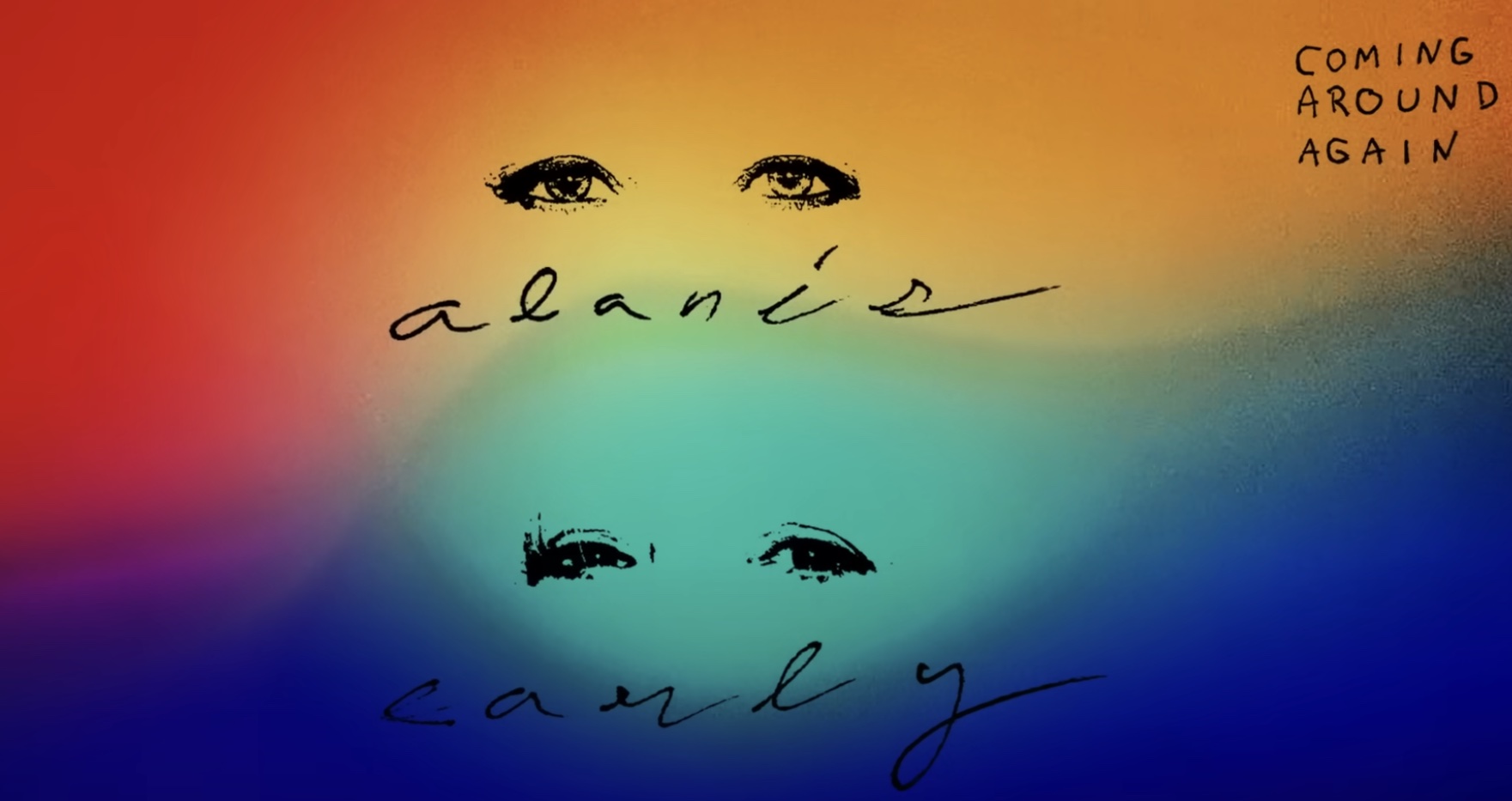
For those who might see it as “non sequitur” for Alanis Morissette to cover a Carly Simon song, look no further than a 2012 New York Times article (titled “If You Like Carly Simon”) declaring, “Alanis Morissette and Carly Simon have both created indelible songs about what to do when life and love don’t match up.” 1986’s “Coming Around Again,” one of Simon’s biggest hits, is a prime example of that disconnect. And yet, even when life and love don’t—or can’t—quite match up, it still remains possible to love anew (romantically or otherwise). Or, to phrase it in a way that Alanis fans can understand, “I recommend getting your heart trampled on to anyone” (Taylor Swift would recommend it too, though for far more financially-motivated reasons). This, of course, meaning that you can’t really learn anything about life without experiencing emotional pain (which itself can manifest into physical pain).
Originally written for Heartburn, the film that might have been directed by Mike Nichols but has Nora Ephron’s imprint all over it (she adapted the screenplay from her highly autobiographical novel of the same name), Simon later included “Coming Around Again” on her thirteenth studio album, which she would name after the single. Its mid-tempo rhythm, that Clive Davis executive produced (though there are also a slew of other producers credited, including Bryan Adams, which tracks in terms of its rather noticeable “easy listening” sound), further heightens the bittersweet tinge of such poignant lyrics as, “So good on paper/So romantic/But so bewildering/I know nothing stays the same/But if you’re willing to play the game/It’s coming around again/So don’t mind if I fall apart/There’s more room in a broken heart.”
Indeed, such words do sound as though they could have been pulled straight from the pages of Morissette’s own 90s-era journal. For her cover of the material, however, Morissette tailored it even more to her personal style by further slowing down the tempo, with the help of co-producers Michael Farrell and Victor Indrizzo, and adding a lot more piano. In fact, there’s a slight tinge of an “Uninvited” sound to the song, which was also made for a soundtrack. To that point, the logic behind Morissette covering the track—and with Simon herself, no less—doesn’t just extend to the singers’ similarities in terms of lyrical content and tone. It’s also because Morissette, too, is offering it up for use in a movie. Specifically, My Mother’s Wedding, the directorial debut of Kristin Scott Thomas, who also stars as the eponymous mother having a wedding. (And it’s more than likely that Scott Thomas hopes My Mother’s Wedding fares better, at least critically speaking, than City of Angels, the above-alluded-to soundtrack that “Uninvited” appears on.)
To have chosen this song to cover in honor of the film’s premise and themes only seems further telling of the lasting resonance across decades of Simon’s baleful (yet hopefully baleful—as in, baleful with a trace of hope) words. Indicative of how, as Madonna also once said (on “Extreme Occident”), “Life is a circle.” And, accordingly, so is love. In the sense that even when one thinks she’s lost the ability to love forever, it can find her at the most unexpected time, in the most unexpected place. As it happened for Morissette—vis-à-vis getting to collaborate on this cover with one of her great influences and idols.
As Morissette noted of Simon’s contribution, which acts more as backing vocals/affirmations than a “full-on” feature, “[It was] a deeply felt honor to collaborate with an inspiration to me since I was a young girl. @carlysimonhq thank you for holding the bar so high.” High enough, perhaps, to know that, even for as accomplished as Morissette is as a vocalist, there’s no holding a candle to the original (as is usually the case). And, although Morissette might bill the song as a “collaboration,” it comes across much like the “collaboration” between Taylor Swift and Lana Del Rey (“Snow on the Beach”) that had so many fans up in arms about the palpable lack of the latter on vocals.
Even so, because Morissette brings something so different to “Coming Around Again” with regard to her “take” on the material, it’s only right that Simon should largely stand aside. Most affectingly during the outro of the cover, when Morissette’s sparse vocals stand out as she repeats, like a mantra, “I do believe, I do believe, I do believe.”
She then delivers the closing, coup de grâce of a line to complement that repetition by announcing simply, and in unison with Simon, “I believe in love.” The result is powerful, giving credence to the notion that there is force and weight in a collective consciousness. Even if that “collective” “only” happens to be Morissette and Simon. Who just might be able to believe in love enough for all the doubters.


