


Apparently, being “co-signed” by a younger musician is all it takes for someone “older” in film to be re-legitimized these days. And there’s no denying that Quentin Tarantino needed that re-legitimization far more than Nicole Kidman, what with his ties to Israel and his harsh remarks about Paul Dano. Thanks to LISA, he’s gotten it in the form of her second single from the Press Play EP, “Tarantino.” And yes, his last name would ostensibly make the title too long if one were to tack on “Quentin.” This in contrast to Adéla’s hit single, “Nicole Kidman,” which keeps the Australian powerhouse’s full name intact. What’s more, the Hannah Lux Davis-directed video pays more direct tribute to the song’s namesake than LISA’s video “honoring” Tarantino.
Directed by James Mackel (lately known for videos such as Harry Styles’ “American Girls” and Doechii’s “Anxiety”), the opening scene finds the camera situated almost as if it’s meant to look like a “fly on the wall” as it faces what looks like an empty room with the perspective focused on a letter on the table in the foreground next to an ornate lamp and an ornamental egg (not Fabergé though, so how successful could LISA really be?). In the background of the mise-en-scène, one can see LISA lying on the bed as she listens to an assistant tell her over the phone, “Remember: styling at five-thirty, flight at eight.” LISA, in what will commence her string of “bad acting” deliveries, interjects, “Hang on, I thought my flight was at ten.” The assistant explains, “That’s when you get in. I couldn’t get anything later. Oh—” LISA interrupts, “Wait. What about Taran—” The assistant interrupts back to assure, “Yes, your favorite director is still at the hotel tonight.” At this point, it’s worth noting that the bad acting (conveyed through their vocal delivery of the lines) is in part due to the script LISA and this disembodied voice are reading from. Like, why would anyone say “your favorite director” in this context? Save for the sake of providing overly expository dialogue.
In any case, the bad acting delivery continues with LISA asking, “Wait, he’s still here?” The assistant confirms, “Till tomorrow. Same room number. Just go give him your letter. I’ll send security up.” LISA, who has by now risen from the bed and started approaching the table to grab her letter, inquires, “What time?” The assistant answers, “They’ll be up in a sec.” LISA proclaims, “Okay. I’m gonna do it.” The assistant then encourages her, as if delivering a letter is the most arduous thing in the world, “Remember: your flight’s at eight. You got this.”
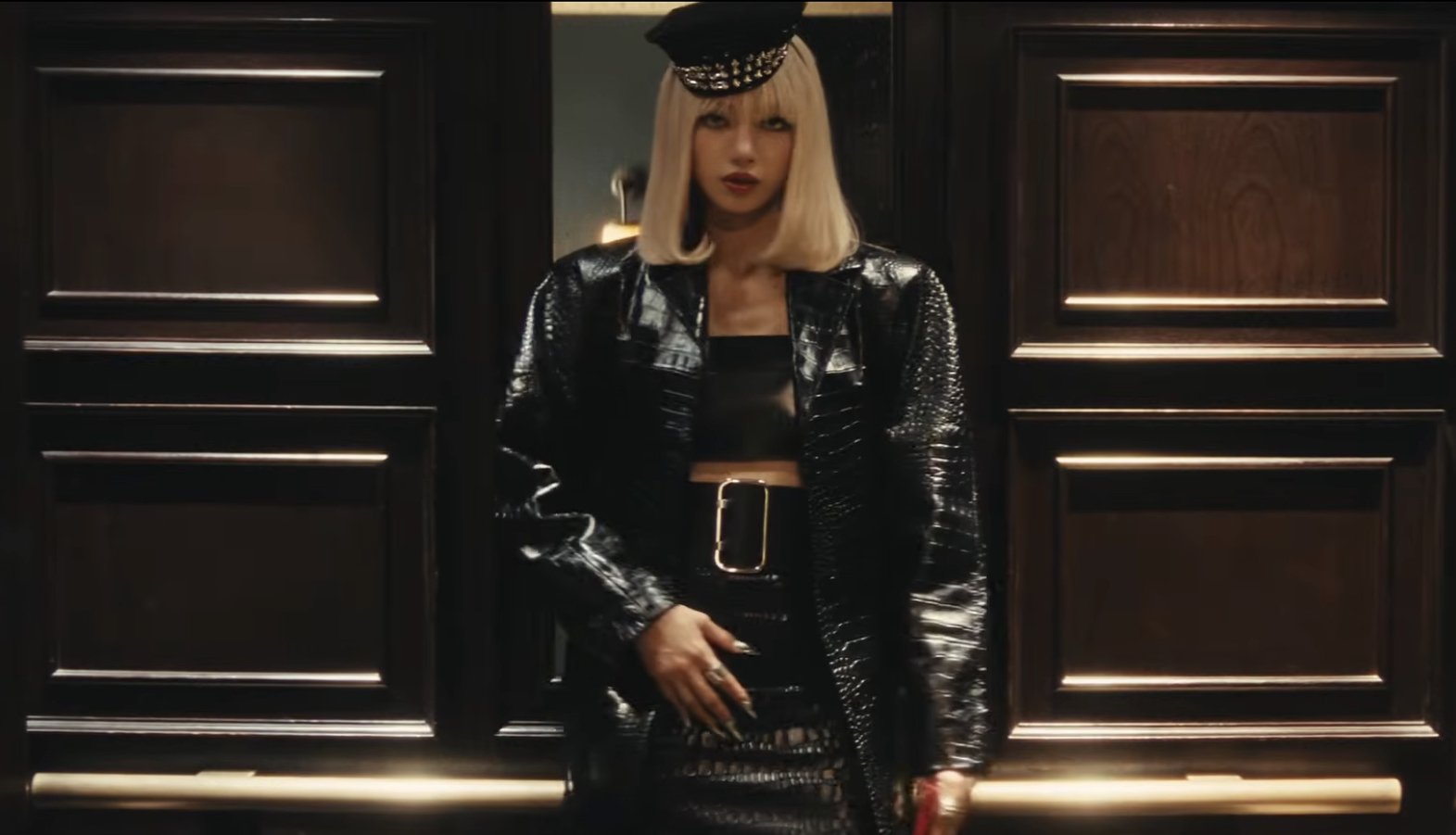
As LISA holds the letter in her hand and walks toward the door of her hotel room, a knock on the door barely waits for a response before the two men on the other side start sawing right through it. And if it’s the “security” her assistant had mentioned, they’re certainly not there to protect her. Breaking the door down, one of them is kicked out as quickly as he entered, with the next cut revealing a cool and collected LISA now wearing a studded leather hat as she fans herself with the letter she’s since put in a fancy red envelope. Clearly, she wants to channel the martial arts savvy/general bad assery of one of Tarantino’s female characters (with Kill Bill’s Beatrix Kiddo [Uma Thurman] being perhaps the most shining example). Few though they may be.
But, oddly, she never really does so “on camera,” instead “suggesting” the violence with off-screen inferences. As is the case with the second man who started to run when he saw his partner-in-attacking-her get tossed out of her hotel room like a bug being flicked. LISA then approaches the remaining man as he tries to retreat into the elevator. She promptly pulls him out, after which some offscreen noise indicates his ass-kicking, followed by LISA being wheeled out of the elevator on another floor of the hotel (one that looks decidedly like the lobby) by the cleaning lady who was already in there with her cart.
So it is that LISA effectively endures the plot of a Tarantino movie (albeit a much less violent and much more low-budget version of one) in order to deliver this “fangirl” letter to him. The kind of letter that one could imagine Adéla would probably want to deliver to Nicole Kidman. And, based on her lyrics to the song of the same name, the letter might read as more genuine in terms of Adéla seeming to know much more about Kidman’s filmography than LISA does about Tarantino’s (which is a bit embarrassing considering that Tarantino has far fewer titles to offer than Kidman). That much is made evident when LISA decides to rhyme “Tarantino” with “Camino” even though at no point in any of his films does such a car materialize. Nonetheless, LISA sees fit to try her hand at an Adéla-esque homage with the “flex,” “Tarantino, Tarantino, got my feet hanging out the Camino” (she’s trying to allude to Death Proof here, but the Camino name-check makes her sound ill-informed).
And, as she joins other members of the hotel staff in a bit of choreo after being wheeled to the lobby by the abovementioned hotel maid, she adds some far less direct references to Tarantino with the verse, “Got my nails really long like the barrel of my gun/And my lipstick all over your face/I’m a boss, I’m a don when I’m driving to the sun/It’s a movie, baby, come and press play.” One supposes such lyrics are in the spirit of Adéla’s own non sequitur-but-somehow-meant-to-be-“adjacent”-to-Kidman phrase, “Every single night/I pray that my tits are sittin’ right.”
In the next scene, LISA infiltrates the hotel kitchen to the tune of the lyrics, “Catch me in a cabana/Wearing just a bandana/Sipping juice, silver tooth/Shining like a katana/I’ma chop-chop nonstop/Bomb drop chopper/Looking out the window/At these window shoppers/Death proof, baby, I do all my own stunts/F you, baby, like a razor on my tongue.” All as she actually ramps up the onscreen violence to take out the kitchen staff that seems like it, too, might want to prevent her from delivering her missive to Tarantino.
When she’s finished kicking the shit out of them, she takes a moment to pick up a fry, hold it like a cigarette in her mouth, take a bite and then flick it aside as she also would a cigarette. She then walks toward a final member of the kitchen staff who is shaking behind a silver reflective pan he’s using to protect himself. LISA spares him and instead glances at herself in the pan before moving on to the elevator again, where she encounters a fan who clocks her and excitedly hands her a LISA Limited Edition PlayStation controller to sign (the kind of product placement that Tarantino would balk at, considering he creates his own fake brands to fit in with his distinct cinematic universe [e.g., Big Kahuna Burger]).
After “indulging” the fan, she rides up to another floor (Quentin’s), with the doors opening again to reveal a slight costume change. One she must have felt she needed to complete her mission of delivering this letter. And, in all honesty, the “difficulty” she faced to do so has nothing on what The Bride endures in Kill Bill. To be sure, LISA and Mackel could have easily incorporated more Tarantino-esque scenes despite the small timeframe that a music video allows. Instead, they chose to devote superfluous amounts of it to the opening and closing scene, which finds the viewer in a “from Tarantino’s perspective” shot as he discovers the letter that’s been slipped underneath his hotel door. In the background, the sound of something violent playing on his TV can be heard as he looks at a script titled Her (maybe LISA isn’t aware that Spike Jonze already famously has a movie called that).
Upon picking up the letter from the floor, he then slaps it down on the same table with the script on it in a manner that suggests a decided disinterest. And honestly, based on what a lackluster tribute “Tarantino” is, both lyrically and visually, one could hardly blame this fictionalized version of the director. Nor could they blame the real one either. Indeed, it’s no wonder the public has yet to hear any gushing sentiments from him about this song the way Kidman immediately expressed hers over Adéla’s co-sign. One that was hardly needed to prove the actress’ enduring influence. LISA’s co-sign, however, is technically needed by Tarantino at a time when he’s struggling to find the same relevance he had in the past with those of LISA’s generation. That is, apart from the classic Pulp Fiction poster still speaking to people (even if Mia Wallace’s [Uma Thurman] face is so often “repurposed” with someone else’s now [Lana Del Rey’s, for example]). A stage play called The Popinjay Cavalier perhaps less so.


+ There are no comments
Add yours