


Although it seems, with time being as elastic as it is since Covid, as if Nobody Wants This has been on since before 2024, the reality is that, no, it didn’t begin until September of that year. Well after the Hamas-led October 7th attacks in Israel, Gaza and the West Bank that set off the most profound rift yet between pro-Israel and pro-Palestine camps. With Nobody Wants This creator Erin Foster apparently falling into the former (via her support of a “two-state” solution that has always been impossible and has favored Israel), while Adam Brody, who is the “born Jewish” person in this equation, being vocal about falling into the latter as he recently noted to GQ, “Put me down as thinking it’s a genocide. Put me down as wanting a free Palestine.” Of course, there are those who would point out that Brody’s declaration is more “nuanced” than being merely “pro-Palestine.” For, as is the case for many other Jewish people, Israel is still invariably viewed as “the homeland.” Hence, Brody adding to his comments, “I’m hopeful that another administration can really do some good and correct some of these policies that are helping that situation be as awful as it is.”
As if any administration of the U.S. government would ever be keen to give up the notion of “Israel” and what it has meant for American politics a constant “window” and “entrée” into the Middle East. Of course, this “hotbed” issue isn’t something that’s ever come up in Nobody Wants This, and it certainly isn’t about to now, with season three. And, as Foster commented of its release, “Sitting here right now at this time in the world where there is almost zero positive representation of Jewish people, I think it’s so important to have that.” This time around, however, the show seems less about “being Jewish” and its “beauty,” and more about the continuing complications that Joanne Williams (Kristen Bell) and Noah Roklov (Brody) must navigate now that they’re actually “happy.” To that point, Foster told Tudum in 2025, “I realized that being happy is way harder than being miserable—there’s nothing to complain about. So, I created this show based on all the ways that finding the right person can be so hard.”
And Foster ought to know. For the biographical elements of her relationship with Jewish music executive Simon Tikhman continue to abound in this season. So much so that it seemed important for Foster to put herself in the fourth episode, “The Wedding Planners.” This being the plotline where Noah takes Joanne to Napa under the pretense of officiating his friend “Brian’s” wedding when, in fact, it’s all an elaborate ruse to throw her off the scent of how he’s proposing to her there. What’s more, in the pilot episode, Noah’s proposal is ripped from him by his OG fiancée, Rebecca (Emily Arlook), who decides to just wear the engagement ring on her hand after finding it in Noah’s locked drawer. Apart from being creepy, it visibly upsets and disappoints Noah, who wanted to do it in a romantic way. Something he finally gets to achieve in spades during “The Wedding Planners.”
And, considering Napa is where Tikhman proposed to Foster in real life, it’s no wonder she wanted to be prominently featured in this episode, which presents her as Nicole, both the person that might potentially rip the proposal from Noah this time around and “the biggest fan of the podcast” that Joanne manages to make her living off of with her sister, Morgan (Justine Lupe). Though it seems that Morgan’s career might have more traction without Joanne at her side these days after she piggybacks off Noah’s brother, Sasha (Timothy Simons), explaining the “let them” theory to her as he subs in for Joanne on the podcast in episode two, “Daddy’s Home.” After hearing him describe how he plans to adopt this ultimately “passive” philosophy, her hot take is, “I think…I think you’ve gotta ‘make them.’ I think if you want someone to respect you, you can’t just sit around waiting for it to happen. You have to, like, ‘make them.’”
The inverse “philosophy” ends up going viral (as so many fundamentally hollow things do) and leading Joanne’s new nemesis, Sebastien (Andrew Rannells), to setting up a meeting with his aunt who works in publishing. Because, who knows, maybe a two-word phrase can be turned into an entire book. The prospect of which sends Joanne into a tailspin at the end of episode three, “Housewarming.” Almost as if she forgot that, in all her romantic happiness, maybe she ought to pay better attention to her career/what her audience wants. But fearing she’s no longer “relatable” because of her happiness doesn’t last very long. This largely because she commits to a new “concept” for herself on the podcast: “I can speak to women who feel crazy because I was crazy. That’s my special sauce. I’m basically a relationship expert.” A declaration that once again ties her to Carrie Bradshaw (Sarah Jessica Parker), who doesn’t mind being called a “sexpert,” and Sex and the City at large.
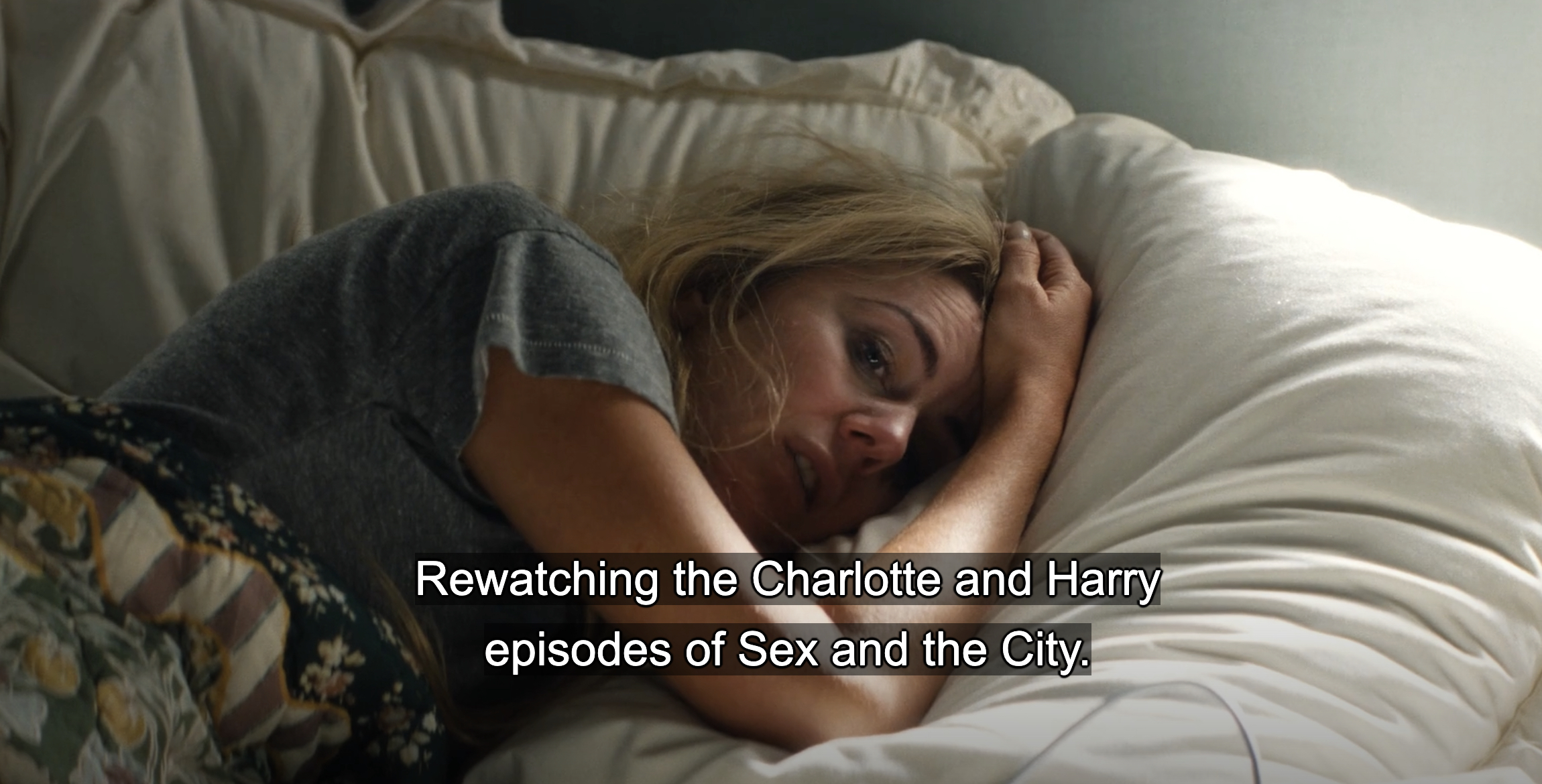
And, as if deciding to unabashedly lean into the comparison (kind of like they did in the season two episode, “Abby Loves Smoothies”)—especially the one where Charlotte York (Kristin Davis) converts to Judaism for her relationship with Harry Goldenblatt (Evan Handler) to work and, in the end, because she vibes with it—there comes a particularly meta moment in episode nine, “Last Christmas.” One in which Morgan tells Joanne and Noah that her Christmas plans are “rewatching the Charlotte and Harry episodes of Sex and the City.” To which Noah immediately responds, “Those are legitimately good episodes. I love them.” And yes, during those episodes, Charlotte goes through her Judaism conversion classes just like Joanne. However, of the latter, it can’t be said that she “took to her Judaism class like a gefilte fish to water,” as Carrie says of Charlotte in a voiceover during the season six episode, “The Perfect Present.” A voiceover that’s given during the same class when Charlotte learns for the first time that converting to Judaism means giving up Christmas for good. Which is why Rabbi Minsch (Pierre Epstein) ominously forewarns his students, “Many find Christmas to be the most difficult to leave in the past.” Something that Rabbi Eden (Sarah Silverman, controversial not just for saying horrific things about Britney Spears at the 2007 VMAs, but also reposting a “hot take” in October of ‘23 about how Israel doesn’t “need” to supply Gaza with water and electricity) doesn’t feel inclined to warn Joanne or anyone else in her class about. Nor does she give the stark advisement, as Rabbi Minsch does to Charlotte, “If you are serious about becoming a Jew, you have to let go of the attachments to your past.”
Joanne, too, has difficulty letting go of her Christmas traditions, which is why “Last Christmas” (a play on the classic Wham! song and this being, what else, Joanne’s last Christmas before she gives it all up to be Jewish) is entirely about her wanting the final one to be perfect. Even though everything initially conspires to make that seem impossible. But at the last minute, it all comes together so that Joanne can walk into her dad Henry’s (Michael Hitchcock) house and see it’s been transformed into the most magically decorated space, complete with a candy cane ice sculpture and Henry telling her, as if to make this episode all the more meta/connected to the SATC universe, “Ooo, you’re just in time for our Family Stone drinking game. Take a shot every time Sarah Jessica Parker is a fussy little bee” (a drinking game that could, frankly, also be played during Sex and the City).
Charlotte, instead, has her last Christmas in July (as her conversion will be finished long before actual Christmas arrives) amid Harry telling her she doesn’t really have to give it up, to which she says that she doesn’t want to be a “meat-eating vegetarian” (harkening back to an analogy that Rabbi Minsch made). Nor, apparently, does Joanne, who has become so committed to and entranced by Judaism that she goes out of her way to make her mikvah in the final episode of the season, “I Jew,” as special and spiritual as possible. Which means renting a beach house overlooking the ocean in Malibu so she can go in the water there to be “reborn a Jew.” For Charlotte, that “rebirth” occurs “in the basement of a synagogue, after seventy-five accelerated classes” with Rabbi Minsch. Who doesn’t show up to oversee Charlotte’s mikvah like Rabbi Eden does for Joanne’s. Along with Morgan, Sasha, Esther (Jackie Tohn) and both sets of Joanne and Noah’s parents. Not to mention Noah himself. To be sure, this is a very “hippie-dippy” California mikvah. But one that Charlotte might have preferred in the sense that Noah feels so moved by it that he’s compelled to ask Joanne to marry him right then and there instead of going through with the hoopla that his mother, Bina (Tovah Feldshuh), has managed to foist on them.
In contrast, Charlotte’s efforts to “satisfy” Harry by becoming Jewish majorly backfire by the episode after “The Perfect Present,” “Pick-a-Little, Talk-a-Little,” during which she goes off on him for not yet “setting the date” for their wedding. Or proposing at all for that matter. And so, even though he once told her, “I never thought a shiksa goddess like you would fall for a putz like me,” Harry is the one to call it off after Charlotte’s tantrum. Sort of like Sasha calls it off with Morgan when she bolts on him the morning after they have sex. Which Vickie Miner (Janeane Garofalo) once rightly said is “the quickest way to ruin a friendship.” But that’s another story altogether, and perhaps one that will be explored in more depth if a season four is confirmed.
If and when that gets released, it will remain the case that “being Jewish” is inherently political at this moment in time. And rather than addressing it in one of the few shows that is centered almost entirely around Judaism, Nobody Wants This opts for more sidestepping. Much as Sex and the City, apart from a few pointed digs at Rudy Giuliani in season one, sidestepped many prominent political issues of the day (in addition, of course, to sidestepping entire swathes of demographics so that it looked like NYC was populated solely by white people). By the same token, the content itself of Sex and the City was political for its time. A rare pronouncement of women’s sexual agency during a period when it still wasn’t really viewed as “normal,” so much as “slutty.”
Of course, it can be said that all “comedic” TV (which still means, to many, being a half-hour show instead of a “one-hour” drama) chooses to seal itself in a vacuum, away from the realities of what’s going on outside of the narrative’s “bubble.” But, in this case, not somehow alluding to the ongoing genocide in Palestine feels like the worst kind of whitewashing. Or, bleaker still, an accurate reflection of how most would prefer simply “not to talk about it” and, in this regard, believe they’ve avoided a political hot potato. Yet saying nothing still speaks volumes.


+ There are no comments
Add yours