


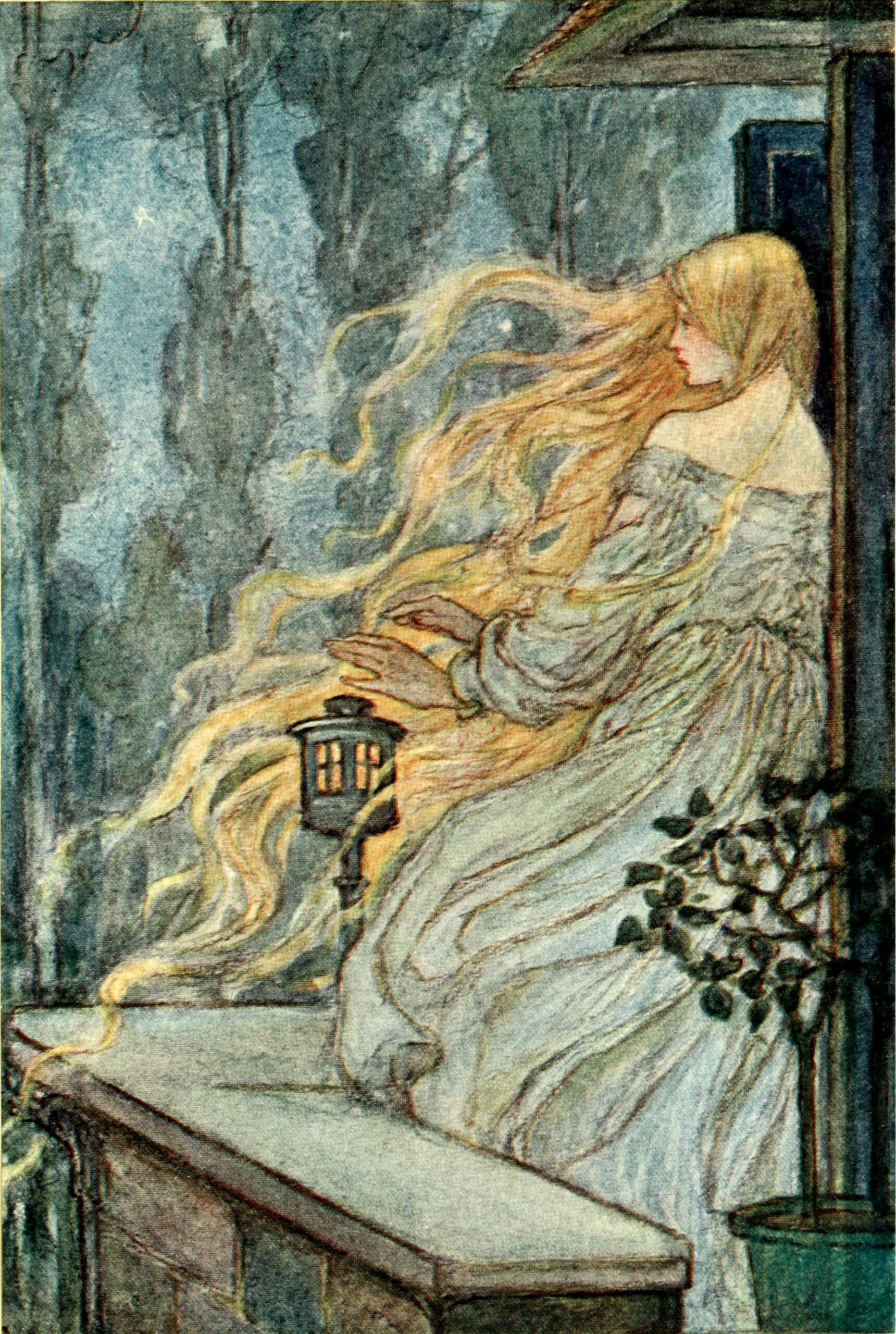
Seeing as how MARINA has never gotten the kind of due that, for whatever reason, Taylor Swift gets all the time (no matter how many similar-sounding songs she puts out), it makes sense that “Princess of Power,” the title track from her sixth album, would go far more unnoticed than the atrocious lead single from Swift’s The Life of a Showgirl, “The Fate of Ophelia.” Yet both songs were released on albums that came out just four months apart, with the latter becoming one of the biggest hits of the year (in addition to becoming the longest-charting number one single of Swift’s career). What’s more, both songs make mention of women being in “towers,” especially since Swift felt the bizarre need to rebrand the suicidal and subjugated Ophelia into a woman more akin to a princess in a Disney movie.
Nonetheless, “Princess of Power” didn’t get nearly the same level of attention, if any attention at all (apart from the usual devoted fans of MARINA that have helped to make her a “millionairess,” as she calls herself in 2021’s “Venus Fly Trap”). And this isn’t just because Swift is a juggernaut within the music industry that dwarfs anyone else with better, more empowering lyrics, but also because, in truth, “the mainstream” doesn’t really want a message like the one MARINA gives in “Princess of Power.” A message that suggests a woman can save herself as opposed to the “classic” trope that she needs a man to rescue her. MARINA upends that notion with a chorus that declares, “I lived the sweet and I lived the sour/Been living life locked up in a tower/But now I’m blooming like a flower/Welcome to my world, princess of power.” And when she says she’s been living her life locked up in a tower, she refers not only to having closed herself off to love and being vulnerable, but also to the idea that she alone has the power to free herself from it.
Put in a different way during the song, she adds, “Looking like a super heroine/I taught myself to love again.” This is in direct opposition to the kind of “fairy-tale thinking” that Swift presents in “The Fate of Ophelia,” despite the character that inspired the song being a prime example of a woman whose agency has been stripped away from her by men. A key contributing factor to why she drowns herself, driven to madness by the abuse and exploitation she endured at the hands of both her father, Polonius, and Hamlet. Swift manages to reduce that trauma for the purpose of a chorus directed at Travis Kelce that goes, “All that time I sat alone in my tower/You were just honing your powers/Now I can see it all/Late one night/You dug me out of my grave and/Saved my heart from the fate of Ophelia.” Having Disney-fied Ophelia in such a way, Swift manages to reiterate a cliché that has been drilled into so many generations of young women taught to believe that the only way they can be saved in life is by a man.
Conversely, MARINA aims to change the way women think about the concept of “being rescued,” insisting, “It’s not too late to change the way you love, the way you care/‘Cause love is in the giving, not on the receiving end/You see, love don’t make you weak/It’s a superpower in me.” Women, instead, are taught to believe that one’s love is not only meant to be funneled entirely into a romantic relationship with a man, but that it’s all about “receiving” in terms of expecting a man to save them from not only “themselves,” but a life of proverbial “locked in a tower”-ness. That is to say, a life in which they’re made to feel helpless and alone because no man ever came along to make them feel otherwise.
“Princess of Power” offers a different narrative for a woman to play in her head. And, on The Zach Sang Show, MARINA remarked of the message behind the song, “That’s the mission statement for the record. It’s like you can teach yourself about what love is or redefine love for yourself regardless of your past and I think that’s something that so many of us struggle with.” When she says “us,” however, the unspoken gender in that is women, who, far more than men, are fed a steady diet of what “love” is supposed to be like. And, per the endless barrage of movies and pop songs (especially the ones released by Swift), what it’s supposed to be like is a fairy tale. Wherein, as the archetype goes, a woman can’t get her “happy ending” unless there’s a man rescuing her in the third act. And while Rapunzel is the most well-known example of a woman literally being rescued from a tower, it’s a common motif in the literature of fairy tales (and also transpires, in its own way, in Rumpelstiltskin—though the miller’s daughter isn’t a princess and Rumpelstiltskin is hardly a handsome prince…but he does kind of rescue her from being locked in a tower).
Swift doubles down on that motif of a woman not just wanting to be saved, but needing to be, thanks to such lyrics as, “And if you’d never come for me/I might’ve lingered in purgatory.” She then one-ups the “helpless woman” archetype yet again with the verse, “‘Tis locked inside my memory/And only you possess the key/No longer drowning and deceived/All because you came for me.” In Swift’s depiction of “love,” a woman (and her mental state) is nothing without the “assist” of a man. And totally invalidated as a person if she’s not loved by one, playing into that Dean Martin-backed adage, “You’re nobody till somebody loves you.” Or, more to the point, “You’re nobody, as a woman, until a man rescues you.”
That’s certainly something Charlotte York (Kristin Davis) of Sex and the City freely admits to buying into during the premiere episode of season three, “Where There’s Smoke…,” during which she famously complains that she’s sick of searching for the white knight. It’s Carrie Bradshaw (Sarah Jessica Parker) who suggests, “Did you ever think that maybe we’re the white knights, and we’re the ones that have to save ourselves?” Charlotte, with no shame, replies, “That is so depressing.” Carrie then turns to Miranda Hobbes (Cynthia Nixon) and Samantha Jones (Kim Cattrall) to ask, “Is it?”
Well, for someone like Swift, it definitely still is, even despite all the “progress” women are alleged to have made in a patriarchal society that encourages them to be dependent on men. Even, apparently, ultra rich women who have no conventional “need” of a man to save her (at least not financially, which is perhaps why Swift was sure to include Cher’s famous quote, “Mom, I am a rich man” in her “You Need to Calm Down” video—even though she doesn’t adhere at all to Cher saying, within the same quote, “A man is absolutely not a necessity”). But, as Carrie asks during her question(s) du episode, “Inside every confident, driven, single woman, is there a delicate, fragile princess just waiting to be saved? Was Charlotte right? Do women just want to be rescued?”
At the very least, it’s apparent that’s not what MARINA wants. And that she’s creating a new benchmark in terms of the image of a princess being presented in a tower. Because, rather than that princess awaiting a “handsome prince” to set her free, in MARINA’s world, the princess can save her damn self. And it is through that ability that she can love another more genuinely (and less in deference to the “ideals” of patriarchy).


+ There are no comments
Add yours