


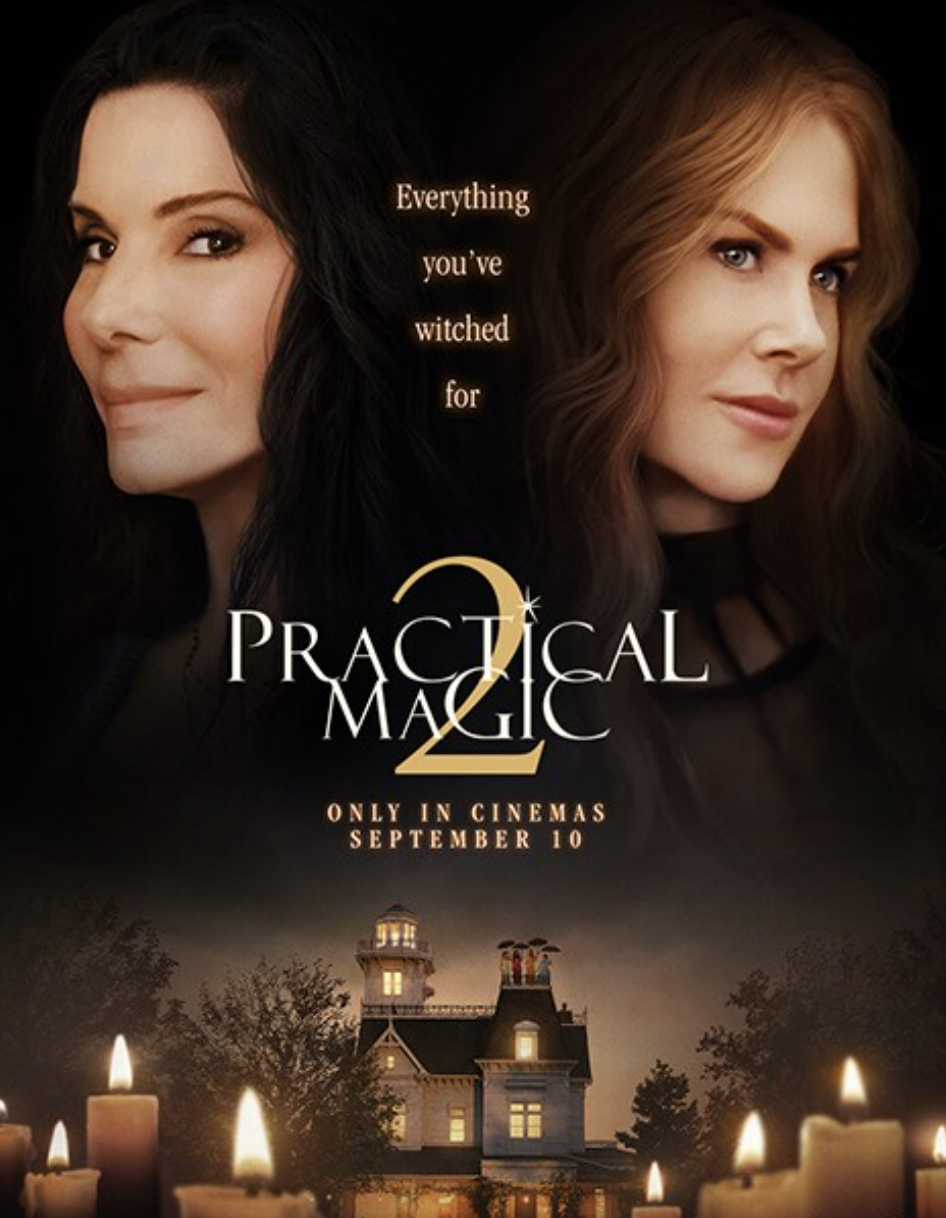
In the new tradition of beloved films that weren’t necessarily critically acclaimed or even notable box office successes getting sequels, Practical Magic 2 joins the likes of other “90s classics” that have been resuscitated “by fan demand.” Including another “spooky season” movie that was released in 2022, Hocus Pocus 2. And while Practical Magic 2 is slightly less disappointing than that, in many ways, the same problems plague it. First and foremost, the total reliance on nostalgia alone and the “joy” of seeing certain actresses reunited together onscreen. And yes, there is that occasional sense of “joy” when Sandra Bullock as Sally Owens and Nicole Kidman as Gillian Owens are allowed their “time” together onscreen.
Alas, too much of the narrative is given to Kylie Owens (far more than her sister, Antonia, whose “plotline” often feels shoehorned in when the writers can remember to include it). And yes, there has been some eyebrow-raising about Kylie being portrayed by Joey King instead of Evan Rachel Wood, who took on the role in 1998. At which time, her character is meant to be around thirteen years old (with Wood herself being eleven at that time). But in Practical Magic 2, her age has been majorly retrofitted so that she’s in her early twenties and still in college. The same, of course, goes for Antonia, originally played by Alexandra Artrip, but now taken on by Maisie Williams (who, incidentally, is two years older than King despite the fact that she’s meant to be the younger sister in the scenario).
Antonia herself was about eight years old in the first film, yet she, too, is now magically also in her twenties instead of her thirties. This, according to Bier, when speaking to Variety about Wood and Artrip’s absence, is because, “The kids in the story are right out of college, so it wasn’t really a question. We had to recast.” And yet, since when has a Hollywood movie ever had to adhere to its source material (except, apparently, when picking and choosing what it wants to adhere to)? In this case, once again a book by Alice Hoffman from the series about the Owens sisters/family. Indeed, the final book in the series, The Book of Magic (released in 2021, thereby further opening the floodgate for a film sequel), is meant to take place only a couple of decades after the first, which is where the math problem came in for the film version, going into production three decades after the first. And yet, like the book, the film could have opted to use the passage of time with better care and attention to detail.
After all, in The Book of Magic, it is stated that Sally is forty-four years old. And yes, in the first Practical Magic, she’s meant to be around twenty-five (though Bullock was thirty-four the year the movie came out). So how does it compute that Bullock and Kidman are now much older but somehow have much younger daughters? Even the least mathematically inclined aren’t so blind to numbers that they can’t notice the disconnect here. And, speaking of disconnects, this sequel feels completely disembodied from the first, with essentially no context about what the Owens sisters have actually been doing for the past twenty-eight years (or twenty-five, since the movie wants to present it that far in advance rather than being more literal with the actual amount of years it’s been since the first one came out). With the only detail that director Susanne Bier and writers Akiva Goldsman, Georgia Pritchett and Kelly Marcel seem to think is truly pertinent being the fact that Sally has chosen to block her children’s powers and make them forget they’re witches once Gary Hallett (Aidan Quinn) dies as a result of the curse placed on all Owens women who fall in love. A curse “bestowed upon” them by their own ancestor, Maria Owens (played by Caprice Benedetti in Practical Magic).
Considering this is now the second time the curse has fucked her over, Sally’s reaction isn’t totally uncalled for. Though it is weird that Bier bothers to have a scene of them at Gary’s grave with Sally’s daughters now looking younger than they did in Practical Magic while Bullock and Kidman look older (though there’s clearly some “magical” technology [i.e., CGI] at play for this particular scene), even as they’re meant to look younger at this starting point. But once the viewer is taken to the “present day,” Bullock and Kidman look more fully like “themselves” (even if that’s an arbitrary word considering the plastic surgery that both have had).
Unfortunately, that moment by the grave is the only “backstory” the viewer will really get about what’s been going on with the Owens sisters for the past few decades. Otherwise, there’s no indication of what Jillian might “do” for a living apart from still frolicking about with men (and even deigning to sleep with one named Chad). As for Sally, it seems she’s the local librarian, though who can say for sure? Except Hoffman herself, who states straightforwardly in The Book of Magic, “Sally had returned to school for her degree in library science at Simmons University, and now… she was the director of the Owens Library.”
Also in The Book of Magic, at least some backstory is given about what Gillian is doing, employment-wise, with Hoffman offering, “…[she] lived in Cambridge quite near to the girls, where she worked in a lab at MIT…” Of course, this character description isn’t really in line with the Gillian that Kidman embodies in the first movie. The free spirit who seems incapable of holding down a conventional job at all. A trait that appears to endure in Practical Magic 2, with her only job, ostensibly, being to serve as a wing woman for Sally when the time comes for them to fly (on a plane, not a broom) to England to track down Kylie, who has fled there to attempt undoing the curse herself. Ah, the hubris of the “younger generation.”
Of course, she wouldn’t have known about the curse at all were it not for her boyfriend, Gideon (Xolo Maridueña), suffering its effect after Kylie lets it slip that she loves him. And this whole plot with Gideon is one of the primary cringe factors of the movie, which didn’t seem to have anyone on the “team” who was aware (or cared to be aware) that Gideon acts in a manner someone of his age (especially a hetero male) would never act—unless that boy so happened to be a teenager in a Shakespeare play. And then there is Kylie saying things that would make any ordinary hetero boy run away (e.g., “I want us to grow old together”). Not to mention the way she delivers the kind of line that acts as one-woman propaganda for monogamy, despite her generation not really being much “about” that pursuit. And sure, there are exceptions to the rule of generational clichés, but the verbal exchange that Kylie and Gideon share in bed together after her reciprocal love confession is far beyond the limits of suspension of disbelief.
Less so the notion that Sally would go to the lengths of blocking her own powers for the sake of “committing to the bit” that she’s not a witch. That there’s nothing “witchy” to see here at all. Indeed, as Hoffman puts it in The Book of Magic, “In Sally’s opinion a life without magic was preferable, and she had done her best to ensure that her daughters wouldn’t live with the cloud of the curse above them, spying danger in every kiss. When the time came, if and when one of the girls teetered on the verge of falling in love, Sally would step in and put a stop to it, as she wished she had done when her sister had fallen for the man whose name was never said aloud for fear he’d be called back from the dead.”
To be sure, though Jimmy Angelov’s (Goran Višnjić) name isn’t said aloud in the second movie, he’s alluded to in one of the more comedic dialogue deliveries from Sally (whereas, for most of the rest of the time, the dialogue so clearly intended to be comedic is mostly awkward and lands with a thud). Who mentions the Diablo de Flores-guzzling ex-lover of Gillian’s not by name, but by “context” in front of Ian Wright (Lee Pace), a scholar on the topic of magic—both light and dark—who is “referred” to Sally by Aunt Jet (Dianne Wiest) before she and Gillian depart for England. And yes, it’s made glaringly obvious from the first moment they lay eyes on one another that Ian is her latest love interest. With the kind of “soulful” connection that Gary also had to Sally in the first movie.
But Ian, in a certain sense, is meant to one-up Gary’s connection by being more open-minded toward and understanding of magic. Thus, able to better “vibe with” Sally than Gary ever could. Besides that, he claims to be unafraid of the curse, believing that love can transcend through time no matter what as he cites such examples as “Ross and Rachel” (which, in its way, ties into Bullock’s recent interview with Jennifer Aniston for Interview) and “Sam and Molly” (from Ghost, that latter detail needing to be specified in the dialogue because of how “esoteric” it is to some viewers). All of this happening within the first forty-eight hours of the pair meeting one another.
Along with, arguably, one of the most uncomfortable attempts at “being romantic” rendered to film in recent memory, which is Ian telling Sally, “I like this, my molecules near your molecules.” He then adds, as if it will somehow make it better for the audience, that means they have “chemistry.” It’s almost as bad as the overly maudlin scene of Kylie looking at a video of herself and Gideon on the train to Thornfield—the birthplace of Maria Owens—while crying. In this moment, there’s somehow more realism to Becca (Whitney Peak) and Izzy (Belissa Escobedo) in Hocus Pocus 2 having a tangible picture of their friend group to provide for “the ritual” in the woods that leads to the resurrection of the Sanderson sisters.
And, talking of that other beloved 90s witch movie, strangely, Hocus Pocus 2 is more watchable than Practical Magic 2 before the actual Sanderson sisters finally show up almost a full thirty minutes into the movie (though their adolescent selves are shown at the beginning). That’s when, for whatever reason, the “modern” version of that story turns it into something of a musical, with the trio singing a rather hair-raising “the witches are back” song. Done solely because Winifred (Bette Midler) and co.’s musical performance at the costume ball is so “iconic” in the first movie. It then goes from “musical” to “Walgreens promo” just as quickly, with the Sanderson sisters being lured in there under false pretenses by Becca and Izzy (though, in reality, it’s to have an “in-kind deal” to shoot there that also provides plenty of “brand integration”). And then spending about a full eight minutes of “plot” on said milieu.
Practical Magic 2 doesn’t do anything quite so egregious on that front (granted, promoting Ninja’s “SLUSHi Twist Slushie Machine” as a way to bring back the “midnight margaritas” concept is pretty close). However, the film is just as guilty of laying it on thick when it comes to the callbacks to the first movie they know viewers like (except for the best one, which is Kidman telling a classroom of women to “hang on to your husbands, girls” as she sways her hips suggestively while rocking a belly chain). For example, as a means to drive home the nostalgia point with as much heavy-handedness as possible, one of the first movie’s most signature lines, “My blood, your blood, our blood” gets repeated far too often. To the point where it doesn’t have much weight.
Perhaps what does, though, is Sally’s end-of-movie revelation, “We’re the aunts now.” In other words, they’re the “olds.” And the ones expected to have the wisdom that’s meant to go with that categorization. But, considering how immature both Sally and Gillian still are, it doesn’t bode that well for Kylie and Antonia. Nor does it bode well that despite how largely unsatisfying this sequel is, Bullock already told Jimmy Fallon that she and Kidman would consider Practical Magic 3 (and hey, Hocus Pocus 3 is already in development, so why not?). Not as the “stars” anymore, but rather, as she phrases it, “We would pass—light the torches of the girls, the young women, Joey and Maisie. Like, we’d be the aunts.”
And so, the cycle continues in more ways than one. For there is also the now common cycle of fanbases for a “cult classic” movie experiencing the initial excitement and yearning to see the “decades in the making” sequel (as was the case for Hocus Pocus 2)—often further stoked by a press tour that’s more riveting than the film itself—only to be met with the disappointment that comes after at last seeing it.


