


The phrase, “Live fast, die young” has been kicking around since at least 1947, with the publication of Willard Motley’s novel, Knock On Any Door. The aphorism then got rendered to screen with the 1949 adaptation of said book starring Humphrey Bogart and John Derek (who gets to deliver the famous line in question, adding to it, “…and have a good-looking corpse”). By the 1950s, the saying felt as if it had become a part of the cultural lexicon because of James Dean embodying it with his role in Rebel Without a Cause…and then actually dying young after living fast (by way of his car). Three years after James Dean left behind a good-looking corpse in 1955, a movie that actually had the title Live Fast, Die Young was released, billing itself as a “sin-steeped story of today’s Beat Generation.”
In 2012, Lana Del Rey, a known James Dean enthusiast, undoubtedly adopted the phrase as a nod to him during the spoken-word portion of her “Ride” video (though not before M.I.A. decided to repeat it as part of her “Bad Girls” chorus earlier that same year). Nessa Barrett, by now making no secret of her penchant for imitating Del Rey’s style and aesthetic (already itself an imitation of many things), has, thus, decided to repurpose the saying as “Too Fast Too Live, Too Young to Die,” the lead single from her forthcoming third album, Tough Love. An idiom that Barrett doesn’t seem to be using in the conventional sense for the purposes of the accompanying video, directed by Claire Bishara, during which her interpretation of “tough love” isn’t about being strict and cold with someone in order to correct their behavior in the long run, but rather, an ostensible homage to a love like Harley Quinn’s for The Joker.
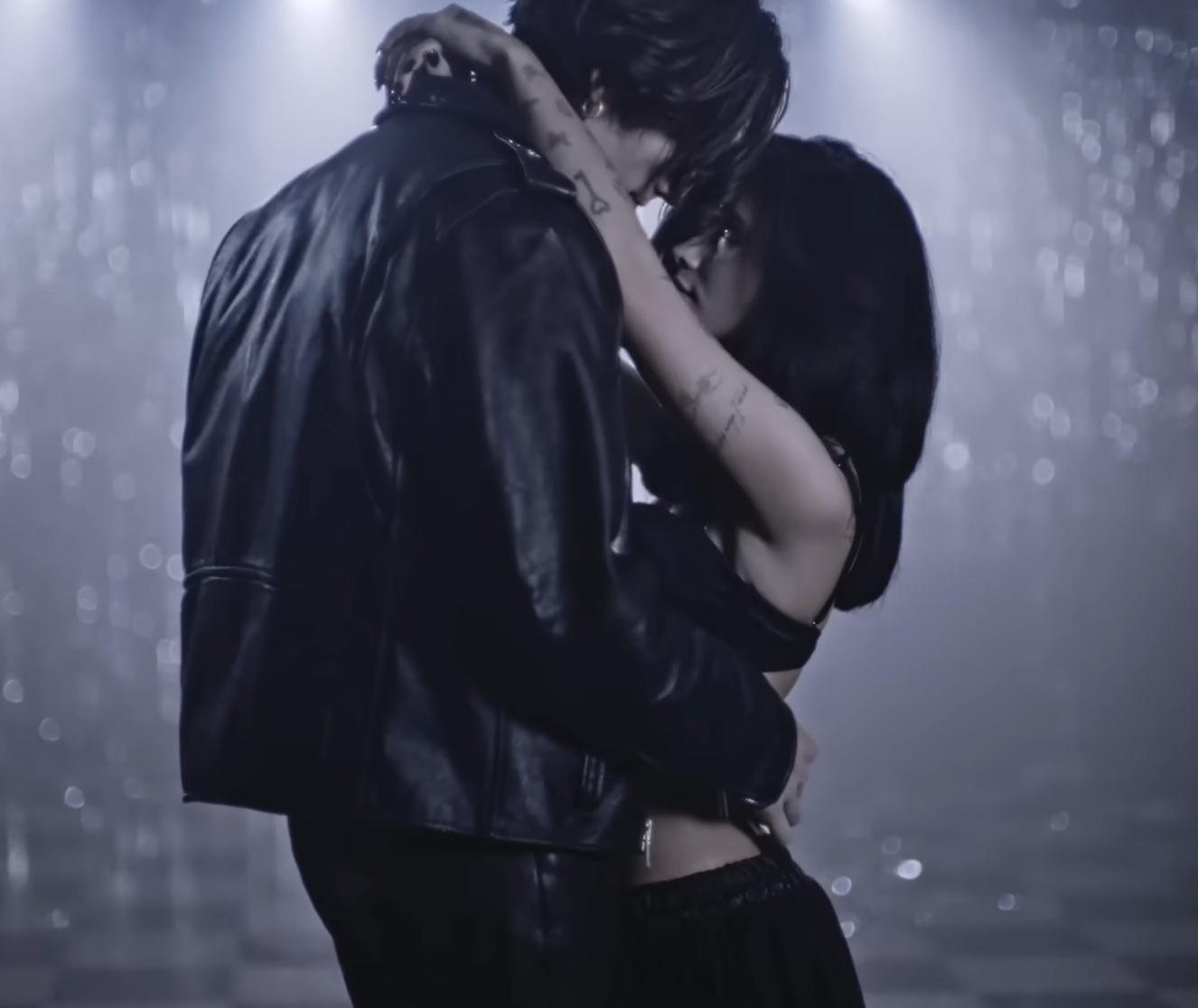
Or, to bring it back to Del Rey, a love like hers for Bradley Soileau’s “character” in the “Born to Die” and “Blue Jeans” videos. A male archetype that Barrett clearly wants to evoke in “Too Fast Too Live, Too Young to Die,” which begins with her and her love interest, played by Briley Stout (who, incidentally, has the same initials as Soileau) gazing into each other’s eyes before the close-ups on each of their faces give way to a medium shot of the two of them continuing their intense gaze, but now while also revealing his leather jacket ensemble and her bridal(ish) one.
The two then take each other’s hand and walk toward Stout’s motorcycle, which conveniently has a California license plate that reads, “RIDE OR DIE.” A phrase that Del Rey also wields in “Blue Jeans” with the lyric, “‘Cause I’m a ride or die/Whether you fail or fly.” Del Rey’s penchant for conveying a kind of “Bonnie and Clyde”/“two against the world” love in her early work is also what Barrett wants to achieve with an opening verse that goes, “He said, ‘Come on baby, are you ready to go?/Grab the money and we’ll hit the road’/Put the pedal to the metal/I love bein’ bad with you (it’s true)/He said, ‘I’ve always been trouble, I’m a smokin’ gun’/I said, ‘I’ll be your trigger, baby, while we’re on the run’/If it’s do or die/Then I’d do it all for you.”
By the time she’s gotten to that declaration, the two are sitting in a diner—yet another very “Del Reycore” setting (see also: Mel’s Diner in Hollywood adding menu items inspired by her)—complete with the maraschino cherry atop the milkshake that Barrett is sipping through a straw after lighting her man’s cigarette for him. Which seems pointless, since, seconds later, he’s lighting another one.
Evidently fortified from their cigarettes and milkshake, the pair subsequently takes to a dance floor that has them doing their best imitation of Mia Wallace (Uma Thurman) and Vincent Vega (John Travolta) in Pulp Fiction as Barrett laments, “Too fast too live/But we’re just too young to die.” At twenty-four, Barrett is, indeed, as young as James Dean was when he died. And, to be sure, generally has an obsession with youth—hence, titling her debut album, Young Forever (and asking during the first track, “Tired of California,” “Can I be young forever?/Would it be fun forever?”).
Yet, for someone so young, she seems to be in a decidedly retro state of mind throughout the video (and overall…much like Del Rey herself). This includes once again romanticizing Vincent Gallo’s 1998 movie, Buffalo ‘66, which she also named a single in honor of from her EP, Jesus Loves a Primadonna (released earlier this year on March 20th). In the actual video for that, however, it was all visual clichés with The Neighbourhood’s Jesse Rutherford, who stuck his finger in her mouth, blindfolded her and carried her around “across the threshold”-style (which also happens to Del Rey in the video for “Born to Die,” albeit because she’s supposed to be, well, dead). In short, all things out of the Del Rey-meets-50 Shades of Grey playbook. So perhaps feeling she didn’t appropriately pay tribute to Gallo’s movie, she clearly does so here with a photo booth scene that majorly channels what Billy Brown (Gallo) and Layla (Christina Ricci) do for their own signature posing in the movie.
All the while, the musical production (courtesy of Arthur Besna and CJ Baran) bears the same style of instrumentation as much of Born to Die (with “Summertime Sadness” coming to mind for the track’s opening—and later, when “Kiss me hard before you go” becomes, “Kiss me reckless/Kiss me goodbye”). The Del Rey-inspired lyricism also shines through with, “Diamond cross around my neck/I don’t really care what happens next/God’s on my side as long as I’m with you.” This sung while Barrett sports a generic t-shirt that just reads, “Rock & Roll” on it as she tattoos her beloved with the phrase, “Tough Love” in honor of her album title. She, too, will get the same immortalized above her hip before a montage of all the previous scenes start to play, leading up to the grand finale of the video, which is that, needless to say, the reckless duo wasn’t too young to die at all.
This much is confirmed by the grand finale image of the crashed motorcycle, with Barrett’s heels and veil strewn next to it. As if to emphasize the point that the two never had a real chance at a future together as such enablers of their respective imprudence, the final scene is of the photo booth spitting out their photo strip to reveal the four vertical images are empty save for the curtain backdrop. It’s the kind of fatalistic conclusion that colors so much of Del Rey’s work, particularly on her first three albums (and no, one is not including Lana Del Ray a.k.a. Lizzy Grant in that). Which perhaps means that, after Barrett has released her own third album, she might start following Del Rey’s musical trajectory of “positivity” that began to shine through on 2017’s Lust for Life.


[…] Nessa Barrett Unleashes More Lana Del Rey Cosplay for “Too Fast Too Live, Too Young Too Die” […]
[…] Nessa Barrett Unleashes More Lana Del Rey Cosplay for “Too Fast Too Live, Too Young Too Die” […]