


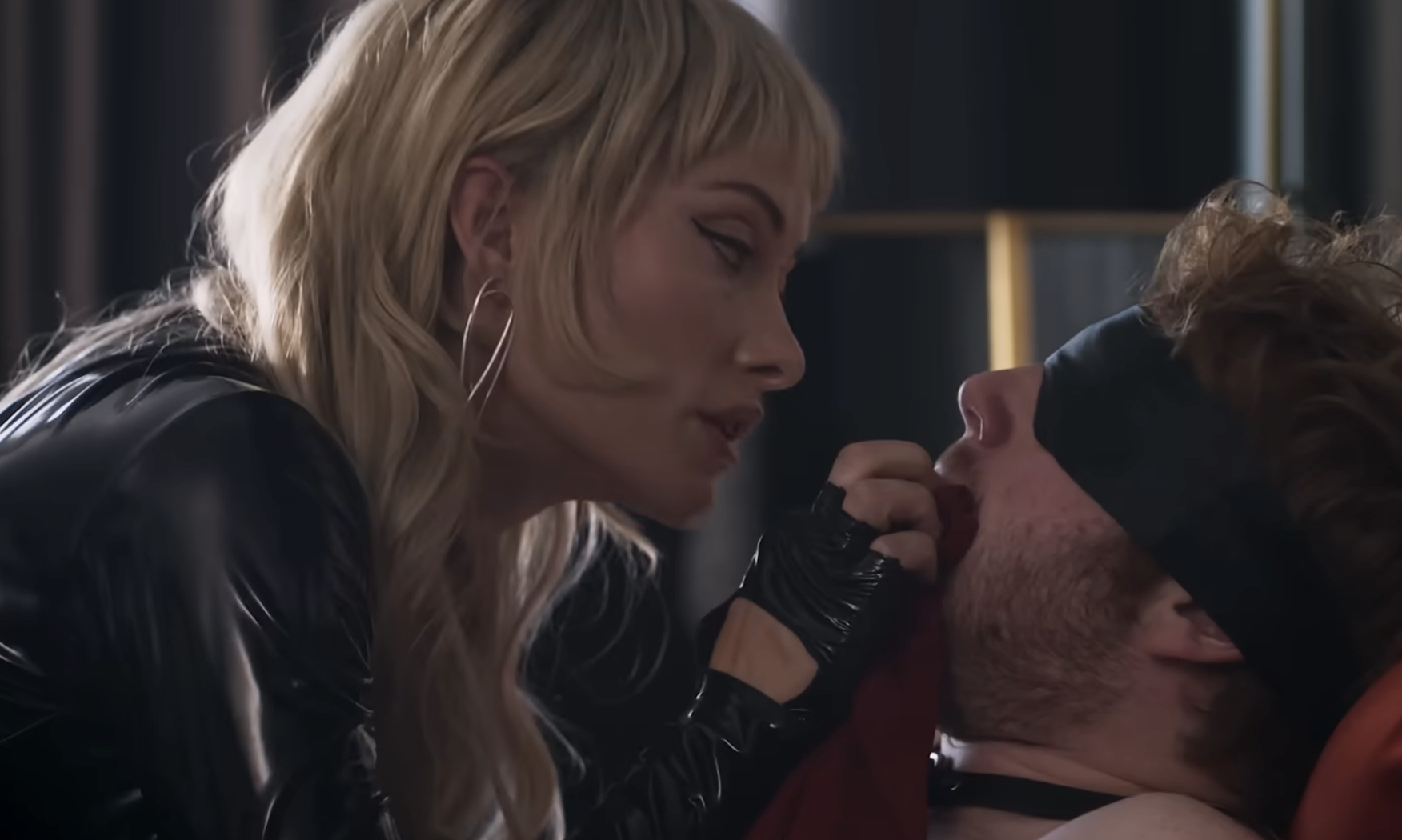
If anyone was “sex positive” long before that term became chic, it’s Gregg Araki (and, well, Madonna). Known as a leading voice in the Queer Cinema movement of the 90s, Araki has never shied away from kink. And his latest film, I Want Your Sex, is no exception to the rule (as the title would suggest). Indeed, maybe the only exception to the rule is the last film he did, White Bird in a Blizzard, released twelve years prior in 2014. As for the reason why Araki was absent from filmmaking for so long, the reality is that I Want Your Sex (a title that takes its name from George Michael’s 1987 single of the same name [though the trailer favors playing Robyn’s “Talk to Me”]) has been in the making for about fourteen years, with Araki first receiving a version of the script in 2012, as he told Film Independent. A version of it was then going to get made circa 2015/2016, but “it fell apart, as indie movies tend to do.”
This, as it turned out, seemed to be a blessing in disguise for the story (and for the casting of Charli XCX, who wasn’t ready until now to transition into an acting career). Because, originally, it centered on a female assistant (or intern) and a male boss power dynamic. Then, in the aftermath of #MeToo in 2017, Araki no longer felt so at ease with this. The image of, say, a woman being pulled around by her hair by a man. So it was that the gender roles were swapped, with Olivia Wilde taking on the part of the extremely dominant Erika Tracy, a contemporary “pop” artist, of sorts, who runs the gallery where her work is displayed. All of that work being sexual in theme. In fact, the first, er, piece that Elliot (Cooper Hoffman, continuing his evident tradition of lusting after older women in film) has to help with is the outline of a vagina that needs to be “filled in” with chewed-up gum. The gum-chewing part being the responsibility of her various interns, which also includes Zap (Mason Gooding, who, like Hoffman, is the son of a famous actor).
Granted, Zap isn’t as surprised by the mundanity of this task as Elliot, still “fresh meat” that assumed somehow this job would be more “intellectually stimulating.” Of course, what it lacks in intellectual stimulation it certainly makes up for in sexual stimulation. Something that Elliot is “turned on to” during the first week of his stint at the gallery, when Erika starts to make some blatant moves on him. This commences with having him carry a painting to her house and then offering him a Spindrift (a very specific product choice that leads one to believe that of course Araki must have gotten some cash for the movie to mention this drink so prominently in a scene—though Charli XCX probably would have preferred it to be Poppi). As the two get to talking on her couch, Erika proceeds to tell Elliot that his generation is wasting their sexual prime hiding behind screens and fears and various hang-ups that are costing them so many potential orgasms.
Needless to say, Erika is Araki, warning Gen Z that they’re going to regret not taking chances, sexual or otherwise, when they get to their forties and fifties and grasp that they’re now the very “olds” they were once mocking. Granted, Araki doesn’t seem to be taking into account how much easier it is to still look young now even when you’re “old.” Like Wilde herself, in her forties but hardly appearing what anyone would call “unfuckable.” In any case, Araki freely admitted during his Q&A with Film Independent, “Erika became very much kind of a spokesperson for myself,” adding that, in one of the first scenes where Elliot is watching a video of Erika talk about her work, “She’s literally saying things that are quotations I’ve said about sex and art before.” Thus, “[Erika] became, in a way, sort of a mouthpiece for me.” But Araki still gives the “Gen Z side” of things a mouthpiece as well, with Elliot trying to explain to Erika that his generation grew up in a world that never felt safe, not to mention how the pandemic turned everyone even more awkward and lacking in social skills.
So it is that Elliot gets his own “defense dialogue” that amounts to what Araki said during an Outfest screening of the movie: “They had technology all their lives, they’re not used to talking to people! Social interaction makes them uncomfortable. And also, they’re being filmed and videotaped constantly. If I thought somebody was going to film me going into that gay bar back when I was a teenager, would I have done it? Probably not. Those things need to happen in private.” To that point, Araki is sympathetic to the fact that, among this generation, “There’s this level of fear of making a mistake, you know what I mean? In public, because everything you do is public.”
Even so, he’s not sympathetic enough to make Erika take anything but a hard (innuendo intended) line on the importance of sexual experimentation. And it’s obviously got Elliot hot and bothered enough to go home and have a wank after their conversation. This done while he’s wearing a Madonna t-shirt (a *chef’s kiss* costuming choice in this context). Besides, it’s not as if his girlfriend, Minerva (Charli XCX), is giving him much opportunity for a sexual release. And yes, her name is clearly meant to evoke the kind of severity/frigidity that Lilith (Bebe Neuwirth) from Frasier does. Indeed, Minerva is her own kind of “dom” in the relationship, without Elliot getting the benefit of a sexual payoff from her form of abuse.
But at least Elliot has his best friend, Apple (Chase Sui Wonders)—a name that must be a nod to Brat more than it is to Gwyneth Paltrow—to turn to for emotional support, if not the sexual kind. Though that certainly shifts toward the second act of I Want Your Sex, when Erika calls Elliot after cutting him off from her to focus on making the art for her upcoming show. Telling him she wants to have a threesome, but it “needs to happen quickly,” Elliot rounds up the only person he can think of to do it: Apple. His roommate (in addition to best friend), and the one who has been both supportive and jealous of his sexual hijinks of late. In fact, she’s the one who encourages him to keep it going with Erika, making a crack about becoming famous by proxy like Travis Kelce (a joke that surely won’t diminish the long-standing belief that Charli and Taylor aren’t friends).
And her prophecy isn’t far off, considering the antics that ensue as a result of Elliot’s full-on sex obsession with her. Which is where the so-called “mystery” and “thriller” elements of the film come in. Starting with the Sunset Boulevard-esque opening scene of Elliot waking up from a blackout and noticing that Erika is floating face-down in her pool. The title card after this then reads “9 ½ Weeks Earlier” (an obvious homage to the 1986 erotic drama of the same name), as Elliot reflects back on his and Erika’s blossoming relationship to the detectives he’s talking to in the present.
Perhaps in telling the story all in one go, it’s easier for Elliot to admit that he did like what Erika was doing, that it was “all his wildest fantasies come to life” (and yes, in the spirit of an Araki movie, there are plenty of animated fantasy-type moments—including a Charli XCX cartoon tit pop). Which is why, when Elliot angrily demands of her at one point, “Why are you doing this?!” she knowingly replies, “Because you like it, baby.” An exchange that has all the trappings of the dialogue between Lisa (Angelina Jolie) and Susanna (Winona Ryder) in Girl, Interrupted when the latter asks, “What the fuck are you doing Lisa?” and Lisa answers, “I’m playing the villain baby, just like you want.” But if Erika is the “villain” of I Want Your Sex, she’s certainly doing some antithetically benevolent deeds in the form of mind and body expansion for a generation dangerously at risk of missing out entirely on their peak fucking years.


