


The ooh’s and ahh’s over Kane Parsons’ directorial debut, Backrooms, are not entirely unwarranted. After all, it’s no secret that society finds everything to be more impressive when a youthful person is doing it (just ask Madonna). And at twenty years old (now twenty-one), Parsons became the youngest director in movie history to have a film debut at number one. So yes, impressive indeed (so impressive that it’s taken away most of the glory from screenwriter Will Soodik). Even if what Parsons has done with Backrooms is, in essence, toss into a blender a number of 90s movies—ranging from The Truman Show to The Matrix to The Blair Witch Project—and suffuse it with an overarching Lynchian tone. With Twin Peaks, of course, being the primary comparison in that the Backrooms are nothing if not Black Lodge-esque. An eerie, sinister distortion of the “White Lodge” sensibilities and aesthetics offered by the “real” world it mirrors.
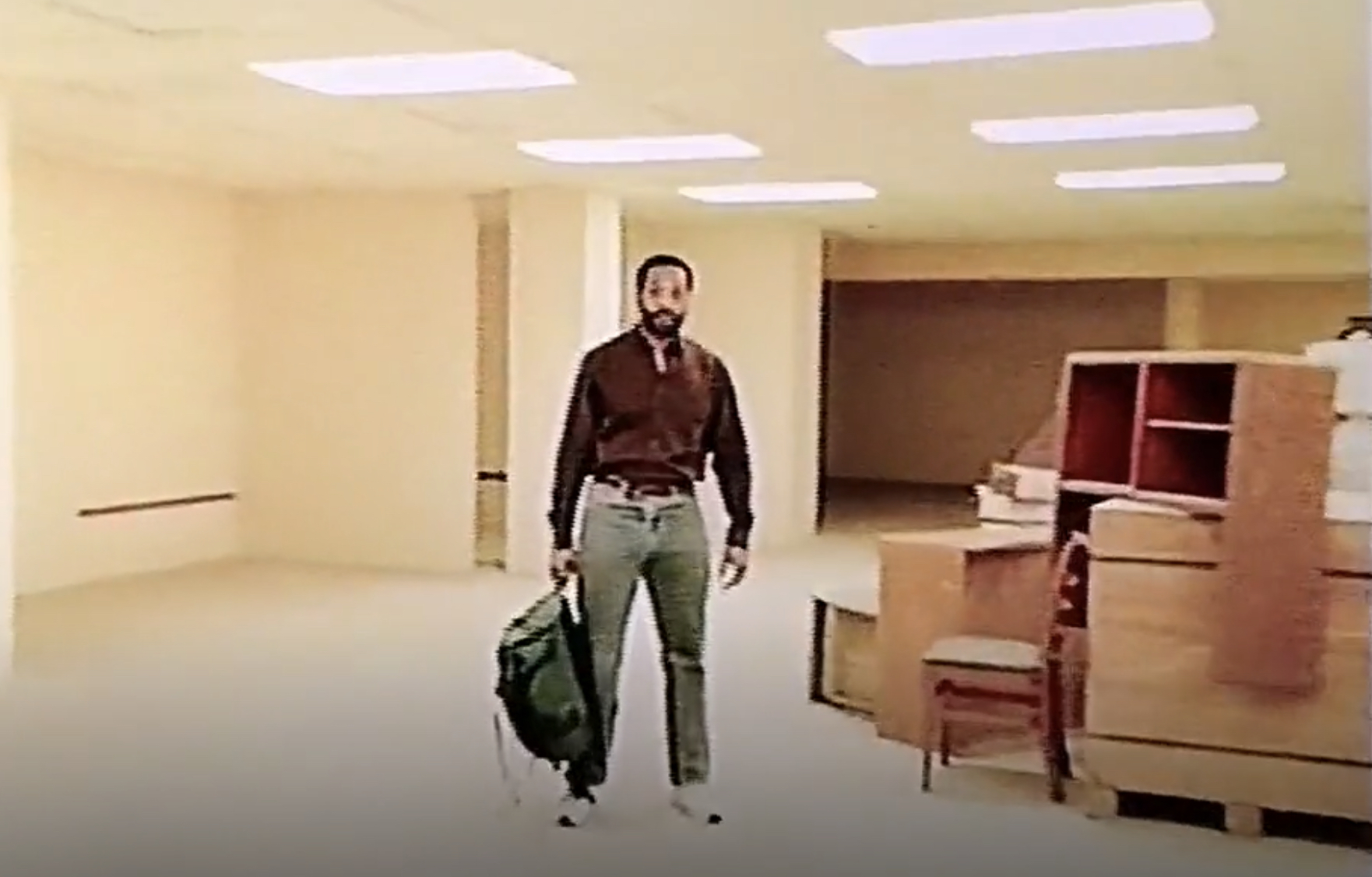
This bringing one to The Matrix connection Backrooms has as well. For it’s quite apparent that Clark (Chiwetel Ejiofor), the owner of a fledgling furniture store called Cap’n Clark’s Ottoman Empire, is looking to tap out of his less pleasant existence in the “real” world in favor of disappearing into the Backrooms (where, at the very least, he doesn’t have to worry about his finances). Even though, in contrast to the “glossiness” of the matrix, some would point out that the jank, gritty Backrooms are actually more “the matrix-y” than the outside world in terms of their unsettling fakeness.
Nonetheless, the fundamental concept/principle remains: the film’s protagonist, like Neo (Keanu Reeves), must choose between a reality that is “ersatz” and (supposedly) real. Even though, as many would argue, so little about the way we live feels real. And that’s been an ever-increasing sentiment since the dawn of the industrial age. This being compounded by the types of spaces (often liminal)—particularly in the United States—that people are forced to spend most of their time in, day in, day out. Whether for work or pleasure. Though there’s little of that to be had when so much of a person’s hours are spent trying to make some money to live in subpar conditions.
As is the case for Clark, who has ended up hawking cheaply-made (but expensively-sold) furniture for a living instead of doing what he really wanted to in life: being an architect. As for the decision to make him a furniture store owner, it’s a clear nod to the origin of the photo that set off the entire Backrooms obsession (no Curry Barker reference intended). For it was eventually traced by internet sleuths to a furniture store in Oshkosh, Wisconsin. A milieu that doesn’t get much more “Anytown, USA.” However, in Backrooms, Santa Clara Valley fits that bill nicely as well, with plenty of long and close-up shots on the cultural emptiness that America so succinctly embodies. This, of course, is serviceable through one particularly ominous shot of a strip mall with a dental office in it. For, like Lynch, Parsons has a knack for spotlighting the inherently sinister “underbelly” of the “wholesomeness” meant to be presented by such establishments. The “wholesomeness” of capitalism. At least for those who can squeeze out the frills of the American dream from it.
Something that hasn’t really been achievable since the 1990s. Which is perhaps at least part of why Gen Z seems to romanticize that decade so much (even more than the 2000s, it would appear). Because, apart from the “funky fashions” and the “novelty” of songs lasting longer than two minutes, there was the ostensible promise that if you adhered to the social contract, you could at least get something worthwhile in return: quality of life. “Nice things.” “Trappings of wealth.” In short, all of what Peter McCallister (John Heard) appeared to have in Home Alone, a primary 90s movie that Gen Z homes in on mostly for how incredulous they are that someone could afford to live in a house like that, a vacation to Paris for the entire family and regularly support five children. And yes, it’s more than a bit depressing that everyone (not just Gen Z) in the present can no longer fathom such luxury for the middle class.
Fittingly, Home Alone was released in 1990, the same year that Backrooms takes place. This being established with the first grainy videotape shown as the intro to the movie. The one that reveals an employee of Async Research Institute, Naren Warne (Avan Jogia), going as far into the Backrooms as he’s ever been, only to be attacked by some unseen entity. Here, too, The Blair Witch Project’s influence can’t be denied, for a key part of that film’s horror is not seeing the “thing” that’s stalking three film students in the woods. The same goes for the “thing” stalking any and everyone who ends up in the Backrooms. That is, at least not until the third act, after a particularly The Texas Chain Saw Massacre-reminiscent scene between Clark and Dr. Mary Kline (Renate Reinsve), his therapist. The one who’s been telling him the “loops” and “behaviors that keep us walking in circles” are why he can’t forge a new pathway that will break him out of his rut. This metaphor about loops and walking in circles also applying to The Blair Witch Project in the sense that Heather Donahue, Michael C. Williams and Joshua Leonard end up doing just that when they spend fifteen hours walking south in the woods only to end up back at the same spot with the same goddamn log.
The Backrooms, one might say, is a more modernized version of those endless woods. Which can also be summed up in the same way that Clark describes the Backrooms to Mary: “You keep going and you realize that none of it makes any sense. It’s like, um, imagine describing a dog to someone who’d never seen one before and then asking them to draw it. They might get some things right, you know, but there’s no way they’d get everything right. The devil’s in the details. So, from a distance, you look at it and you think you’re seeing a dog, but then, you look closer…” In other words, he’s basically trying to say that the Backrooms are a full-on Monet (to borrow from still another 90s movie).
The “something off” quality that the Backrooms has is due, in large part, to Parsons being of a generation that “misremembers” (to use Clark’s word) how things were mainly because they were barely sentient during those early years of their childhood when the late 90s and early 00s would have been “imprinting” on them. And in Parsons’ case he didn’t get to experience any of the late 90s and early 00s at all, born in 2005 to a video game developer father (hence, the look and nature of Backrooms) and a therapist mother (hence, a therapist main character). It was the former parent who, as Parsons tells it, had a room decorated in the Black Lodge style: a red curtain and zigzagged black-and-white carpet. Though at the time of the interview in which he says this, he had yet to actually watch Twin Peaks.
In any case, maybe his birth year is why his take on that period of time is, as he told VICE in 2022, as follows: “I mostly remember that time through little glimpses of memories here and there and then family photos. The flash is always on, the lighting is gross looking, there’s yellow walls, the white balance is all off.” It’s that “glimpses” style that pervades Backrooms with its hodgepodge of influences. Even including something like Stranger Things, what with Async channeling the Hawkins Lab researchers, complete with monitoring an alternate dimension/portal to another world called the Upside Down, itself a sinister foil for the “real world” Hawkins. Except, thus far in the Backrooms universe, there is no real explanation for the Backrooms or how they came to be. Only that it’s “everything that ever existed.” That is, everything horrible about capitalism and the American dream (a.k.a. nightmare) that ever did.
At the beginning of the film, the viewer is shown a scene of Clark walking into his furniture store for the first time, clocking the fact that someone has graffitied one of the exterior windows with the words “RIP OFF.” In essence, that’s what everyone forced to exist in a post-90s timeline is feeling more and more acutely of late. As if they’d rather even be in the Backrooms version of it, no matter how distorted the memories, to get even one small taste of “the way it used to be.” And yet, ironically, what Parsons ends up emphasizing to his viewers is that, fundamentally, it was depressing on an entirely different level in that decade. When the promises of “No Credit Needed!” and effortless self-improvement (à la Mary’s The Window Within book) are part of why society has further devolved into its current state. One that even Gen Z, despite “coming of age” in it, still doesn’t entirely find totally “normal.” Vaguely aware that something isn’t “quite right.”


