


While some might not remember, Oscar Isaac and Carey Mulligan aren’t strangers to acting with one another, having played somewhat contentious ex-lovers in the 2013 Coen brothers movie, Inside Llewyn Davis. In fact, there’s some aspect of their latest acting endeavor together, Beef (season two), that could be imagined as how it would have been between Llewyn Davis and Jean Berkey if they had 1) gotten married and 2) lived in the current era rather than the 1960s. Indeed, there’s even a musical connection between that “pairing” and the couple they play in Beef: Josh Martín and Lindsay Crane. It’s the former who had musical aspirations at one point before becoming the general manager at a tony country club in Montecito called Monte Vista Point.
Before “falling into” this role, however, Josh and Lindsay also had grand plans to start their own music festival, foiled by “life happening while they were making other plans” (to paraphrase John Lennon). The music festival then turned into wanting to start a “bespoke” bed and breakfast that has also fallen by the wayside, as Lindsay so angrily points out to Josh after they return home from a fundraiser (“Save the Frogs”) at the country club during the first episode, “All the Things We’re Never Going to Have.”
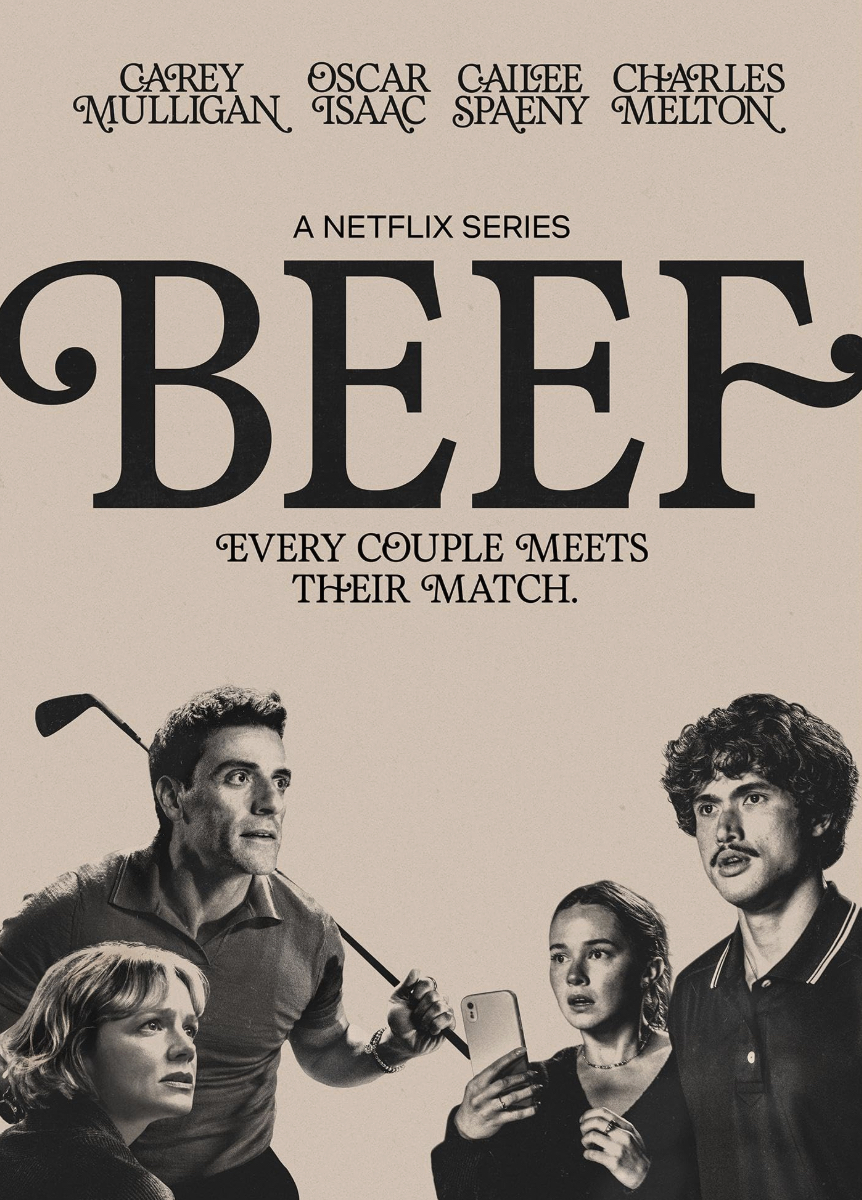
It’s during this knock-down, drag-out fight that the couple who will serve as their foil for the season, Ashley Miller (Cailee Spaeny) and Austin Davis (Charles Melton), drive up to the house after being instructed to return Josh’s wallet that he left behind at the club. For, as nothing more than lowly country club workers, that’s the type of grunt work expected of them. However, what they’re certainly not expecting is to encounter the violent altercation they witness between Josh and Lindsay, with Josh looking like the villain (even though Lindsay was the one who lunged at him with a golf club first) on the video that Ashley decides to record as they follow the sound of shouting voices to the part of the house where it’s all going down. And while this development theoretically begins to frame this season of the series as a “couple vs. couple” motif (complete with the tagline, “Every couple meets their match” being written on one of the promotional posters), that’s not at all the permutation of this season’s Beef. Nor is it “millennials vs. Gen Z” (even if Isaac is Gen X playing a millennial and Charles Melton is a millennial playing Gen Z, with Spaeny barely making the cutoff to be considered as “Z”).
Instead, the real setup for the “nemesis” actually being capitalism arrives just before Ashley and Austin turn up on the Martíns’ doorstep at the end of episode one to serve up some blackmail with their video. Prior to going over there, Austin explains to Ashley that her low-simmering rage lately is the cause of “late-stage capitalism” and “the system [being] designed to make you feel despair,” further explaining, “None of this is your fault, okay? The people in charge have made it impossible for us… We work at a fucking country club where everyone grabbed the bag before we could.” With Ashley homing in mainly on Josh as a prime example of someone who grabbed the bag before her even though he himself has plenty of financial woes (though many of them are self-inflicted due to his pesky gambling habit). Indeed, it’s Josh who, by episode two, “A New Starting Point for Further Desires,” starts to have a similar revelation to Austin, telling Lindsay, “Babe, everyone is scamming. We have been grinding away here and for what?”
This all part of being how he explains to her that they’re going to “get back on track” by embezzling thousands of dollars from the club so that they can not only finish their work on the bed and breakfast, but also, as they discuss in episode three, “The Increasing Flimsiness of any Certainties About the Future,” “convert[ing] the barn into, like, a little concert space” as a substitute for the music festival they had once dreamed of starting. This being a conversation that allows them to throw in talking about Hot Chip opening for LCD Soundsystem at The Hollywood Bowl (which puts this memorable outing of theirs in October of 2010). And, among many unexpected “celebrity” cameos (e.g., Finneas O’Connell), Hot Chip will have their comical place as part of the plot in episode five, “I Am Killing My Flesh Without It.”
As for the “B” couple of the scenario (that wants so badly to become “A”), they’ve been involved in an increasing power imbalance after Ashley took over in a higher-paying, more authoritative position (even if she really is just being used as a glorified assistant). One that prompts her to treat Austin more like her errand boy than her boyfriend. This perhaps further opening the floodgate for him to become attracted to Eunice (Seoyeon Jang), the Korean righthand woman of Chairwoman Park (Youn Yuh-jung)—the exorbitantly wealthy (she “accounts for two percent of Korean GDP”) CEO type who swoops in to claim her ownership of the club. After which it doesn’t take long for the series’ creator and showrunner, Lee Sung Jin, to present her as the overarching “symbol of capitalism.” For she is all-being, all knowing and all-powerful.
And maybe because “capitalism is the real villain” in this iteration of the series, that’s why it doesn’t actually feel like Beef at all, but some entirely different series that could have had its own name. Or at least could have waited until season three to pull something so deviating from the structure and style of the first season (you know, like The White Lotus season three). What’s more, while Lee might have intended to convey the message that capitalism is “evil,” what really ends up coming across is more of a “why fight it?”/“Surrender Dorothy” type of message regarding what George W. Bush once called “the greatest system ever devised.” Because, by the end, everyone has surrendered to their so-called unavoidable destiny.
A destiny that is represented for all who are not rich within the system of capitalism (a.k.a. on the top of the food chain) from the outset of their lives. This manifest at the the beginning of the first episode, when director Jake Schreier focuses on the image of a line of ants (to be sure, bug imagery abounds in this season) being thoughtlessly crushed by the passing footsteps of a man the viewer will soon recognize as Austin. This instant foreshadowing the fact that even Austin, for as “pure-hearted” and “well-intentioned” as he is meant to initially come across, will succumb to the system he rails against at first. Even if he does so rather robotically, since he’s pulled most of what he knows from podcasts or articles that he doesn’t fully read. Though one hardly needs to do much research to understand that capitalism is a piece o’ shit (yet also, as Mark Fisher, Frederic Jameson and Slavoj Žižek would phrase it, impossible for most people to imagine an alternative to—save for the end of the world itself…which, “lucky” for pro-capitalists, is precisely what capitalism guarantees).
This much is underscored by how the driving force behind Ashley wanting to blackmail the Martíns is because she sees no other way to get promoted to a position that will give her the health insurance she needs to cover the costs of surgery for her ovarian cyst (which she finds out exists in episode one). In the wake of her successful attempt to get what she wants by any means necessary, it’s telling that it was all for little more than forty-five grand, ten days’ worth of paid vacation and health insurance. That’s what Ashley gets all excited about, and what she deems worth compromising all sense of morality.
It’s a testament to just how low the bar for “happiness” has been set in American capitalist society. Where no one is experiencing happiness at all, nor is anyone safe from what others might do to get ahead within that system. Not even sweet little Burberry, the Martíns’ Dachshund, and the only pure spirit in the entire show. Which, under the rules of capitalism, is evidently why he had to be sacrificed. With nature itself being almost as savage.


[…] Beef Season 2’s Real Contention Isn’t Between People, But Between People and a System […]
[…] hard to think of a dog in recent pop culture memory that’s been done as dirty as Burberry from Beef’s second season. Not just because he’s saddled with two owners, Lindsay Crane (Carey Mulligan) and Joshua Martín […]