


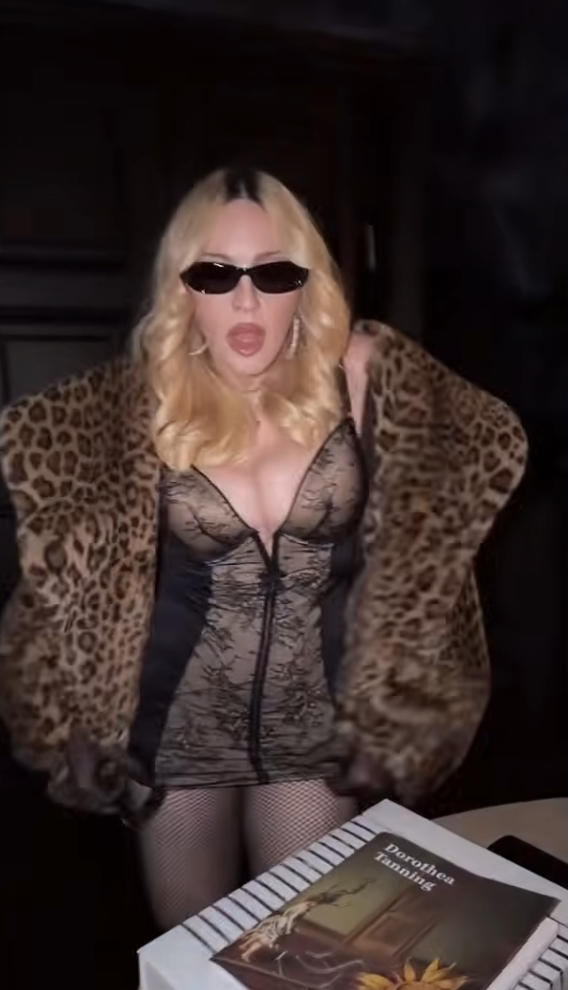
Maybe the most unusual thing about Gen Z glomming onto Madonna’s 1992 non-hit, “Thief of Hearts,” via TikTok isn’t the fact that it’s a “deep cut,” but rather, how much it’s a representation of internalized misogyny. Then again, seeing as how it’s no secret at this juncture that Gen Z was faux woke all along, maybe it also shouldn’t be a surprise that they don’t mind hearing Madonna rail against another woman she views as “competition” worthy of having her legs broken. That’s right, Madonna venomously asks early on, “Which leg do you want me to break?”
Perhaps still shaking off the tough-talking dialogue of her Dick Tracy era (along with potentially trying to mimic the “hardness” of rap and hip hop, as it was coming up in the world at that particular point), Madonna doesn’t stop there when it comes to verbally picking apart her rival. Though the indication is, of course, that she would also like to cause some physical harm to this “bitch.” And yes, that still derogatory word so often used against women was also quite big in the rap music of the day (e.g., Dr. Dre’s “Bitches Ain’t Shit”). For Madonna to reinforce the male predilection for using it as an insult against women (as opposed to trying to reappropriate it in the “N-word” way as some women have [e.g., Doja Cat’s “Boss Bitch”]) signaled that she was still very much under a patriarchal influence despite her reputation for being “liberal” and “rule-breaking.”
While Madonna is widely known as a beacon of advocating for women and the LGBTQIA+ community, there’s no denying that even she didn’t escape the influence of societal brainwashing when it comes to seeing other women—and “the other woman”—as the enemy. Seemingly not laying any of the blame on the man in this scenario. As for who that might be, more recent speculations have been that the song was inspired by her relationship with Warren Beatty, but the older (and frankly, more valid) lore is that it was about Robin Wright, who started dating Sean Penn after the ink was barely dry on his and Madonna’s divorce papers. The two then had their first child together in 1991, hence the reference in the song that goes, “Little Miss thinks she can have his child/Well anybody can do it/Here she comes/Little Susie ho-maker, thinks she’ll get respect if she screws it.” So no, considering that Madonna was fine with letting her Beatty romance fizzle out naturally and was still calling Sean “the love of [her] life” while dating “Dick Tracy” himself (for Truth or Dare, wherein she says this, though released in ’91, was filmed in ’90), it’s less likely that the song is aimed at Annette Bening than it is at Wright. Who became “Wright Penn” (at least for a while).
When the two eventually divorced in 2010 (with lots of on and off threats about doing so in between), perhaps Madonna thought to herself, “No one ever takes what’s mine/And gets away with it.” Yet another line in the song that indicates not only her possessive nature, but how that possessiveness is the product of living in the capitalist system. However, for Madonna, it isn’t just that she lived (and lives) in that system, but that she, as a baby boomer, got to experience it during its heyday. This, of course, would be very formative to one’s worldview. Particularly on the matter of ownership. Whether of tangible possessions or, well, people. Indeed, it’s no coincidence that Madonna once said, “Ownership is everything.” While it might have been in reference to how she would never sell her music catalogue (unlike many other artists have been succumbing to this “temptation,” even Britney Spears), it’s a telling statement coming from someone who managed to benefit from the alleged tenets of capitalism as tied to “the American dream” (meaning anyone, no matter who they are or what their background is, can get rich [or die trying] a.k.a. climb the class ladder). In fact, Madonna was quite keen in post-fame interviews to express how she pulled herself by her bootstraps at every turn upon moving to New York City and trying to “hit the big time.” In whatever form that might take shape.
Eventually, it was music. This after Madonna realized how long it would take and how painstaking it would be to try to get rich and famous through this means. Not only that, but, as she once said of being directed in a movie (namely, Shadows and Fog), “To me, the whole process of being a brushstroke in someone else’s painting is a little difficult.” The same went for being “backup” in any capacity. So part of the “pivot” away from dance was, whether she fully knew it or not, the desire to be in control. To be the “landowner” rather than the person working on the land, so to speak. And, being that the music industry was still a lucrative business for musicians who entered it at the time, it didn’t take long for Madonna to start expressing herself through this medium instead.
Her early music also showed signs of the indoctrination of patriarchy and capitalism, especially during the years when Madonna was growing up. Not to mention growing up with a strict Catholic father, the very embodiment of patriarchy. Although her debut single, “Everybody,” was a taste of the Madonna that had been awakened in the “it” clubs of New York (especially Danceteria), many of the other songs on her self-titled debut were lovelorn numbers like “Borderline,” “Burning Up,” “I Know It” and “Think of Me.” And though Madonna isn’t usually associated, for whatever reason, with making music that puts her in the position of being the pining type, when one thinks about it, that is what so many of her songs explore thematically (whether it’s early era fare such as Like A Virgin’s “Stay” or Like A Prayer’s “Till Death Do Us Part” [also Sean-inspired] or “later” (which has, at this point, become “middle”) era offerings such as Bedtime Stories’ “Take A Bow” or Ray of Light’s “The Power of Goodbye”).
And this is why the jealousy theme of “Thief of Hearts” should come as no surprise. For it goes hand in hand with the idea Madonna (and the majority of the population even still) has long been conditioned to believe: that monogamy is “the way.” What’s more, so is the nuclear family (hence, Madonna’s disgust that this “other woman” would dare to beat her to the punch on “securing” her erstwhile boyfriend in this tried-and-true manner). A structure inextricably tied to monogamy. Both “phenomena” being undeniably linked and beneficial to fortifying capitalism.
Although Madonna doesn’t have a “conventional” family structure anymore (granted, she tried to “keep it together” for a while by getting married to Guy Ritchie and having a son, Rocco, with him while also bringing her daughter, Lourdes, from another relationship into the permutation), she’s still very much the monogamous type. In fact, it seems her predilection for younger men is at least, in part, so that she might keep them on a tight leash in a way that’s more challenging to do with older men. Thus, again with the power and control “fetish.” Something Madonna emulated from the men she looked to for inspiration (her father included) on how to get by in the world “successfully” (that is to say, with autonomy and money—often synonymous). As so many women have—ergo, their repetition of the same patriarchal behavior and attitudes “in feminine form.”
So it is that when Madonna concludes “Thief of Hearts” with, “Stop, bitch/Now sit your ass down,” she might actually want to direct the sentiment at herself now and again so as to ask why she’s reinforcing these traditional archetypes. And now, imparting to them to a “next generation” that, like Madonna, tends to consider itself quite “liberated.”


