


In a series called Mondo Ironico, let us discuss how fucking antithetical something in pop culture is.
Long ago now, in a pre-pandemic world called 2018 (a year far more romanticizable than 2016), Mariah Carey released her fifteenth album, Caution. And, to everyone’s surprise, it kind of slapped. Much more than her latest, Here For It All does (though there’s no denying “Type Dangerous” is an earworm). While there were numerous bops to choose from, including “GTFO,” “Caution” and “A No No,” one of the non-single tracks that especially stood out was “Giving Me Life” featuring Slick Rick and Blood Orange (a.k.a. Devonté Hynes, who also co-produced the song—and it shows). Not just because the opening part samples, in a very affecting (almost haunting) way, Eddie Murphy’s dialogue (as Billy Ray Valentine) from 1983’s Trading Places, but because Carey makes some glaring pop culture allusions in her lyrics (something that, despite her so-called rap and hip-hop background, she doesn’t tend to do very often). Namely, to Norma Jeane and “Babs” (the affectionate nickname for Barbra Streisand).
While the Barbra reference (“Livin’ like Babs ‘cause it’s evergreen”) isn’t worth nit-picking, the line when Carey sings, “Feelin’ myself like I’m Norma Jeane” isn’t quite as effective as she might have believed. For yes, on the surface, it’s obvious that anyone who thinks they look as “glamorous” and “sex symbol-y” as Marilyn Monroe would be “feelin’ themselves,” Carey’s casual comparison overlooks (and, worse still, totally ignores) the by now well-known reality that Monroe essentially drove herself mad trying to ensure her appearance adhered to the Marilyn image. One that, as she would reveal to those closest to her, didn’t align at all with how she really felt. Which is to say, someone who didn’t feel attractive enough by any means.
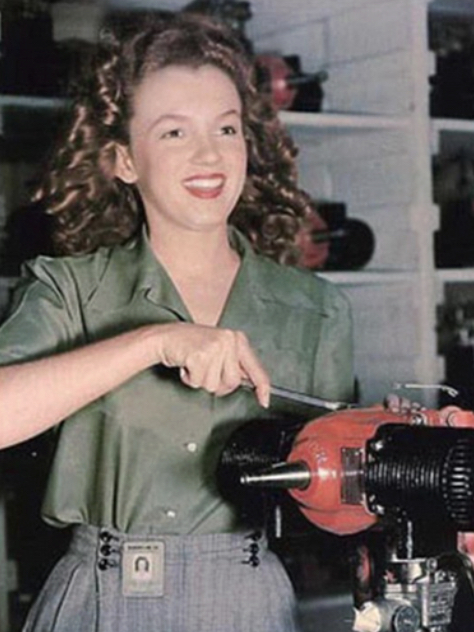
Indeed, the transformation from “Norma Jeane” to “Marilyn” was practically a lifelong one, with the former starting out as a somewhat mousy brunette whose only “saving grace,” conventional sex appeal-wise, were the contours of her body (which she used to her advantage on her long climb up the ladder to stardom). This being one of the most ogled things about her even after she got her “above-the-neck situation” more Hollywoodized.
Even so, Monroe’s obsession with “doing up” her face just right before appearing at an event or on set got to be so maniacal and body dysmorphic that it became one of the key reasons she was always late (apart from the endlessly flowing cocktail of alcohol and barbiturates she was on). So no, Monroe was hardly ever “feelin’ herself.” In fact, most of the time, it seemed as if she hated herself, and was constantly afraid that she would lose the collective “love” she had gotten as a result of her appearance. An appearance that took a lot of effort to “put on.” On this note, it’s been said that Marilyn was, in many regards, like a drag queen (long before Chappell Roan ever thought to take on that aesthetic for herself). Donning all the accoutrements of femininity (a heavily made-up face included) in order to be accepted and, better still (for her), desired.
Even at her “best” and most “self-confident,” there was no denying that Norma Jeane, deep down, constantly felt like shit. A pain that was perennial in large part due to the sense of rejection she felt throughout her childhood, being shuffled from one caretaker to another while her own mother, Gladys, could never seem to be bothered to hold on to her long-term (not that hanging with Gladys proved to feel like much of a “safe space” either). That Carey also chooses to wield Monroe’s real name (for little more than the purposes of rhyming it with “seventeen”) is an additional slap in the face. Because “Norma Jeane” was hardly ever feeling herself. That’s why she had to become Marilyn.
Thus, for Carey to make this “analogy” designed to give the listener a sense of how confident and self-assured she feels (both in general and about her appearance), well, it doesn’t really land. Not for anyone who knows how deeply insecure Norma Jeane and Marilyn truly were. So it is that when another piece of Eddie Murphy’s Trading Places dialogue is sampled—specifically, “Yeah, right, just get the fuck out”—it’s as if Carey ought to be telling that to herself vis-à-vis wielding Marilyn in this way. But, of course, it’s hardly the most affronting or exploitative thing that’s ever happened to Monroe.


